Follow Us on Google

On June 18, 2026, at the Abuja Leadership Centre of Excellence of University of Abuja (UniAbuja), the Executive Secretary of the Tertiary Education Trust Fund (TETFund) delivered a lecture that offered a comprehensive diagnosis of the governance challenges confronting Nigeria’s higher education system.
The revelation was drawn from his doctoral thesis titled Leadership Selection Process and Governance of Federal Universities in Nigeria (1993–2024). At the meeting, he presented not only a critique of the existing system but also a practical blueprint for reform.
The lecture delivered before an audience of professors, vice-chancellors, policy experts, students and education stakeholders, quickly evolved into a robust conversation about the future of university governance in Nigeria.

At the heart of Echono’s research lies a simple but compelling proposition: the quality of a university can rarely rise above the quality of its leadership.
Based on a three-year study covering 20 federal universities across Nigeria’s six geopolitical zones, he argued that many of the challenges confronting tertiary education from declining research output to institutional instability can be traced to weaknesses in governance and the processes through which university leaders emerge.
While inadequate funding, decaying infrastructure, brain drain, industrial disputes and insecurity continue to affect the sector, Echono maintained that ineffective leadership often compounds these problems.
He warned that the increasing politicisation of vice-chancellor appointments has gradually displaced the merit-based culture that once defined Nigeria’s university system. “Instead of competence, integrity and vision, appointments are increasingly influenced by ethnicity, political patronage, religious considerations and sectional interests.
“The result has been a narrowing of the talent pool and a weakening of institutional governance,” he said.
NEED FOR MERIT IN THE UNIVERSITY LEADERSHIP
One of the strongest themes in Echono’s presentation was the need to return merit to the centre of leadership selection, recalling that Nigeria once deliberately appointed vice-chancellors outside their states of origin, a policy designed to promote national integration and ensure that universities attracted the best available leadership regardless of geographical background.
Sadly, he observed that such long-standing practice has steadily faded. “Today, universities increasingly favour candidates with local affiliations, often at the expense of competence and broader institutional interests,” he said.
For Echono, restoring transparent and competitive selection processes is essential to rebuilding public confidence in higher education, noting that universities that appoint leaders through credible and merit-driven processes are more likely to attract top academics, encourage innovation, strengthen research, promote accountability and sustain excellence in teaching and community service.
However, the presentation was not limited to theory. It pointed to the National Research Fund (NRF) grant cycles as evidence that visionary leadership produces measurable outcomes.
Echono further said: “The Federal Universities of Technology in Minna and Owerri secured first and second positions respectively in the 2025 NRF awards with 18 and 11 grants, while the Federal University of Technology, Akure, recorded 12 grants in the 2024 cycle.
“These achievements demonstrate how strong institutional leadership can translate into research excellence and national competitiveness.”
SETTING A REFORM AGENDA FOR NIGERIAN UNIVERSITIES
Rather than merely highlighting problems, Echono proposed practical reforms that could strengthen transparency and accountability in university governance.
Among his recommendations was the adoption of electronic voting systems and online application platforms to reduce human interference and improve fairness in leadership selection.
He also advocated virtual town hall engagements and the public presentation of selection outcomes to encourage openness and accountability.
To further strengthen confidence in the process, he recommended periodic independent audits of leadership appointments as well as accessible feedback channels through which stakeholders could report grievances and raise concerns. “These proposals constitute a governance framework aimed at making university leadership selection more transparent, inclusive and credible.
Other News
THE EXPERTS AGREE
The ideas resonated strongly with participants at the public lecture. During the panel discussion, UniAbuja Vice-Chancellor, Prof. Hakeem Babatunde Fawehinmi, warned that governing councils were increasingly turning vice-chancellor appointments into political contests.
He called for a return to leadership founded on integrity, competence and institutional values.
Other panellists also expressed concern over the growing practice of selecting university leaders based primarily on ethnic and local political considerations, warning that such tendencies inevitably diminish institutional performance.
They recommended reviewing the powers of pro-chancellors, broadening the composition of search committees and involving faculty members, students, alumni and industry representatives in leadership selection processes.
The Director of the Abuja Leadership Centre, Professor Abdulhamid Ozohu-Suleiman, reaffirmed the Centre’s commitment to promoting evidence-based reforms capable of restoring excellence to Nigeria’s higher education system.
WHEN ACADEMICS BECAME STUDENTS
Beyond the policy prescriptions, Echono’s lecture left a lasting impression on the participants particularly the academics that were in attendance. Repeated applause punctuated the presentation as professors, administrators and students listened attentively.
Among those visibly impressed was Professor Olympus Ejue of the Department of Theatre Arts. He described the lecture as worthy of a university convocation, noting that many professors know surprisingly little about the intricacies of university administration.
He said he intended to study the lecture carefully because it contained valuable lessons for anyone aspiring to leadership within the university system.
So impressed was the Vice-Chancellor of University who announced Echono’s appointment as a Visiting Scholar of the institution. The appointment, obviously, underscored the regard in which Echono’s scholarship was held by the university community.
He further assured the TETFund Executive Secretary that an office would always be available for him whenever he wished to return to mentor students, scholars and administrators.
The honour reflected the growing influence of Echono beyond his role as head of TETFund.
“Increasingly, universities are turning to him not only for infrastructure support but also for ideas capable of transforming governance, research and institutional development,” he said.
SIGNIFICANCE OF THE LECTURE
The significance of Echono’s lecture lies not merely in its scholarly depth but in the national conversation it seeks to provoke.
Nigeria’s universities face numerous challenges, but his research suggests that meaningful reform begins with getting leadership right.
Transparent selection processes, merit-based appointments, stronger governance structures and greater accountability are not simply administrative ideals, they are prerequisites for rebuilding institutions capable of driving innovation, producing globally competitive graduates and supporting national development.
But whether policymakers translate the blueprint into concrete reforms, however, remains to be seen.
PHOTO CAPTION
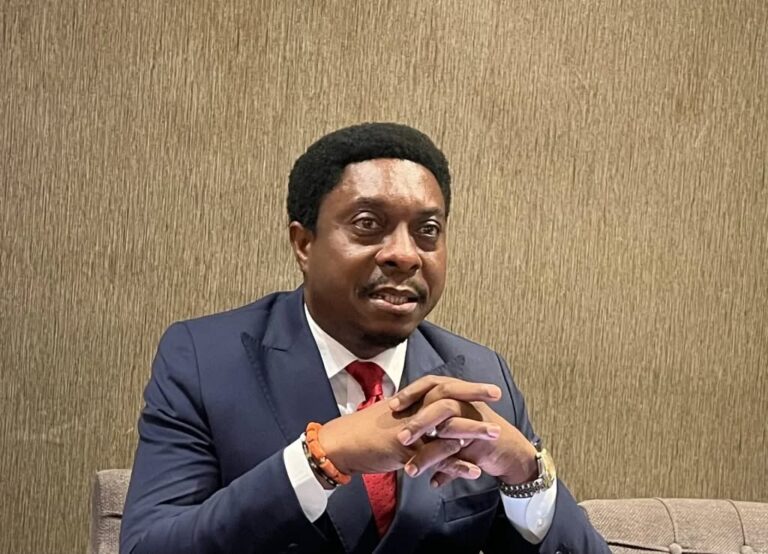
Echono delivering his doctoral thesis titled Leadership Selection Process and Governance of Federal Universities in Nigeria (1993–2024) at UniAbuja recently.