Follow Us on Google
By Moses Akaigwe
One of the simplest – and most important – things you can do to keep your tyres in good shape is to make sure that they are correctly inflated. Failure to maintain correct tyre pressures may result in fast and uneven treadwear, improper vehicle handling and excessive build-up, resulting in tyre failure.
Regular tyre pressure checks
You should check your tyre’s pressure at least once a month, before each trip and each morning you drive during a trip. Ideally, tyre pressure should be measured when tyres are cold, that is, before doing any driving on tyres. Only “bleed” or reduce air pressure from a hot tyre when you need to lower pressures to drive on particular terrain but remember to re-inflate your tyres when you reach your destination or return to terrain that requires higher pressure.
Measuring tyre pressure
It’s essential to be accurate when inflating your tyres. Don’t try to “eyeball” the pressure – a tyre can lose half its pressure without looking flat. Instead, use a reliable tyre pressure gauge. It’s a good idea to have your own gauge.
Under-inflation
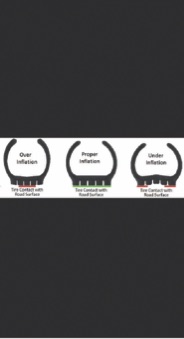
If your vehicle’s tyres are under-inflated by as little as 6 psi, it could lead to tyre damage. Additionally, the tyre’s tread life could be reduced significantly with tyres wearing more on the outside shoulders.
Lower inflation pressure allows the tyre to flex more as it rolls, causing internal heat to build up, which could lead to tyre failure.
Also, low pressures increase rolling resistance and cause a reduction in fuel economy. You would also find a significant loss of steering precision and cornering stability.
While 6 psi doesn’t seem excessively low, remember, it usually represents about 20% of the tyre’s recommended pressure. You should also be aware that the load capacity of your tyres is reduced at lower pressures.
Over-inflation
If your tyres are over-inflated by as little as 6 psi, they could be damaged more easily when driving over potholes or debris on the road. Overinflation also causes tyres to wear in the centre of the tyre’s tread, which will reduce the tread life; higher inflated tyres will also give you a much harsher ride.
Important factors when selecting tyre pressures
There is no universal “right” pressure for all tyres. The proper inflation level is dependent on many factors such as what tyres you have, type of vehicle, amount of load, how the vehicle is being driven and condition of the road, to name a few. The important thing to remember is that as load increases, you will need to increase pressure but never exceed the maximum pressure stamped on the tyre’s sidewall. For harsher road surfaces, a lower pressure with lower speed may be needed to avoid tyre damage. This could mean the difference between an empty tray in a UTE vs. a loaded tray.
Wear patterns of an under-inflated, properly inflated and over-Inflated tyre
There is no universal “right” pressure for all tyres. The proper inflation level is dependent on many factors such as what tyres you have, type of vehicle, amount of load, how the vehicle is being driven and condition of the road, to name a few.
The important thing to remember is that as load increases, you will need to increase pressure but never exceed the maximum pressure stamped on the tyre’s sidewall.
For harsher road surfaces, a lower pressure with lower speed may be needed to avoid tyre damage. This could mean the difference between an empty tray in a UTE vs. a loaded tray.
● From .Cooper Tyres