Follow Us on Google
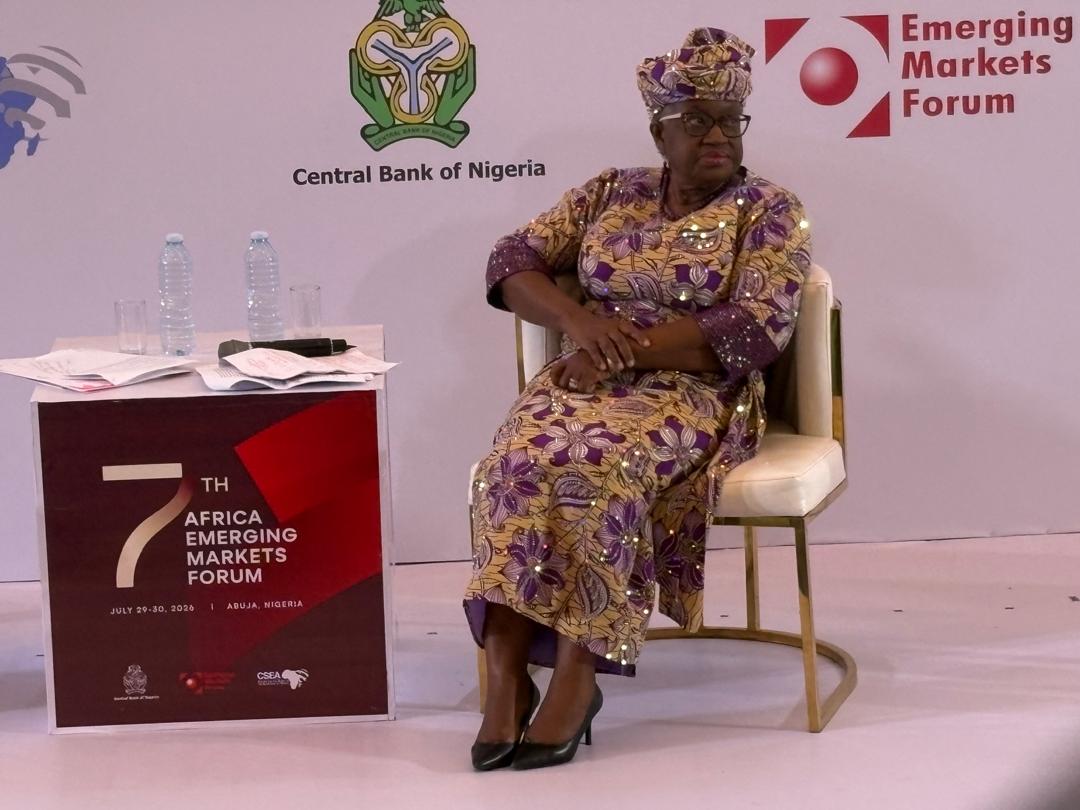
World Trade Organisation (WTO) Director-General Ngozi Okonjo-Iweala has called for greater participation of women in leadership and economic decision-making, saying Africa cannot achieve its full development potential without harnessing the talents of its female population.
Speaking during a fireside conversation with the Governor of the Central Bank of Nigeria, Olayemi Cardoso, at the 7th African Caucus Meeting in Abuja, Okonjo-Iweala said women have a critical role to play in driving economic transformation across the continent.
She argued that while Africa’s youthful population presents enormous opportunities, the continent must also ensure that women are empowered to contribute meaningfully to economic growth.
Describing women as natural multitaskers, the WTO chief said creating more opportunities for women would strengthen Africa’s workforce and improve development outcomes.
“We have to mobilise women to contribute what they need to the continent and the economy.
“Women are very hardworking. They are ideal multitaskers, and we have to mobilise them to contribute what they need to the continent and the economy,” she said.
Okonjo-Iweala stressed that inclusive leadership is essential to unlocking Africa’s vast economic potential, adding that the continent’s future depends on leaders who prioritise national development over personal interests.
“We need leadership that has the interest of the country and the continent at heart, not self-interest or group interest,” she said.
She maintained that transparent, accountable, and implementation-driven leadership would help create jobs, improve governance, and position African economies to take advantage of emerging opportunities in global trade, artificial intelligence, and renewable energy.
Other News
The former Nigerian finance minister also urged governments to invest in young people through skills development and job creation, warning that Africa’s growing youth population could become a burden rather than an asset if adequate opportunities are not created.
Looking ahead, she said her hope is that within the next decade, African countries will become places where young people choose to build their futures rather than seek opportunities abroad.
Responding, Cardoso agreed that Africa’s youthful population presents both an opportunity and a challenge, stressing that the continent must create jobs and expand economic opportunities if it is to reap a demographic dividend.
Drawing from his experience as Commissioner for Economic Planning and Budget in Lagos between 1999 and 2005, he said understanding the implications of rapid population growth helped shape policies that prevented the state’s economy from becoming overwhelmed.
He recalled that Lagos’ economy was growing at about two to three per cent annually while its population was expanding by about five to six per cent, creating pressure on infrastructure and public services.
“It became clear to us very quickly that it was not a sustainable model and that it was a question of time before what was defined as a megacity would collapse if something wasn’t done urgently,” Cardoso said.
He said the experience underscored the importance of investing in infrastructure, mobilising domestic revenue, and implementing reforms that create economic opportunities for a growing population.
Cardoso added that Africa’s future will depend on governments and the private sector working together to create jobs, improve infrastructure, and equip young people with the skills needed to compete in an increasingly technology-driven global economy.