Follow Us on Google

From Sola Ojo, Abuja
The fight against gender-based violence (GBV) in Nigeria requires not only stronger institutional coordination but also dedicated financial support to ensure effective investigation and prosecution of cases, according to Assistant Commissioner of Police (ACP) Abdulkadir Yahaya. The police chief, who is currently AC Admin and Finance, Kaduna State Police Command, spoke to the newspaper while reiterating the need for continuous capacity-building training for Divisional Police Officers (DPOs) who are the first responders to issues like battery, defilement, rape, child abuse, child labour among others.
In this interview, he warned that GBV investigations are often complex, sensitive, and resource-intensive, adding that without sustained funding and stronger cooperation among justice sector institutions, many cases risk being poorly handled or delayed. He also stressed that effective response to GBV depends on collaboration between the police, judiciary, correctional services, government agencies, NGOs, and communities.
Reported cases of GBV seem to be on the increase in recent times because people are now speaking up. What is the experience like in the Kaduna State Police Command?
Yes, I see gender-based violence as one of the most important aspects of the fight against crime and criminality globally. It is not peculiar to Nigeria or Kaduna State alone; it is a worldwide challenge that requires standard procedures, continuous training, and strong coordination among all stakeholders.
Without proper training for first responders especially Divisional Police Officers and investigators who handle complaints at the earliest stage, the objective of addressing GBV can be seriously undermined. That is why trainings like the one recently supported by CLEEN Foundation and the Ford Foundation for DPOs in Kaduna State, is very important.
It clearly shows that the police cannot do it alone. We need support from government, non-governmental (NGOs), communities, and individuals. Even within the police system, officers must act professionally to protect vulnerable persons, especially women and children.
Back to your question, we receive a high number of GBV-related cases at the headquarters. In fact, these cases rank among the most frequently reported crimes. Unfortunately, increasing social decay has made women and children more vulnerable to abuse, sometimes within their immediate environment.
Disturbingly, some perpetrators are people expected to provide protection; family members, guardians, or trusted acquaintances. There are cases where fathers abuse their daughters, and some attempt to justify it using alcohol or other excuses. Such acts are unacceptable.
Can you share examples of devastating cases handled by the command in recent times?
There are several disturbing cases that reflect the vulnerability of victims. One involved a physically challenged girl from a very poor background. Her parents were blind, and she herself had a disability, although she had reached puberty. Because of her vulnerability, she was repeatedly exploited by different individuals in her community. The abuse involved multiple perpetrators up to about 15 of them, and she eventually became pregnant.
Fifteen suspects? How did that happen?
Like I said, she was vulnerable. So, when one finished with her, he will tell his corrupt fellow and he too will go and take a turn on her. On and on like that. It was a very disturbing development because these criminal elements are supposed to protect her and her family.
Cases like this are difficult because of the need to identify the actual perpetrators among several suspects. However, the matter was transferred from the divisional level to the State Criminal Investigation Department at headquarters and charged to court. While I may not be able to confirm the final outcome, the police remain committed to ensuring that justice is pursued through due process. This highlights the importance of proper investigation, evidence handling, and professional case management.
What operational steps is the command taking to address criminal tendencies especially the GBV?
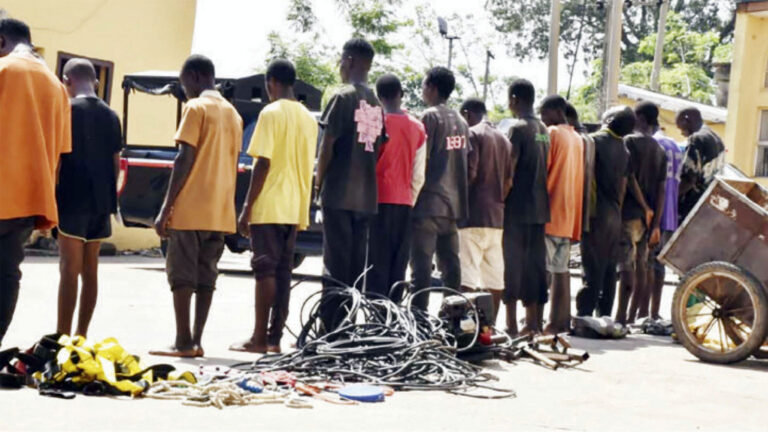
The command has been blessed with a proactive commissioner. For instance, the command has established a special task force in response to the activities of Sara Suka groups, violent street gangs involved in phone snatching, armed robbery, and assaults. These criminals operate with dangerous weapons such as knives and daggers and pose serious threats to public safety. In some cases, their attacks escalate to rape and other violent crimes.
The task force is a multi-agency initiative involving the police, military, Nigeria Security and Civil Defence Corps (NSCDC), immigration service, and other stakeholders. They identify criminal hotspots, carry out raids, arrest suspects, and recover weapons and drugs. Drug abuse is a major driver of violent crime, including GBV and gang-related activities. These coordinated operations have contributed to a reduction in violent incidents in several parts of the state.
How do you handle cases of compromise when your men, especially those at the lower cadre, are involved?
Other News
You should know better. Police don’t tolerate nonsense. Once your cup is full with overwhelming evidence that our men are involved in any act of unprofessionalism, he or she will be duly prosecuted. Examples abound.
What is your message to the public on supporting policing efforts?
Policing is a collective responsibility. The police cannot do it alone. Even developed countries practise community policing because security requires the involvement of everyone. So all hands must be on deck. Every individual and institution has a role to play. The police investigate and enforce the law, but others can contribute through information sharing, logistical support, and cooperation.
Market associations, community leaders, government institutions, and civil society groups all have roles to play. When this synergy exists, crimes can be resolved faster and more effectively.
This is the essence of proactive policing, preventing crime before it happens rather than reacting after damage has been done.
What are the major challenges the command encounters in handling GBV cases?
One major challenge is weak coordination among key institutions in the administration of criminal justice system. The police alone cannot secure successful prosecution without the judiciary and correctional services.
Even when investigations are properly conducted, gaps in other institutions can affect justice delivery. Therefore, stronger inter-agency cooperation is essential.
Another major challenge is funding. GBV investigations are expensive and require medical examinations, forensic analysis such as DNA testing, transportation, and sustained investigative logistics.
In many cases, suspects flee to other states after committing crimes, making arrest and prosecution more difficult and costly. Tracking such suspects requires significant resources.
We also need stronger support from NGOs and development partners, especially in victim assistance and investigation funding, because many victims come from less privileged backgrounds.
What is your final message to government and stakeholders?
Government at all levels, that is, federal, state, and local, should establish dedicated funds for GBV investigations because of their sensitive nature and human rights implications.
There is also a need for stronger collaboration among all justice sector institutions to ensure effective prosecution and timely justice delivery.
We must also change our mind-set. People should not assume GBV happens only to others. Victims can come from any family. Children are exposed in schools, universities, and during movements such as NYSC.
As leaders, we should put themselves in the position of victims. If it were their own children, responses would be more urgent and compassionate. That perspective would significantly improve prevention and justice outcomes.
Ultimately, when adequate funding, institutional cooperation, and community participation are in place, society will achieve stronger deterrence and better protection for vulnerable persons.
As a command, we will always do our best in partnership with sister agencies, well meaning institutions, organisations and individuals to reduce issues of GBV to a nearest minimum.