Follow Us on Google
By Leslie Osigbemhe
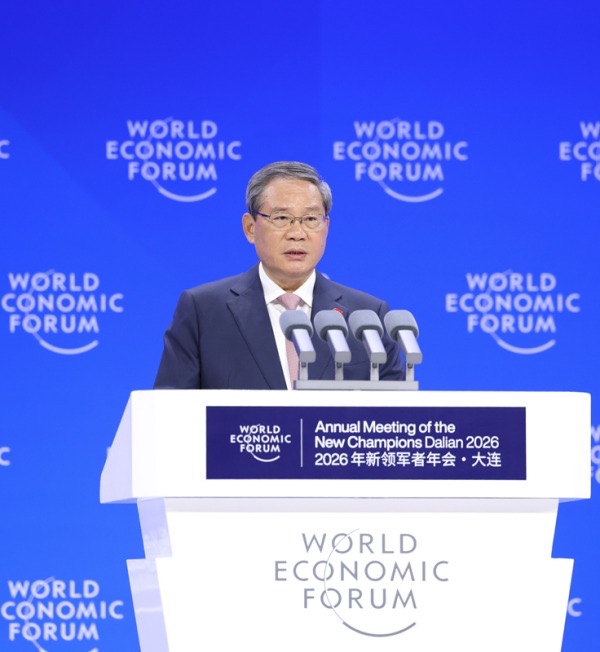
When Chinese Premier Li Qiang stood before world leaders at the 2026 Summer Davos Forum in Dalian, China, he did much more than defend China’s economic model. He sought to redefine one of the most contentious debates in the global economy.
The event, 17th Annual Meeting of the New Champions of the World Economic Forum, which was held from June 23 to June 25, 2026, centered on the theme ‘Innovating at Scale’, and convened over 1,700 global leaders to discuss AI integration, China’s economic trajectory and the energy transition.
For years, many policymakers in Europe and North America have warned about a new “China Shock” – the fear that another wave of Chinese industrial competitiveness, powered by electric vehicles, artificial intelligence, robotics, batteries and advanced manufacturing, could overwhelm industries elsewhere.
At Summer Davos, Li rejected that narrative and proposed a different one: “China Opportunity 2.0.” Whether one agrees entirely with Beijing’s position or not, the speech deserves careful attention, especially in Africa, where China’s economic transformation has profound implications for development, industrialization and international cooperation.
To start with, a careful reappraisal of history would reveal that innovation, not merely manufacturing, defined China’s quantum leap. China’s first economic miracle was built on inexpensive labour, massive manufacturing capacity and integration into global supply chains after joining the WTO. The second phase is remarkably different. Today’s China seeks to compete through innovation.
Premier Li argued that China’s competitiveness increasingly comes from technological breakthroughs, sustained investment in research and development, a vast domestic market capable of rapidly commercializing innovations, and an ecosystem where universities, government institutions and private enterprises interact closely.
He rejected the notion that subsidies alone explain China’s technological progress, pointing instead to decades of corporate investment in innovation and industrial upgrading. Indeed, one does not need to spend long in cities such as Shenzhen, Hangzhou, Suzhou or Guangzhou to appreciate the speed with which ideas become products.
Cashless transactions, autonomous logistics, electric mobility, smart factories and AI-powered public services have become part of everyday life rather than futuristic concepts. China’s innovation story is therefore less about isolated inventions than about creating an ecosystem where innovation scales rapidly. To me, that may be the country’s greatest competitive advantage.
Having lived and worked within both Nigerian and Chinese environments, one notices a striking contrast. In Nigeria, brilliant ideas abound. In China, brilliant ideas are systematically converted into industries. This difference is not necessarily about intelligence; it is about institutions.
Take for instance, the country’s Electric Vehicle revolution, which reinforced its dominance in clean technology and global climate leadership. This win is a direct result of decades of consistent government backing, subsidies and mandated EV production, which created a robust domestic market and manufacturing base. The Chinese government started introducing EV-friendly policies in earnest around 2009, offering manufacturers cheap credit and funding for research.
China combines long-term planning with infrastructure, industrial policy, technical education, digital connectivity, patient capital and disciplined implementation. Universities collaborate with industries. Local governments compete to attract innovation. Companies invest heavily in research. Consumers eagerly adopt new technologies.
The result is a continuous cycle of innovation, production, market feedback and improvement. Innovation, therefore, is not treated as a slogan. It is treated as national infrastructure.
China Opportunity 2.0
Li Qiang’s concept of “China Opportunity 2.0” rests on a simple proposition. The first China opportunity gave the worldaffordable manufactured goods. The second offers innovation itself. China is positioning itself as a provider of affordable clean energy technologies, AI applications, electric vehicles, advanced communications systems, industrial automation and digital infrastructure.
But before then, the Premier explains the dynamic behind China’s ability to weather the storm of present global economic turbulence.
“Since the beginning of the year, there has been increased volatility in the international landscape as geopolitical conflicts erupted one after another. Global economic recovery, fragile as it was, has now come under greater strain. Against this backdrop, China’s economy got off to a good start. It withstood the challenges, forged ahead and demonstrated strong resilience and a promising outlook. The overall performance can be summarized in four keywords,” he expatiated.
They are stability, innovation, dynamism, and integration, together presenting a comprehensive outlook of China’s economy, sketching out both the current picture and future trajectory. These values could underpin the world’s readiness for “China opportunity 2.0”, which means more accessible advanced technologies and widely shared outcomes, as ‘innovation cooperation is an imperative for tackling global growth predicament’.
For developing countries, this presents enormous possibilities. African countries no longer need to repeat the industrial pathways followed by Europe during the nineteenth century.They can leapfrog directly into cleaner energy systems, digital public services, precision agriculture, smart manufacturing and intelligent logistics.
This is particularly significant for Nigeria. The country’s youthful population, entrepreneurial culture and expanding digital economy position it well to benefit from partnerships that transfer technology rather than merely import finished products.
The Zero Tariff Opportunity
Perhaps one of the least discussed but potentially transformative developments is China’s decision to extend virtually zero-tariff treatment to imports from African countries with diplomatic relations with Beijing, broadening market access for African exports.
For decades, Africa has exported largely raw commodities while importing finished goods. If utilized strategically, expanded access to the Chinese market could encourage value addition across agriculture, food processing, textiles, leather products, pharmaceuticals and manufactured goods.
But market access alone is insufficient. Nigeria cannot export what it does not competitively produce. The real opportunity therefore lies not merely in selling more products to China but in improving productivity, quality standards, logistics and industrial capacity.
In other words, China has opened a door, walking through it remains Africa’s responsibility. China-Africa relations have evolved significantly over the past two decades, with the Forum on China–Africa Cooperation serving as the principal framework for engagement.
Early cooperation focused heavily on infrastructure, roads, railways, ports, power stations and public buildings. The next phase should emphasize innovation partnerships. In practical terms, Africa requires joint research centres, technology incubators, agricultural innovation, renewable energy manufacturing, vocational training, artificial intelligence applications suited to African realities, and climate adaptation technologies.
Nigeria’s Moment
I am of the view that Nigeria may be better positioned than many realize. It possesses Africa’s largest consumer market, one of its most vibrant technology ecosystems and extraordinary entrepreneurial energy. Yet innovation remains constrained by inconsistent electricity supply, inadequate logistics, policy uncertainty and limited investment in research.
China’s experience demonstrates that innovation flourishes where infrastructure and policy provide confidence. Rather than asking how Nigeria can become another China, policymakers should ask a simpler question: How can Nigeria build institutions that consistently reward innovation?
Universities should collaborate more closely with industry. Research funding should address practical economic challenges. Industrial parks should encourage manufacturing clusters. Local governments should compete to attract technology investment. These are lessons that transcend ideological differences.
Premier Li Qiang’s Summer Davos address was ultimately an invitation to rethink China’s role in the global economy. The choice between “China Shock 2.0” and “China Opportunity 2.0” may not be entirely binary. Different countries will experience elements of both.
Industries unable to innovate may indeed feel competitive pressure. Those willing to learn, collaborate and modernize may discover unprecedented opportunities. For Africa – and particularly Nigeria – the question is therefore not whether China will continue to innovate. It almost certainly will.
The more important question is whether African countries will innovate alongside China or merely watch from the sidelines. That answer depends not on Beijing. It depends on us, and what we make of Premier Li’s final charge:
“I encourage you to be pioneers of innovation: look beyond today’s contested red oceans toward the vast blue oceans ahead – use innovation to expand the global market, make the pie bigger and to win the future for your businesses. I encourage you to be champions of win-win cooperation: support, join and advance global innovation cooperation, tear down walls and build bridges, generate fresh ideas through exchange and mutual learning, and grow together by enabling each other’s success.”
Osigbemhe, an international affairs analyst, writes from Lagos.