Follow Us on Google

• Stops some overseas schemes over cost, sets aside N365m yearly for National Laureate Prize, queries N650m bill for students studying journalism, psychology, others abroad
From Fred Ezeh, Abuja
The Federal Government has begun redirecting education funding from some foreign scholarship programmes to initiatives aimed at strengthening research, innovation and intellectual excellence in Nigerian tertiary institutions.
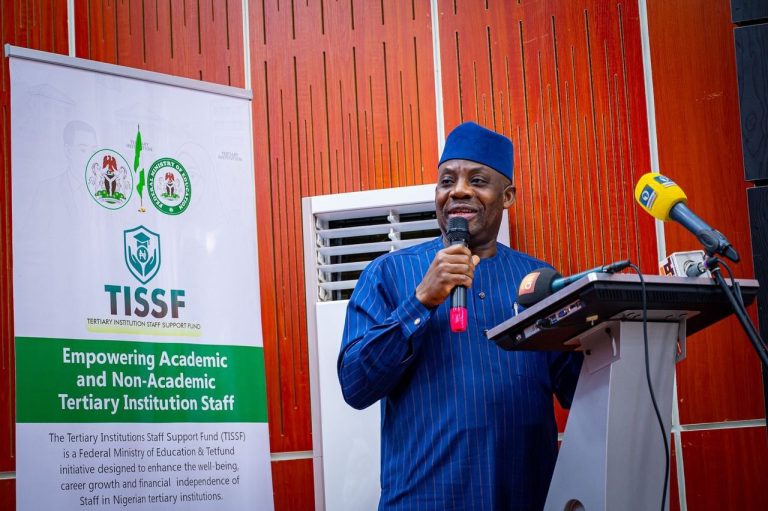
Minister of Education, Tunji Alausa, who disclosed this in Abuja on Wednesday, said the government discontinued funding for some overseas scholarship programmes after reviewing their financial implications and concluding that they no longer represented the best use of scarce public resources.
In contrast, the government has earmarked an annual prize pool of about N365 million for the newly established Tertiary Institutions National Laureate Prize, which will reward outstanding research, innovation and academic excellence in universities, polytechnics, monotechnics and colleges of education across the country.
Alausa said the shift reflected the government’s determination to make education financing more sustainable and direct public funds towards programmes capable of delivering greater benefits to Nigerians.
Recounting his experience shortly after assuming office, the minister said he was presented with a proposal requiring the government to spend N650 million in one year on a relatively small number of Nigerian students studying abroad.
He said some of the students were pursuing programmes in Behaviour, Journalism and Psychology, courses he believed could be undertaken in Nigerian tertiary institutions.
“My first month in office, the project file came to me to approve, just in our own way, students going through the programme, studying in areas of Behaviour, Journalism and Psychology. And those students, they will cost us N650 million for just one year,” he said.
Alausa said the proposal raised concerns, particularly as some of the beneficiaries would spend their first year learning French before commencing their substantive academic programmes.
“They were going to spend the first year learning French before they started the programme. So the financial agreement we made for no money makes sense again to government,” he said.
The minister said the government consequently reconsidered the manner in which such programmes were funded, stressing that it could not continue spending public resources on arrangements merely because they had existed for years.
He maintained that the decision did not amount to abandoning students or scholarship programmes but was intended to ensure that government support was financially responsible and provided better value to the country.
According to him, the administration remains committed to supporting education and students but would increasingly prioritise interventions that are sustainable and capable of benefiting a larger number of Nigerians.
Against that backdrop, Alausa unveiled details of the Tertiary Institutions National Laureate Prize, with an annual prize pool of approximately N365 million to reward exceptional academic research and innovation.
He said the initiative, being jointly implemented by the Federal Ministry of Education and the Nigeria Education Repository and Databank (NERD), was part of President Bola Tinubu’s Renewed Hope Agenda for the education sector.
Other News
According to him, the National Laureate Prize Committee, which he recently inaugurated, has been charged with providing the strategic direction, governance and integrity required for implementation of the programme.
Alausa said the initiative was designed to change the culture of national recognition by ensuring that exceptional academic achievements receive greater attention and reward.
“Scholarship matters; research matters; innovation matters; and intellectual excellence deserves a prominent place in our national consciousness,” he said.
The prize categories will include outstanding undergraduate dissertations demonstrating strong commercial potential, exceptional master’s theses and doctoral theses with clear industrial and developmental applications.
Special prizes will also recognise outstanding works in Engineering and Technology, Medicine and Health Sciences, Arts and Social Sciences, Agriculture, Law and Teaching Innovation.
One of the awards will be the Dr. Stella Adadevoh Prize for Medicine and Medical Innovation, named after the late physician whose intervention during the 2014 Ebola outbreak helped contain the spread of the disease in Nigeria.
Alausa said participation would be open to universities, polytechnics, monotechnics and colleges of education, irrespective of whether they are owned by the Federal Government, states or private organisations.
A member of the National Laureate Prize Committee, Nwhator Solomon, said the selection process would begin at institutional level, with participating institutions identifying their strongest entries for progression to zonal and national assessments.
He said selection committees would be established across the six geopolitical zones to assess the best works emerging from their respective areas, after which finalists would proceed to a national selection process.
“The process will involve recognised experts and professionals with established records in research, academic publication and peer review. Supervisors, heads of departments and external examiners will also play roles in validating submitted academic works.
“To guard against conflicts of interest, members of the national governing committee will be excluded from institutional selection committees,” Solomon said.
Other members of the committee assured that the process would be transparent, competitive and merit-driven, and insulated from political, institutional or personal influence.
They said the initiative would broaden national recognition beyond entertainment and sports by creating a prominent platform for celebrating scholars, researchers and innovators.
Alausa said the larger objective was to build an education system that would not merely produce certificates but generate “solutions, innovations, enterprises and measurable national value.”
He said the administration’s policy direction was to strengthen domestic tertiary institutions, encourage academic excellence and promote research and innovation capable of contributing directly to national development.
According to the minister, the most successful countries in the 21st century would be those capable of transforming knowledge into solutions, research into enterprise and intellectual capital into economic and industrial value.