Follow Us on Google
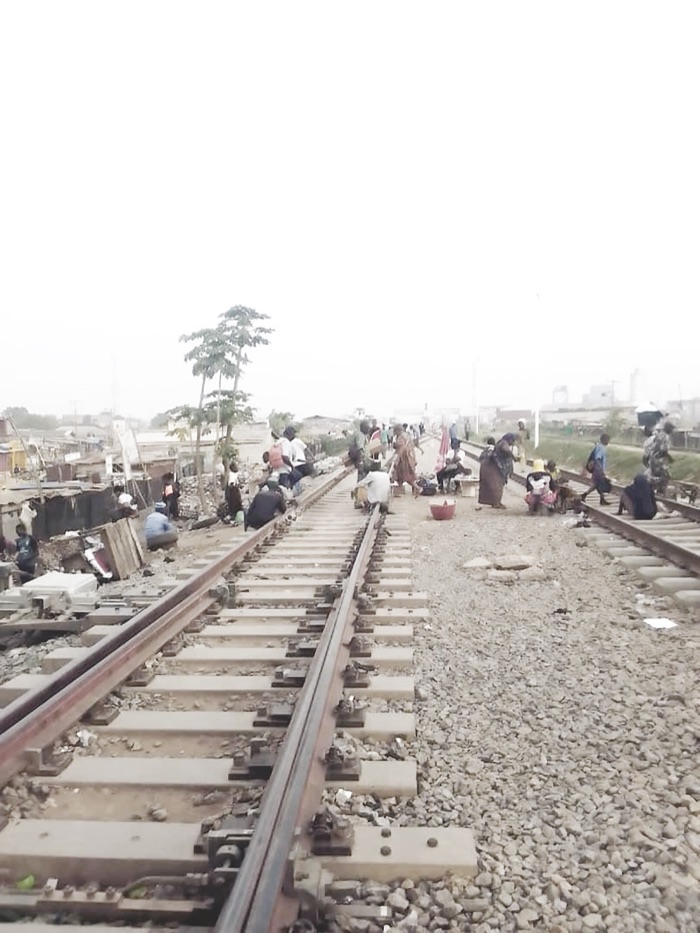


As Lagos State government braces up to commence commercial train service along the Oyingbo-Agbado standard gauge railway corridor, management of Nigerian Railway Corporation (NRC) has been enjoined to arrest and prosecute people who encroach on railway lines instead of climbing pedestrian bridges where available.
The call on NRC management is coming on the heel of recent announcement by Lagos state government to arrest and prosecute people who prefer to cross the roads on foot instead of using the pedestrian bridges.

A cursory look at present design of construction of standard gauge railway lines, shows that overpasses and underpasses are built alongside pedestrian bridges such that trains, vehicles and humans have their separate right of way.
In other words, the design of railway level crossing whereby motorists and pedestrians are flagged down or gated at railway level crossings whenever a train is approaching will be gradually phased out in the present dispensation.
It is noteworthy that there are about 8 railway level crossings between Oyingbo and Agbado some of which feature overpasses built alongside pedestrian bridges.
In specific terms, the newly constructed overpasses at Oyingbo, Yaba, Mushin, Ikeja Adebola and Agbado railway level crossings come with pedestrian bridges while the level crossings at Jibowu, Oshodi, Arena Shopping Complex, PWD, Ikeja, Fagba and Powerline are regulated by flagmen whereby people and motorists are allowed to play and cross the roads respectively after passage of trains.
It is on record that some people have killed in the past by trains while either crossing the railway line or walking along the railway line with ear piece of their phones inserted their ears.
Investigation carried out however shows that people seldom use the pedestrian bridges constructed alongside the overpasses at Yaba, Ikeja, Adegbola and Agbado amongst others thereby exposing themselves to danger.
Speaking on this issue, Ipa Lucky, a Chartered Accountant described the attitude of not climbing pedestrian bridges by some category of people as unruly behaviour and lack of respect for the rule of law.
He wondered why a pedestrian would prefer to cross railway line or road where their is a pedestrian bridge.
According to him, “Government is doing its best to reduce or avert avoidable deaths on our railway lines and roads but people don’t obey traffic rules and regulations to save their own lives.”
While commending Lagos state government for threatening to arrest people who fail to use pedestrian bridges, he noted that nobody has been arrested since the announcement was made.
He stated categorically that the railway Management should enforce the compulsory use of pedestrian bridges where available at railway level crossings and ensure that culprits are arrested and prosecuted.
The Chartered Accountant noted that the railway management has a civic responsibility to continue to enlighten the public on the relevance of using pedestrian bridges.
Mr. Tunde Ojo noted that about 12 underpasses and overpasses are expected to be built between Iddo/Apapa and Agbado by the Lagos state government and Federal Ministry of Transportation based on their terms of agreement.
It is however noteworthy that while Lagos state government has completed work on the construction of about 6 overpasses at Oyingbo, Yaba, Mushin, Ikeja, Adegbola and Agbado-Crossing as agreed, the Fedel Ministry of Transportation has only been able to contruct the overhead bridge at Costain and and underpass at Ashaye in Agege.
Ojo advised the Federal Ministry of Transportation to meet its own terms of agreement by constructing overpasses/underpasses as well as pedestrian bridges in the agreed locations so as to avert deaths along the 27 kilometres railway corridor from Oyingbo-Agbado.
But Mr. Tunde Abayomi held a contrary view saying, it is the civic duty of people to adhere strictly to the use of pedestrian bridges as against crossing the railway lines.
He stated further that there are some basic rules and regulations like “No U Turn”, “Zebra Crossing”, and “Use of Padestrian Bridges” that does not need to be enforced but should be obeyed.
Criticisms trail agreement between FG, U.K firm over Port-Harcourt, Abuja rail project.
Some Nigerians have expressed concerns over the recent signing of a memorandum of understanding (MoU) between ministry of transportation and MPH Rail Development Limited, a company registered barely 5 years ago.
The company, registered in the UK, is expected to manage the design, construction, commissioning, operation, and eventual transfer of the Port Harcourt-Enugu-Calabar-Abuja standard gauge rail line.
“Minister of Transportation, Sen. Said Alkali on behalf of Nigerian government signed MoU with Messrs MPH Rail Development (UK) Limited for the design, construction, operation & transfer of the Port Harcourt–Enugu –Calabar–Abuja SGR Line on a PPP basis,” the ministry wrote on its X page.
The ministry said the signing followed the approval of outline business case and issuance of a compliance certificate by Infrastructure Concession and Regulatory Commission (ICRC).
This clearance, the ministry said, enables the firm to focus on compiling the necessary documentation for federal executive council’s (FEC) approval to advance the project.
The ministry said vital documents required for the project’s progression include a comprehensive feasibility study report, a complete business case study, an environmental and social impact assessment, the development of a resettlement action plan, and the formulation of a financial model to facilitate project implementation.
However, some stakeholders have criticized the agency for signing an MoU with a company that was only incorporated less than five years ago — September 26, 2019.
Others described it as another PI&D saga in the making adding that a project of such magnitude should not be entrusted to a young company with little or no history.
The Ministry of Transportation in a statement issued by the Director, Press and Public Relations Olujimi Oyetomi, said the the MoU was not binding adding that it only states each party’s intentions to take action, conduct a business transaction or form a new partnership.