Follow Us on Google
By Olu Obafemi
This Lecture props the core principles and notions of humanism—passion, compassion, kindness, morality, dignity, freedom, identities, integrity, essentialisms, destinies, scientific methods and the deployment of science to the advancement of humanity. What is in descent is the failings and pitfalls of these human values, and which need to be reassembled and restored. These pitfalls, which include war mongering, stoked by the availability of superior and sophisticated weaponry, moral bankruptcy such as corruption and the corruptibility of power, pride, greed, rapacious avarice, religious fanaticism, ethnic irredentism, and so on, defray from humanism and need to be eliminated for the reaffirmation of humanity. These pitfalls include the robotization and thingification of humanity that result from advanced technological innovation and artificial intelligence.
In electing to deploy this three forms (literature, music and the media), from among the diverse tools and fields of the humanities, to mediate humanism, its ideology, the thought of the choice of three, just three, rested on the above discussion among the three witches at the opening of William Shakespeare’s Macbeth. There is tempo-spatiality (time and space—of when and where); of witchcraft—there is so much metaphorical witchcraft in the arts—all of them, literature, theatre, film, music, the media and so on. When you fold or scaffold time, ages, into a few hours; ‘holding eternity in the air,’ take on persons and characters into oneself, remove costumes and make-ups and wake up instantly from death to active life without the miracle of Christ; confer immediacy upon news and news paces; record events into soundtracks and soundbites and make them live for aye; you confront the witchcraft and the magic of the arts; the humanities. So, the idea of echoing the witches and their witchcraft is not too far-fetched afterall—not stretching the imagination too thin, as is done in the vocational engagement in the arts. The Yoruba Nollywood talks of Idan, which is magic (the magic if). Apidan, magic- makers, the theatricians, the actors, the storytellers, and the whole process of their art of creation on stage, screen, studios and so on,compel magic. And timing (the duration) of the clap-trap of lightning—the age of cataclysm, violent eruptions in the streets, outright warfare, (which is actually what the witches were referring to);plagues, epidemics and pandemics, tornadoes,mass flooding, ravaging fires, earthquakes; chaos, banditry, kidnapping, dystopia is implicated. The similarities of these landscape of operation of Shakespeare’s witches or even more positively Soyinka’s The Earth Mothers in Madmen and Specialists; and our current scenery, the raging war that is upon us since mid- 20th to the present, which we have inflicted upon ourselves, more aptly) war which our nation currently wages; these do not make the echoes of witches, magic, the cult of Iyas, too intriguing; too dissimilar, afterall. In all ages, the writers, people of literature covet the news-space, the locale of the media, for self- expression; to say the things that must be said urgently; to test the waters of their creation as they form words from their thoughts—poetry, prose, drama sketches. In that sense, there is an intriguing love relationship between the media and literature. The two are also radically disparate even in their mutual affinity. Throughout time, the men of letters seek refuge in the media as they mould their blocks of expression which will later become books. The role of newspapers in the evolution of literature: the nudge to be heard soon and urgently and enduringly, drew the writers into the waiting ‘arms’ of the media, newspapers to be specific, in a relationship that has become permanent, as the newspapers, periodicals and journals and their creators themselves became a new type of literature and literary artists; hence, from the C18century, the ‘inventors of the periodical essays extended the tactic’ of the fictitious self into the new territory and became writers’. All over, including in Nigeria, overt and subtle control proved incapable of stemming the growth of the media industry.
The creeping in of censorship—to control the opinions and feelings expressed in the media, which had begun to accommodate issues and topics ‘on politics, the lives of public individuals and business.’ Its popularity generated the desire of governments to control what would come out in the newspaper the following morning; the state and politicians alike tried with limited success to control the press, to dictate its views and to contain its criticisms. Indeed, everywhere, the media and literary realm and phenomenon proved too large for such ‘arrant limitations’.
From since the Eighteenth century, newspapers detailed the news and notes of current events and the works of famous literary authors( Charles Dickens, the Brontes, Hardy, down to our time here in Nigeria, the works of many of our writers are first serialized in the newspapers and journals—Clark, Soyinka, Achebe, Amadi in the Black Orpheus, The Horn, etc; Osofisan’s novels such as Maami and Cordellia, , Osundares Eye of the Earth ahis sustained deployment of the media for his popular poems even till this moment, and Ofeimun’s initial poems in Opon Ifa, my own Wheels (novel) and Songs of Hope were all serialized in Nigeria’s newspapers before they were published. The literary pages in many of our newspapers have become a permanent feature in the relationship between the media and literature in Nigeria. The press stimulated and simulated conversation, on opeds, columns. In fact, newspapers are similar, except in length and width, to novels in the sense that they are available for everyone to read, to inform, entertain and to instruct on matters of social, economic, business, educational and political import.
Even in earlier times, newspapers traded on the assumption that they were reporting what ‘actually’ happened, but gradually the boundaries between facts and fiction became considerably blurred and the character of literature and the newspaper tended to mesh. Getting too hot and pinching the skin and the nerves, government created ‘licensers of the press’, raking laws on libel for the press people and heresy and sedition for all other forms of writing, including even the charge of prison. The State introduced the Licensing Acts during the Restoration period, government tried ‘ through strict licensing laws to limit the flow and narrow the range of newsprint, but whenever these laws lapsed, innovations in newspapers abounded. The bid to kill freedom of speech, arising from the gradual dehumanizing capacity and strategies of power had been there, and remains with us. We must reach out to our society, where the contribution of the media in those early days of independence struggle was hurriedly resisted by the colonial authority. Their succeeding, inheritors of power, the politicians inherited that strategy to control, censor the media—civilian, military and all. The draconic decrees to muzzle and snuff out freedom of the press and of literature are evidence of the descent from humanism derived from the corruptibility and corrupting power in our country and continent. The Decrees, 2 and 4, and the anti- fake news (real and imagined) of today everywhere in Africa and in Nigeria exemplify the ever-increasing intolerance of the State against the media, literature and music as we shall show later.
Literature stands as bridge-head between music and the media. Just as the media and literature became inextricably linked, in a siamese-twins’ relationship, so does literature and music bonded in close affinity, such that many at times, it became difficult to draw distinctive lines between the two. Poets were said to be considered as failed musicians and musicians as failed poets and when those the world considers as pop culture musicians began to win the Nobel Prize for literature (Bob Dylan for instance), the separation line between the two blurs and melts into oblivion. Not much time will be expended on theorizing but we must put the discourse in a clear context. As succinctly captured in the two epigrams above, Humanism, which I consider the ideological plank of humanity, reclines on the principles of reason and rationality; the human agency to attain a better society where love, humane value, and freedom reign, away from excessive religiousity (not religion), fanaticism, fundamentalism, Pentecostalism, all of which place the power for individual action in some other forces outside of the self and which have brought so much human destruction, ravages of wars, crippling violence upon humanity since many centuries ago; and of course, in the age of applied science and technology, the unmediated innovation of atomic bomb, nuclear weapons and rockets, guns and drones with the capacity to snuff out the whole world in a matter of minutes, when humanity is excluded from participation.( trans humanists talk of life after humanity, alteration of the shape of nature) There abound myriad theories of humanism since the age of Renaissance. For instance, Humanistic psychology emerged in the mid-20th century as a rebuttal to the limiting pessimisms of Sigmund Freud’s psychoanalytic theory and B. F. Skinner’s behaviourism to provide a ‘perspective that emphasizes looking at the whole individual and stresses concepts such as free will, self-efficacy. And self -actualization’ in replacement for the ‘concentration on dysfunction’; striving to help people fulfill their potential and maximize their well-being’ . In line with my offering above, Humanism has been rendered as a ‘philosophy that stresses the importance of human factors rather than looking at religious, divine, or spiritual matters.’ It is perceived as being ‘rooted in the idea that people have an ethical responsibility to lead lives that are personally fulfilling while in the same breath, contributing to the greater good of society. These are well discussed in secular humanism (a philosophical dependence and embracement of human reason, secular ethics and philosophical humanism; it rejects ‘religious dogma, supernaturalism and superstition ‘as basis of morality’ and religious humanism which (integrates ‘humanist ethical philosophy with congregational rites and community activity’ centring on human needs, interests, and abilities). It is a moral doctrine that can combine with sectarian principles—Islam, Christianity, Budhism, Animism, Afrels, which provide for supernatural endowment of knowledge and power of revelation. The secular accommodates a meshing of metaphysic and the ethical dimension which enable a belief in God or gods, and so on.
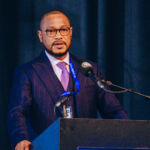
Excerpts of the Convocation Lecture for the 22nd and 23rd Annual Lecture, Delivered on August 12, 2021 at the J.F. Ade Ajayi Auditorium, University of Lagos, by Professor Olu Obafemi, FNAL, NNOM