Follow Us on Google
By Steve Agbota
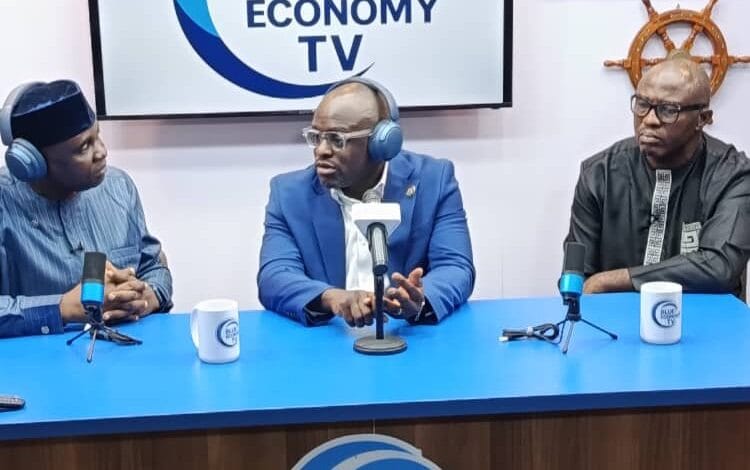
Blue Economy Academy, yesterday, officially launched Blue Economy TV (BETV) in Lagos a channel dedicated to advancing Nigeria’s maritime and blue economy sector, heralding a new era of specialised broadcasting as the first of its kind in Africa, with a focus on marine resources, policy discussions, shipping, coastal tourism, and other sustainable ocean-based industries.
Daily Sun learnt that the launch of the TV drew key stakeholders in the maritime sector, government officials, and industry experts.
Speaking at the launch, the General Manager of the Lagos State Waterways Authority (LASWA) and Special Adviser to the Governor on Blue Economy, Emmanuel Oluwadamilola, highlighted the strategic importance of the state’s maritime assets, adding that its extensive coastline and inland waterways form a vital corridor for trade and economic activity.
“With over 180 kilometres of coastline and over 140 kilometres of inland waterways moving through our communities, we have a maritime corridor that supports over 70 per cent of international trade. Yet, for years, we are only just awakening to the true value of our waters and maritime space. Today marks a significant shift,” he said.
However, he described the unveiling of BETV as a significant step towards reshaping public perception of the maritime sector and unlocking opportunities embedded within the blue economy.
He hinted that the platform is expected to spotlight critical sectors such as fisheries, aquaculture, water transportation, tourism, sports, and marine services, while also advancing conversations around environmental sustainability and climate resilience.
“The launch of Blue Economy TV is not just the unveiling of a platform, but the awakening of a consciousness, a realisation that our waters are not barriers, but bridges; not limits, but lifelines; not just scenery, but strategy. Within these waters lie jobs for our youth, food security, mobility solutions, investment opportunities, and pathways to environmental sustainability. What we are witnessing today is a signal — a sound that Lagos is ready, and that the blue economy is no longer an idea, but a movement,” he added.
Earlier, founder of Blue Economy Academy, Ubong Essien, said that the Blue Economy TV was driven by the need to deepen awareness and unlock Nigeria’s vast marine potential through media and knowledge.
He traced the origin of the project to the Academy, which he said is approaching its second year, with a clear mission to bring to light what Nigeria is about to exploit to its fullest.
“We have the Blue Economy Academy, an institution designed on the mission to see a Nigeria that prospers by water. That is our mission. That is what drives us. We can’t have so much prosperity from Badagry to Bakassi and not make the most of it,” he said.
Essien explained that the Academy was established to provide practical, industry-driven knowledge across key segments of the blue economy, stressing that its philosophy centres on “knowledge you can use” rather than purely academic learning.
“So when you come to the Blue Economy Academy, you are learning with a view to implementing immediately. All of the knowledge we bring is essential to enable you to act immediately and actualise that vision,” he stated.
Essien also outlined the Academy’s framework of ten “inclusion buckets”, covering areas such as commerce, governance, climate, energy, and finance, noting that Lagos, as Nigeria’s financial hub, is well positioned to emerge as a centre for “blue capital”.
On the newly launched television platform, he said it would serve as an extension of the Academy’s vision, using media to drive engagement, policy conversations and national reorientation.
“Everything we will be doing is through a blue prism, until Nigerians realise that we are a blue nation. Our national colour may be green, but it is blue that keeps green alive,” he said.
He added that the channel would feature programmes such as Blue Morning Nigeria and Watchers of the Seas, alongside dedicated news content, all aimed at shaping discourse and influencing policy direction.
Essien further emphasised the strategic role of coastal and water-linked states in advancing the sector, calling for stronger collaboration to overcome what he described as “sea blindness” across all levels of society.
“For the blue economy to succeed, the littoral states must take the lead, and the blue corridor states must also see the value. In the end, what we are trying to do is eliminate sea blindness, at the top and at the bottom,” he said.