Follow Us on Google
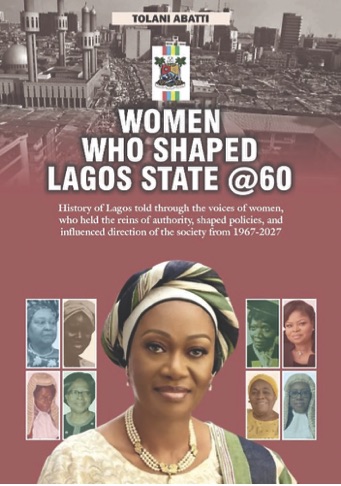
For decades, the story of Lagos has largely been told through the achievements of its male political leaders. Yet, behind many of the state’s defining milestones are women whose influence, leadership and public service have quietly helped shape Nigeria’s most dynamic state. In Women Who Shaped Lagos @ 60, veteran political journalist Tolani Abatti brings those women to the forefront in a compelling historical work that fills a significant gap in the documentation of Lagos’ political evolution.
Richly illustrated and written in lucid, engaging prose, the 220-page volume is both a historical record and a celebration of female leadership. It chronicles the contributions of women who have influenced governance, politics, the judiciary, academia and grassroots administration since the creation of Lagos State in 1967.
Lagos is no ordinary state. With a population of nearly 20 million people and an economy larger than those of many African countries, its political and administrative trajectory has profound national significance. While governors and other public office holders have dominated historical narratives, Abatti reminds readers that women have been equally instrumental in building the state now proudly known as the Centre of Excellence.
Divided into seven carefully researched chapters, the book examines women who served as First Ladies, members of the Executive Council, legislators, judges, academics and local government leaders. It also recognises grassroots political mobilisers whose quiet dedication has sustained Lagos’ political institutions across generations.
One of the book’s strongest sections is its comprehensive account of Lagos’ First Ladies. Beginning with the late Olufunmilayo Johnson, wife of the state’s first Military Administrator, Brigadier Mobolaji Johnson, Abatti traces the lives and legacies of every First Lady to Dr Claudiana Ibijoke Sanwo-Olu, wife of the incumbent governor. The narrative highlights how each woman, despite holding no constitutionally recognised office, used advocacy, philanthropy and social intervention programmes to influence governance and improve lives.
The book also shines by documenting trailblazers whose pioneering achievements altered the course of public service in Lagos. Readers encounter remarkable women such as Kofoworola Abeni Pratt, the state’s first female commissioner; Justice Modupe Omo-Eboh, the first female judge; Lateefat Okunnu, the first female Deputy Governor; Louisa Akerele-Bucknor, the first female senator from Lagos; Professor Jadesola Akande, the first female Vice-Chancellor; Princess Adejoke Orelope-Adefulire, the first woman elected into the Lagos State House of Assembly; and Professor Adenike Grange, the first female federal minister from Lagos State.
Beyond profiling notable personalities, Abatti succeeds in preserving institutional memory. His years of covering Lagos politics are evident in the depth of research and historical accuracy that define the book. Like his earlier publications on the Lagos State House of Assembly and other public figures, this work reflects meticulous documentation and a deep understanding of the state’s political history.
Perhaps the greatest strength of Women Who Shaped Lagos @60 lies in its corrective power. It restores visibility to women whose contributions have often been overshadowed by the dominant narratives of male political leadership. In doing so, it offers younger generations a richer and more inclusive understanding of leadership, proving that women have long occupied the frontlines of public service, policy formulation and social development.
Abatti’s language is refreshingly simple without sacrificing intellectual depth. The accessible style makes the book appealing not only to scholars and policymakers but also to students, researchers and general readers. At a time when the teaching of history is regaining prominence in Nigeria’s educational system, the book deserves a place in secondary school, university and public libraries.
The attractive cover complements the importance of the subject. Ultimately, Women Who Shaped Lagos @60 is more than a collection of biographies. It is an important contribution to the historiography of Lagos State, preserving the legacies of remarkable women while inspiring future generations to pursue excellence in leadership and public service. It is a timely reminder that the story of Lagos cannot be fully told without the women who helped build it.