Follow Us on Google

From Obinna Odogwu, Awka
If urgent actions are not set in motion across towns and local government areas in Nigeria, many endangered species of plants, wild animals and important organisms may go extinct in or before the next 10 years.
This is because of the growing, and most times illegal, exploitation of their populations and other harmful human practices that deplete their numbers at a rapidly increasing rate.
At the moment, Nigeria has a total of 309 threatened species according to a red list drawn by the International Union for Conservation of Nature (IUCN) in 2013.
That list, cited in the government’s National Biodiversity Strategy and Action Plan (2016 – 2020) published by the Federal Ministry of Environment in 2015, listed their taxonomic categories as follows: mammals (26), birds (19), reptiles (8), amphibians (13), fishes (60), molluscs (1), other invertebrates (14) and plants (168).
Ever since that report was published, human actions which endanger the existence of these plants, animals and other creatures have not stopped; and it doesn’t seem that the government is taking real actions to address the menace.
Although a bill proposal, which when passed would help to address the issue of illegal exploitation of wildlife, has been presented in the House of Representatives, there hasn’t really been strong enforcement activities of the previous laws and policies designed to tackle the illegal wildlife trade.
There haven’t also been serious awareness campaigns to reduce the demands for illegal bush meat in the urban and rural areas, and as well, discourage patronage of ivories and others across the country.
The bill, prepared by the Federal Ministry of Environment, is jointly sponsored by the House Committee Chairman on Environment, Hon. Johnson Oghuma, and Hon. Sam Onuigbo.
Called the Endangered Species Conservation and Protection Bill 2023, the legislative document which passed first reading in January would strengthen the country’s laws to aid the prosecution of offenders.
Oghuma said: “The rate at which some species of fauna and flora are being extinguished is assuming a frightening dimension. Every day, more and more species are becoming endangered and pushed to the brink of extinction.
“It is worthy of note that any action that is against biodiversity sustainability comes with a great cost. Just as humans have the right to life, so do the plants and animals.
“We (Nigeria) must therefore do everything within our strength to ensure their sustainability. It is time to act to stop environmental degradation and protect our wildlife and plants globally and Nigeria cannot afford to be the last.”
Speaking on the development, founder of Wild Africa Fund, an environmental conservation group, Peter Knights, described the bill as “a new state of the art legislation which would help Nigeria get away from this role of being this hub of trafficking, to really being a regional leader in encountering wildlife trafficking.”
He said that the bill, if passed, would give the authorities the legal tools to close down trafficking. He said that border agencies have made huge seizures but have struggled to prosecute and pursue criminals internationally due to weak laws previously.
But in a recent interview, Knights explained that the bill, when passed and signed into law, would help improve the current enforcement efforts, given that it was prepared by the Ministry of Environment and as such has the administration’s backing.
“Some new reforms include that it will bring Nigeria into compliance with international conventions like the United Nations with the right laws to implement them.
“It will also increase the investigative powers including financial inquiries and intelligence led operations which will really assist the Customs Service, NESREA and the police in conducting investigations.
“They will be able to use undercover techniques, look into financial records of people involved in wildlife trafficking, and this could really help to disrupt the organised crime which wildlife trafficking has become.
“It will also increase penalties to reflect the seriousness of the crime. Penalties in the past were very low. The new penalties would be a big disincentive for people who want to commit wildlife crime
“The law will also expand the court’s ability to expedite seizure of assets used in the commission of wildlife crime. So, if people are using their vehicle to transport wildlife, they could lose that vehicle. These are very standard penalties that people have used all over the world in combating organised crime.
“Wildlife crime is very organised and often involves foreign nationals, not just Nigerians, so the new law will increase the ability to have international cooperation and even extradition.
“It will also address habitat destruction, permit violations and invasive species which is another threat to biodiversity as invasive species that come from another continent, perhaps, dislodge local wildlife. So, it will be an offence to conspire or to perpetrate such illegal acts.
“It really clarifies definitions, the roles of key agencies that were not clear in the legislation and their powers”, he said.
Knights said that the new legislation also provides mechanisms to strengthen the current enforcement of the existing laws and policies.
“For example, it enables Customs Service to do undercover investigations. There are a number of provisions in this bill, which would make it easier for the enforcement agencies because the penalties have increased.
“Obviously, they don’t want to spend a lot of resources and time if at the end of the day, it’s a very minor penalty, this doesn’t make any sense. But now with the ability to seize assets, law enforcement agencies have been incentivised. It elevates wildlife crime into a significant crime.
“There are new techniques like undercover investigations, ability to extradite and pursue criminals from other countries, which makes this bill effective in fighting wildlife crime”, he said.
But until that bill passes through the legislative rigours and gets presidential assent, the illegal exploitation of wildlife which is rapidly driving many of them into extinction will continue.
Interestingly, Nigeria has an abundance of plant and animal species which make it very rich in biodiversity. This is due to the country’s complex topography, favourable climate and a wide range of habitats.
These include the rainforests of the Cross River basin, the coastal creeks of the Niger Delta, the mountains along the Cameroun border and the marine and freshwater ecosystem across the country among others.
In addition to that, there is the existence of an inland layout of an array of other forest ecosystems including the Sahel Savannah in the extreme north, Sudan Savannah, Guinea Savannah and Derived Savannah woodland.
Statistically, Nigeria has an endemic flora of 91 species belonging to 44 families with rubiaceae accounting for the highest numbers.
But with the rate of human exploitation of these already endangered species, they may just all be gone in no distant time if the menace is not urgently checked.
Already, the ugly results are beginning to show. Scientists reported that only about 50 lions were still around in Nigeria. Reports also indicate that the population of pangolin is rapidly decreasing due to the illegal trade in its scales.
According to WildAid, Nigeria has emerged as the top transit point in the world for illegal ivory and pangolin scales trafficked from Africa to Asia. It said that between 2016 and 2019, over half of the pangolin scales seized globally came from Nigeria.
In February 2020, Wildlife Justice Commission (WJC) published a report that showed a significant and rapid increase in the volume of pangolin scales being trafficked, revealing that it was facilitated by transnational criminal networks that are driving the species to extinction.
The commission reports that between 2016 and 2019, an estimated 206.4 tonnes of pangolin scales were confiscated from 52 seizures. It believes that the rate is only a fraction of the total being trafficked, as it is likely that a significant proportion of smuggling passes undetected.
“Six of the 27 identified countries and territories disproportionately involved in the trafficking of pangolin scales were found to be linked to 94 per cent (193.2 tonnes) of all seized contraband during the period analysed in this report, with Nigeria and Vietnam playing prominent roles in the supply chain.
“Between 2016 and 2019, they were linked to almost 70 percent of pangolin scale seizures (143.6 tonnes). During 2018-2019, this prevalence even increased as 84 per cent of all detected shipments involved one or both countries.
“The Nigeria – (Singapore) – Vietnam smuggling route has also been identified as a significant transportation route for the smuggling of scales on their own or in combination with ivory”, Wildlife Justice Commission reported.
WJC believes that it’s an organised crime considering the coordination and infrastructure required to facilitate the harvesting, processing, storage and transportation of the reported volume of pangolin scales which appear very huge.
“In order to effectively dismantle the criminal networks behind it and bring the high-level traffickers to justice, the trafficking of pangolin scales must be tackled from a truly intelligence-led approach, identifying the chronic crime enablers combined with the use of advanced investigative techniques applied to other organised crimes, such as controlled deliveries”, it added.
While there was an outcry to save the remaining pangolins and lions in Nigeria, some other animals have gone extinct in the country.
A report by WildAid shows that Nigeria has no surviving cheetahs, rhinos or giraffes and fewer than 50 lions, 100 gorillas, 500 elephants and 2,300 chimpanzees are left in the wild.
“Despite the ongoing conservation efforts, poaching for body parts and meat along with habitat loss from deforestation, infrastructure development, and agricultural expansion threaten wildlife in Nigeria.
“Illegal bush meat consumption is widespread across Nigeria’s top cities”, it says.
A survey carried out by GlobeScan revealed that 70 per cent of the respondents said that they had consumed bush meat at some point in their lives.
The survey, commissioned by WildAid which was published in January 2021, showed that there was a growing appetite for bush meat among urban residents.
“This consumption also overlaps with the illegal trade networks, fuelling the trade in protected species like elephants and pangolins.
“While studies have shown that bush meat consumption in Nigeria is influenced by a number of factors such as taste, health and culture, there is a little information on the attitudes, awareness, preferences and reservations of the general public in major cities such as Lagos, Abuja, Port Harcourt, and Calabar”, the survey report reads.
Despite the risk of zoonotic diseases’ transmission, 75 percent of the 2,000 respondents sampled within the months of September and October 2020 disclosed their intentions to eat bush meat in the future.
“Results found that over 70 percent of urban Nigerians have consumed bush meat at some points in their lives, and 45 percent consumed it within the last year.
“Taste and flavour are significant factors influencing urban bush meat consumption, with about 51 percent of bush meat consumers indicating that it is one of the primary reasons for their choice,” the report partly reads.
By now, 2023, it is possible that the population of Nigerians, especially those living in the urban centres who relish bush meat, might have increased. And beyond taste and flavour, hunger and high cost of fish and beef might have also influenced their choices.
The Federal Government has said that it was making spirited efforts to stop illegal wildlife trade and all harmful practices that threaten the nation’s biodiversity, saying that it was interested in ensuring that its citizens live in harmony with nature.
The government said that it was for that reason that it floated the National Biodiversity Strategy and Action Plans (NBSAP) and has been using it to work towards stamping out illegal wildlife trade and the protection of the country’s biodiversity.
“Nigeria considers the five goals of the Global Strategic Plan for Biodiversity 2011-2020 very appropriate and applicable to its situation and adopted them to form the basis of the current NBSAP.
“It has also adopted 14 SMART National Targets with 21 Impact Indicators and 67 Actions with 123 Performance Indicators and 20 Programmes.
“Consequently, Nigeria’s current NBSAP is closely aligned to both the Convention on Biological Diversity (CBD) Strategic Plan for biodiversity 2011-2020 and its Aichi Biodiversity Targets and Nigeria’s unique priorities and features”, the government says in its NBSAP report.
But despite these efforts, illegal killing of wild animals has continued to take place across the country. In the urban centres, restaurants and entertainment centres where bush meats are sold continue to boom.
For example, in Kogi State, about three hippopotami were killed in 2022 according to reports. The last one was killed in that confluence state in November that year at the Ganaja axis of the Rivers Niger/Benue.
It’s been about five months after the locals killed the hippopotami but till date, there has not been any report of any action taken by the Kogi State Government to protect the already endangered wild animals.
In fact, one of the hippopotami that were killed in that state was said to have been shot dead by some local vigilantes in the area. The villagers reportedly shared the meat among themselves.
In Taraba State, the story is not so different. About 14 hunters, in March 2022, reportedly killed a hippopotamus at the Kwoi River, close to Bajimba village, in the Gassol Local Government Area of the state and shared the meat among themselves.
That action prompted the state government to declare them wanted. As of the time of filing this report, it was not clear if any of the hunters had been apprehended and if the government was still interested in the matter.
Commissioner for Environment in the state, Alhaji Lawan Ibrahim, had blamed the Gashaka/Gumti National Park located in the state for the death of the hippopotamus, saying that the wild animal would still have been alive if the park officials had responded quickly to a call on them to rescue it.
In an interview published by Punch, the commissioner said: “The hippopotamus belongs to the category of wild animals. You know that they survive and move in riverine areas.
“So, when the water in the area dried off, it left the hippopotamus vulnerable and when we heard about it, we drafted some of our personnel there who went and brought back the report.
“We immediately wrote a letter to the Gashaka/Gumti National Park located in the state, notifying it of the presence of a hippopotamus disturbing people around the area and destroying their crops.
“People in that area do dry season farming, so we wrote to the national park to come and handle the situation.
“The national park equally wrote to their head office, but before they got a reply, the people in the area, who are into dry season farming, ran out of patience because of the level of destruction of their crops by the hippopotamus.
“Before we knew it, we were informed that the hippopotamus had been killed. That is why the state government ordered the killers’ arrest”, Ibrahim said.
Asked why the state government wrote to the national park instead of handling the situation immediately, the commissioner said: “We wanted to liaise with the national park because our principal, Governor Darius Dickson Ishaku, was outside the country.
“You know how the civil service operates – the bureaucracy would have taken some time and we wanted to act fast.”
But contrary to the commissioner’s account, the villagers denied killing the wild animal. They claimed that hunters from Mayo-Renewo, Binnari and Shagarda communities in the Ardo-Kola, Karim Lamido and Gassol LGAs of the state did.
A resident in the area who gave his name as Musa Maikudi told newsmen that “The hunters secretly mobilised themselves in the night and went to the river where the hippopotamus was staying and killed it.
“They dragged the body to the forest far away from the river and shared the meat. The report of the killing of the hippopotamus was, however, leaked by a rival group that was not involved in the killing of the animal.
“The state government has ordered the arrest of the hunters involved and all the hunters are now on the run.”
Sometime in August 2015, soldiers reportedly killed a ‘notorious’ hippopotamus in a dam in Gombe State. The slain hippo had been accused of terrorising Yamaltu/Deba LGAs of the state.
The animal was alleged to have killed some fishermen and farmers near the Dadin/Kowa dam before it was shot dead by soldiers on a Wednesday, according to local officials.
The state authorities had said that the ‘notorious’ hippo had “killed many people in the last two years.”
The Head of Forestry, Yamaltu/Deba LGA, Ismail Umar, confirmed the killing of the wild animal, saying that the state officials were aware of the threats posed by the hippopotamus since 2013, and had complained to the LGA about the damages it had caused; adding that permission to hunt it down was sought.
“We were lucky to trap it outside. We used military men. And with the help of the local hunters, we shot it yesterday night around 10:30pm when it came out to eat grasses, and today we butchered it into pieces”, Umar had told newsmen; adding, however, that there were about 100 hippos in the dam.
The permanent secretary of the state Ministry of Environment and Forest Resources, Adamu Pukuma, said that the hippo that was killed was “notorious” in the area. He said that the state was committed to protecting hippos to ensure they do not go extinct.
“It killed people around the area as well as destroyed people’s farms and fishing equipment, and there were complaints from the people. That was why we sought the governor’s approval and killed it,” Pukuma was quoted as saying.
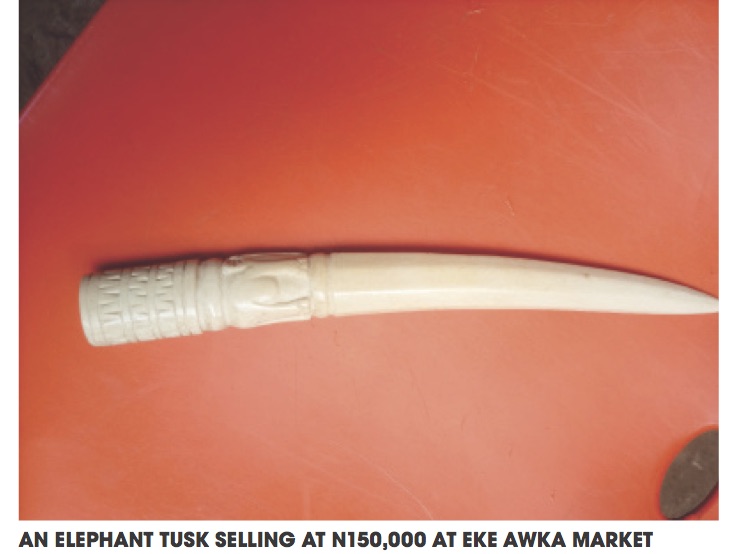
In Anambra State, ivories and other wild animal parts are being sold in some of the major markets in the state just as it is the case in other states. And they are expensive too. An elephant tusk in Eke Awka Market is sold at N150,000 while other animal parts have different price tags.
A community leader in Awka, the state capital, Mr Paulson Okeke, lamented that the country no longer has wildlife. He told Saturday Sun that Nigerians have driven the wildlife he used to see as a child into extinction.
“The truth is that we don’t still have wildlife in this country because human activities have put them into what I could call endangered species.
“Take for instance, there are parts of the north where elephants were common before; but today you cannot see them again.
“We used to hear about Yankari Games Reserve in Bauchi. We grew up there. We used to go to Bauchi Games Reserve to look at animals. We watched lions, tigers, elephants and others; just in their natural habitat. But today you cannot see all those things again.
“In Jos, Plateau State, there is this national park in Jos; when you go there, you see wildlife; they’re in quantum but today they’re no longer there.
“Down there in Enugu, there is Enugu Zoological Garden, the Enugu Zoo. During our childhood days, we used to go to the zoo to watch all these animals. Enugu Zoo today has been converted into a housing estate and sold to big men.
“And such is the danger posed to wildlife in this country. I must tell you honestly that we don’t have wildlife in this country again. Those that are remaining are going into extinction.
“This is because some businessmen are poaching them, selling them; killing them and selling their skins. Some eat them. So, that is the problem”, he lamented.
Okeke, however, revealed that his people of Awka community protect monkeys. He said that their cultural practices prohibit the killing of monkeys in the town.
“Here in Awka, my town, the wildlife that is common here which we protect is monkeys. The monkey is protected but the activities of strangers have put them into dangers.
“The reason is this. Inasmuch as Awka people are protecting and keeping them, those who are not from Awka are killing and eating them. So, it becomes what is good for you may not be good for me.
“If it is good for you to keep it, it is good for me to eat it. So, these are part of it”, Okeke said.
A lecturer in the Department of Technology and Vocational Education, Nnamdi Azikiwe University, Awka, Gabriel Alonta, told Saturday Sun that he was worried about the onslaught on wild animals in the country and, indeed, harmful practices driving some plant species into extinction.
“I don’t eat bush meat. I have heard about restaurants where bush meats are being sold in Anambra but I have not visited any. I have not visited any because I am not a fan of it”, he said.
Alonta said that although the country may have laws prohibiting illegal killing of wild animals, his countrymen have no record of obeying such laws and were not likely going to do so.
“Are Nigerians really going to abide by any rule that the government has promulgated? I ask because Nigerians should first start by showing love to their fellow humans first. They need to start being humans themselves before they can extend such love to animals.
“Why I am saying this is because Nigerians may find it difficult to follow any rule in that regard. I am aware that there are international efforts geared towards the protection of the environment, animals and the rest of them.
“There may be rules against illegal killing of wildlife but the question is ‘are there enough monitoring agencies to monitor the implementation of such?’
“I remember that in Nnamdi Azikiwe University, Awka, for instance, there is a zoo. The university established it to preserve wild animals. I don’t know how effectively the place is being managed but I know it exists.
“The situation is worrisome but a common Nigerian would tell you that they need to feed and survive first before talking about protecting animals. I think that it boils down to systemic failure that we have in the country,” Alonta submitted.