Follow Us on Google

Why 53% of Nigeria’s poorest still financially excluded – EFInA
By Juliana Taiwo-Obalonye
For millions of Nigerians, the door to formal finance is opening wider. But for those at the bottom of the economic ladder, getting through that door remains a struggle.
The latest Access to Financial Services in Nigeria (A2F) 2026 survey by Enhancing Financial Innovation and Access (EFInA) puts the disparity in stark numbers: 53 per cent of adults in the poorest wealth quintile remain financially excluded, compared with just 1 per cent in the richest quintile.
Almost half of all financially excluded Nigerians are drawn from the poorest 20 per cent of the population. It is a striking divide in a country where the overall financial exclusion rate has fallen to 21 per cent.
The national picture appears encouraging. Digital financial usage has risen from about 47 per cent to 64 per cent, while mobile money usage has more than tripled, from 12 per cent in 2023 to 38 per cent in 2026.
Formal savings have also climbed from 38 per cent to 53 per cent. Yet the benefits of that expansion are not reaching everyone in the same way.
For the poorest households, the problem may not simply be whether there is a bank account nearby or whether money can be transferred digitally. It is whether there is enough income left to save, whether affordable credit is available when a business needs working capital, whether a family can withstand an emergency and whether years of work can eventually translate into financial security.
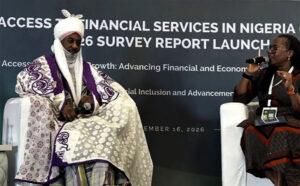
That tension came sharply into focus at the Abuja launch of the A2F 2026 Survey. During a fireside chat with the Emir of Kano and former Governor of the Central Bank of Nigeria (CBN), Alhaji Muhammadu Sanusi II, moderated by Olayinka David-West, one question stood above the statistics: what should financial inclusion actually mean in the daily economic lives of Nigerians?
Sanusi’s answer was blunt: “Opening an account, moving money, is not the same as earning money. It’s not the same as operating out of poverty.”
That distinction runs through the latest A2F findings. Nigeria is becoming more digitally connected financially, but cash remains deeply embedded in the economy. Among agricultural workers, 92 per cent reported receiving their payments in cash.
And when shocks occur, many households have little financial cushion to absorb them. The survey found that 61 per cent of Nigerian adults remain in severe liquidity distress. Among adults who experienced financial shocks, 71.6 per cent relied on fragile or erosive coping mechanisms, compared with only 13.8 per cent who used protective or adaptive mechanisms.
For farmers, who often operate at the mercy of weather, markets and fluctuating input costs, the vulnerability is particularly pronounced. The survey found that 51.2 per cent of farmers experienced a financial shock. Among shock-exposed farmers, 52.2 per cent used erosive coping mechanisms, while 76 per cent experienced residual distress.
Behind the statistics are households whose responses to one emergency can leave them more vulnerable to the next. That is the deeper story emerging from the A2F report: financial exclusion is not simply about being outside the banking system; it is also about how vulnerable people remain once they enter it.
EFInA board chair, Agnes Martins, said this was why the organisation was increasingly looking beyond traditional measures of access. Welcoming stakeholders to the launch, Martins said EFInA’s 2024–2029 strategy placed greater emphasis on the usage, quality and impact of financial services and their contribution to wider economic inclusion.
“Access is only the beginning of the journey. It is not the destination,” she said.
She challenged policymakers, regulators and financial institutions to ask what access actually enables Nigerians to accomplish.
“Does participation in the financial system expand people’s opportunities? Does it help households and businesses manage their financial lives more efficiently? Does it enable people to participate more productively in the economy? And ultimately, does it contribute to greater economic empowerment?” Martins asked.
For women, the A2F data presents both progress and persistent gaps. Formal inclusion among women business owners rose from 67.5 per cent to 76.3 per cent, while among women farmers it increased from 42.7 per cent to 53.6 per cent.
But exclusion among dependent women increased to 52.2 per cent. Edidiong Uwemakpan, Vice President, Corporate Affairs, Moniepoint Group, said gender-disaggregated data could help financial institutions recognise economic activity that conventional credit assessments often overlook.
“For years, traditional balance sheets saw Amina as high risk, simply because she had no landed collateral or formal paperwork,” Uwemakpan said.
“But when we look through the lens of gender-disaggregated data, her story transforms entirely. Amina was never inactive.”
According to her, women may process numerous transactions every day, operate on thin margins and support entire households while remaining invisible to conventional measures of creditworthiness.
“When data accurately reflects a woman’s daily cash flow and resilience, it turns an invisible trader into a bankable entrepreneur and a pillar of the society’s economic agenda,” she said.
Uwemakpan disclosed that a Moniepoint impact survey found that 62 per cent of women surveyed obtained their first formal business loan through the company.
The survey also found that 83 per cent of users reported an improved quality of life, while 85 per cent reported greater confidence in achieving their financial goals. But the wider A2F data shows that formal credit remains limited, at just 10 per cent nationally.
Insurance stands at five per cent, while pension participation is only about nine per cent. That pension gap worries the Director-General of the National Pension Commission (PenCom), Omolola Oloworaran.
“Financial inclusion cannot end with access to an account. It must build resilience, security and well-being,” she said.
Pension participation increased from 7.8 per cent of adults in 2023 to 9.1 per cent in 2026.
But Oloworaran noted that the improvement still leaves roughly nine out of every 10 Nigerian adults outside formal pension arrangements. According to her, behind that statistics are “the trader who opens a shop every single morning, the farmer who feeds our cities, the mechanic, the driver, the tailor, the hairdresser, the young Nigerian earning on a digital platform.
“They work, they earn, they carry this economy. But too many of them are growing older without building any security for the day they can no longer work.”
The challenge, she argued, is to build pension products around the economic realities of informal workers rather than expecting informal workers to conform to conventional pension structures.
“What will make those without one start saving and keep saving? What will persuade the market woman to put aside 1,000 naira today and again next week? How will the pension work for a farmer who becomes entitled to income during August only?” she asked.
Her warning was direct: “Opening a pension account is not by itself pension inclusion. An account that is open but never funded will not provide dignity in retirement.”
The CBN governor, Olayemi Cardoso, represented by the Director of Consumer Protection and Financial Inclusion, Dr Aisha Isa Olatimu, similarly urged stakeholders to judge financial inclusion by its outcomes.
Cardoso described the A2F survey as “far more than a statistical publication,” calling it “an accountability instrument.” It reveals, he said, “who is participating in the financial system, how financial services are being used, which barriers remain, and whether access is translating into stronger households, more resilient enterprises, and wider economic opportunity.”
For the CBN, he said, the task was to ensure “meaningful usage, affordability, reliability, safety, trust, and measurable improvement in financial health.” But Cardoso also placed financial inclusion within the wider economic environment.
Persistent inflation, he said, weakens purchasing power, reduces savings and raises the cost of credit, with the greatest burden falling on low-income and underserved Nigerians.
“Price stability protects livelihood,” he said.
Other News
He also stressed that greater participation in financial services must be accompanied by stronger consumer protection.
“Assets must be accompanied by redress,” Cardoso said, noting that the CBN merged consumer protection with financial inclusion in 2025 to facilitate easier redress for bank customers.
The question of consumer protection and regulatory responsibility became one of the strongest points raised by Sanusi during the fireside chat.
The former CBN governor warned that overlapping mandates among regulators could create confusion for consumers, particularly where complaints cross sectoral boundaries.
“And I think consumer protection is so critical to financial inclusion that once you begin to fragment and there isn’t one point of call, there is an issue,” Sanusi said.
He specifically raised concerns about possible conflicts between sector regulators and the Federal Competition and Consumer Protection Commission (FCCPC).
“When you think about laws, we have a consumer protection department of sector. We now have court rulings that are creating conflicts between them and some agency called the FCCPC,” he said.
Sanusi argued that complaints involving regulated financial institutions should have a clearly defined regulatory pathway.
“You cannot, when you’re dealing with bank customers, if you begin to have multiple regulators involved, you’re creating a situation where the customer will not be protected,” he said.
“Individual cases have to be left for the regulator,” he added.
He extended the argument to other sectors, including telecommunications and pensions, saying consumers should know precisely which regulator has responsibility for resolving a complaint.
For someone already struggling to navigate formal finance, uncertainty over where to seek redress can become another obstacle to trust.
But Sanusi’s intervention went beyond regulation and redress. He also challenged financial institutions to use the data they already hold to build products that protect Nigerians against the risks that can wipe out years of economic effort.
He advocated greater use of transaction data generated by banks, fintechs and payment companies to develop savings, pension and insurance products for Nigerians with small or irregular incomes.
“If I were at the Central Bank today, I would call in MoneyPoint and OPay and say, guys, you have all this data, you’re transferring money. Tell me, how can you build pension products on top of this? How can you build savings products on top of this?” he said.
Sanusi suggested that even small deductions from everyday transactions could gradually build financial protection.
“You can have a small system where out of every transfer you take a small amount and it’s forced savings, it is insurance, it is pension,” he said.
He specifically pointed to insurance as a way of protecting people whose livelihoods are vulnerable to sudden losses.
Sanusi said insurance products could be designed to protect market traders against risks such as fire outbreaks and farmers against crop failures.
The proposition is significant against the backdrop of the A2F finding that only five per cent of Nigerian adults currently use formal insurance.
For a trader, a fire can destroy stock accumulated over years. For a farmer, a failed crop can erase an entire season’s expected income. Insurance, in Sanusi’s formulation, would therefore not simply be another financial product but a mechanism for preventing one shock from pushing a household deeper into financial distress.
His broader argument was that financial inclusion should connect people to tools that help them withstand economic shocks, rather than merely provide channels through which money can be transferred.
Technical Assistant to the President on Economic and Financial Inclusion and Executive Secretary of the Presidential Committee on Economic and Financial Inclusion (PreCEFI), Dr Nurudeen Abubakar Zauro, said EFInA’s evidence had become an important tool for policymakers.
“Data has been such a very good and instrumental in taking decisions within this financial inclusion ecosystem,” he said.
Zauro linked Nigeria’s financial inclusion journey to earlier policy interventions, including participation in the Maya Declaration and the development of the National Financial Inclusion Strategy.
He said initiatives involving mobile money operators, super agents and financial literacy had helped expand financial access points across the country.
For GIZ, which supported the survey, the A2F report provides an evidence base for development cooperation and interventions.
“We are proud to have contributed to this report and to the data set because also for us it’s a very important tool to align our cooperation to the Nigerian realities and to the Nigerian progress,” the representative said.
The representative said GIZ wanted to contribute to “a prosperous and all-inclusive Nigeria,” particularly through greater economic participation among women and in agriculture.
The A2F 2026 findings therefore tell two stories at once.
There is measurable progress: financial exclusion has fallen, digital financial usage has expanded, mobile money is growing and formal savings have increased.
But the gains are uneven.
The poorest 20 per cent remain dramatically more likely to be excluded than the richest. Credit, insurance and pensions remain relatively shallow. More than six in 10 adults are in severe liquidity distress, while many Nigerians facing shocks resort to coping mechanisms that can weaken their future financial position.
For Martins, the significance of the survey will ultimately be determined by what happens after the statistics have been published.
“The value of the evidence is in what we do with it,” she said.
That means moving beyond counting accounts, access points and transactions to asking whether those services are helping Nigerians build productive livelihoods, withstand shocks and participate more securely in the economy.
As Martins put it: “The next chapter of financial inclusion will be defined not by access alone, but by the possibility that access unlocks.”
For the 53 per cent of adults in Nigeria’s poorest wealth quintile who remain financially excluded, that possibility is still a distant one.
The challenge now is to turn financial access into something they can actually use to save, invest, insure against loss, protect their livelihoods, absorb shocks and build a more secure economic future.