Follow Us on Google
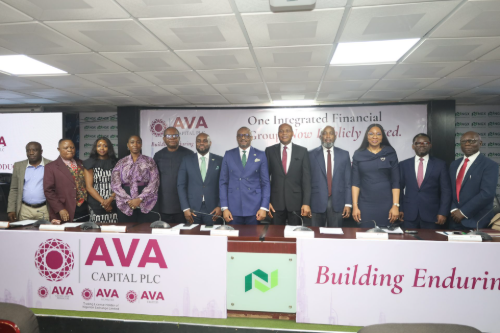
AVA Capital Plc has said preserving investor trust will be its foremost priority following its recent listing on the Nigerian Exchange Limited (NGX), as the investment banking group seeks to strengthen governance, transparency, and accountability while pursuing long-term growth as a public company.
The company said maintaining investors’ confidence is fundamental to its business model, noting that although it continues to monitor risks such as inflation, exchange rate volatility, and interest rates, safeguarding investors’ capital remains its biggest post-listing challenge.
Speaking during an executive media roundtable in Lagos on Tuesday, the Managing Director and Chief Executive Officer of AVA Capital Plc, Kayode Fadahunsi, said the firm’s greatest risk extends beyond macroeconomic challenges, stressing that investor confidence is critical to sustaining the capital market.
“The highest risk is to continue to responsibly connect opportunities to capital. If the person that connected the opportunity to capital loses people’s capital, that trust is gone. It is a very serious risk.”
He said that while inflation, exchange rate movements, monetary policy, and political developments remain important considerations for investment decisions, preserving trust is central to the firm’s operations because its role is to connect investors’ funds with credible opportunities.
Kayode said the company’s transition to a publicly listed firm has significantly expanded its governance and disclosure responsibilities.
“We are now accountable to a broader community of shareholders, regulators, clients, employees, and the investing public. With that comes a deeper commitment to transparency, good governance, and open engagement,” he said.
He explained that the company’s admission to the NGX Main Board through a listing by introduction was driven by governance objectives rather than a need to raise fresh capital.
“We did not issue any shares to the public, and we did not raise capital. This was a governance and business decision, not a capital-raising exercise,” he said.
According to him, the company’s existing capital already satisfies regulatory requirements, adding that future capital-raising would only be considered if expansion plans or regulatory changes create a genuine funding need.
“If you do not need capital, why raise it? If we need capital in the future because opportunities require it, we will return to the market,” he said.
He cautioned companies against raising funds without clear deployment plans, arguing that capital should only be sourced where it can generate value for shareholders.
Other News
On the broader financial market, Kayode identified integrity as one of the principal risks confronting Nigeria’s capital market, saying weak governance and poor understanding of how investment opportunities should be structured could discourage capital formation.
“Opportunity must speak the language of capital. Our responsibility is to ensure that opportunities that are not genuine do not gain access to investors’ capital,” he said.
He also called for improved financial literacy, arguing that many businesses with viable ideas struggle to access funding because they lack the structures required by investors.
On growth plans, Kayode said technology would play a central role in the company’s expansion strategy, with a target of increasing its client base from more than 5,000 to 100,000 by 2030.
“The simple answer is technology,” noting that digital investment platforms and electronic trading services would drive customer acquisition and improve service delivery.
Kayode said current economic conditions, including elevated interest rates, have redirected substantial investment flows into government securities, reducing capital available for businesses. He argued that lower inflation would eventually create room for lower interest rates, encouraging more private sector investment and economic growth.
AVA Capital was admitted to the Main Board of the Nigerian Exchange on July 31 through a listing by introduction, with five billion ordinary shares listed at N7.50 each. The listing did not involve the issuance of new shares or the raising of fresh capital but subjected the company to the disclosure, governance, and reporting requirements applicable to publicly quoted companies.
Chairman of AVA Capital Plc, Adeyinka Adedeji, said the company’s admission to the NGX marks the beginning of greater responsibility rather than an end in itself.
According to him, “becoming a publicly quoted company commits the firm to higher standards of governance, accountability, transparency, and long-term stewardship expected by shareholders and the investing public.”
Adedeji said the board’s responsibility extends beyond overseeing financial performance to ensuring the institution remains resilient and well governed amid changing economic conditions.
While acknowledging the challenges facing the economy, he said disciplined financial institutions still have opportunities to support capital market development by strengthening investor confidence and maintaining sound corporate governance.