Follow Us on Google
By Uchay Okobi
Artist, Godwin Archie-Abia, has carved a niche in the Nigerian art world. He has been consistent and synonymous with particular art styles and pieces that stand out for the subject matter, medium, execution and long-term value.
He propagated bone-collage paintings in the 1990s. His works can be found in private collections and public galleries for art lovers in Nigeria and abroad. Archie-Abia has exhibited in group and solo shows where his creations stood out for their unique features.
Nevertheless, there seems to be a shift, as he retreated for a while and emerged with something equally extraordinary and fresh.
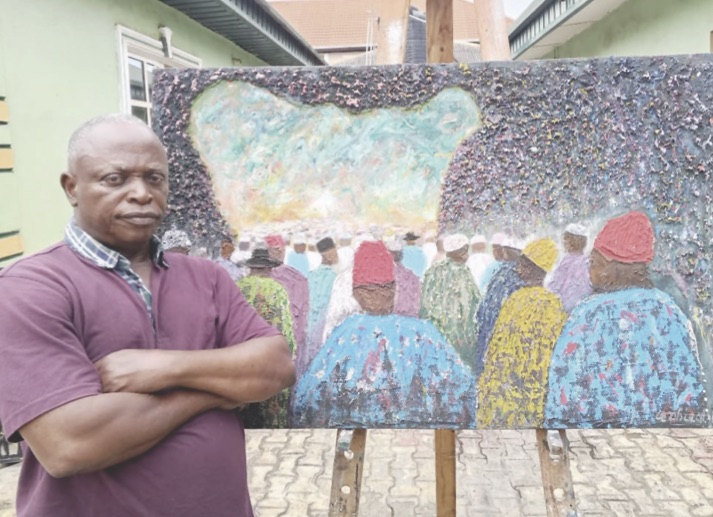
“My new style, I call it graven oil painting on canvas,” he said. “The material has to be glued to either board or canvas panel to create a relief format. First, I sketch, provide the materials, engrave the materials, before glueing them to either board or canvas panel to create a super relief effect. Then I prime the materials on the panel to allow it to dry and then start applying colours to it. At the end of the day you get a super and unique work.
“The medium is unique because of the richness of the materials and the colour effects, the impasto rendition. I can achieve any concept with the medium but it is very interesting and challenging. One has to put his head down and be very patient to create a work that is of international accepted standard.
“Due to the richness and uniqueness of the medium, my collectors are showing more interest in it and are eager for more. Unlike bone collage, in which you can only use a board panel, with this new medium, it can be both canvas and board.
“In the months to come, I want to do a show to officially unveil this medium to other collectors who might not have seen this medium before.”
His latest endeavours, a collection of colourful and thought-provoking artworks, which he created in the new, distinctive graven style, in addition to the art education programme for children and upcoming artists powered by his establishment, Winarc Gallery, in Peace Estate, Lagos, have put him in the limelight once more.
Archie-Abia remains one of the older generation of artists who fought their way to the top with sheer willpower, talent, self-belief and tenacity. Today, he qualifies to be called a master. And he is passing down his art legacy to the next generation of artists. Despite his engagements and businesses, his gallery gives opportunities to upcoming artists, with free studio access and guidance. He creates time to personally guide youngsters towards art success in Nigeria’s saturated and competitive art industry.
He explained to The Sun recently, “My new project is to develop children who can think. To this end, we organise summer art classes when schools are on vacation and every Saturday at the gallery. You can check our social media accounts to see the progress they are making. We have developed some other media with the children.”
As someone who first came to national renown for his bone-collage artworks, Archie-Abia has, unusually, pivoted away from a medium that gave him fame, fortune and relevance. When asked what led to bone-collage, how long he stayed with it and why he abandoned the medium, the master craftsman in him poured out, starting from the beginning: “I am a divinely called, self-taught artist. I am a graduate of history and international relations from Lagos State University. I have never attended art classes in the formal sense, but have several classes in my dreams. Apart from handwork class in primary school level arts and crafts, I was taught spiritually.
“I started with the bone-collage medium and drove it to the highest level where I used cow horns and bones to achieve portrait pictures.
“I remember my first media chat (art review) was with African Vision Magazine, ‘An Artist with a Mission,’ in November 1995. From that day till date, I have done so many private viewings, saloons and exhibitions, to mention but a few, including Didi Museum, Victoria Island, 1995, Bishop Vining Church, GRA, Ikeja, and Nimbus Gallery, Ikoyi. I stayed with bone collage for 25 years. I have so many commissioned works in bone collage in Nigeria and overseas both in private collections and public galleries.
“I started with bone-collage but as time went on I discovered the need to diversify as there was no enabling environment to continue. Like I told you, I’m a focused person with the Holy Spirit in me. I seek God’s face and revelation on how to paint: invention and the use of other media such as metal and mixed media sometimes come to mind.
*When you are with the Holy Spirit, you can see the future; the Holy Spirit is my Senior Partner. He assisted me a lot in this journey. Again, I dropped the bone concept because there was no enabling environment to continue. Since my life was created for arts, God gives me vision to drive it. From time to time, I do bone but it is not my major focus now.
“I experienced technical problems in my execution of bone-collage. There was no electricity to power the machines I was using in cutting the bone. Even with generators, there is still petrol scarcity and high cost. So I diversified to other mediums.”
Other News
But how have collectors and art lovers who were followers of his bone collage art pieces reacted?
Archie-Abia said the response has been encouraging. He expressed gratitude to collectors for “following” him all the while, believing in his creative prowess and supporting his artistic journey.
“Having practiced arts for more than 26 years, I have gained enough knowledge to think and create a medium that will stand the test of time,” he said.
The artist and gallery owner, unable to divorce the political economy from art and creativity, called on the Nigerian government to “place embargo on importation of foreign art” and diversify the revenue sources of the nation in view of dwindling oil prices.
He added that economic growth without job creation is a mirage and no serious economy will want to undermine the importance of the creative industry, in which visual art plays a vital role: “In a developing economy like Nigeria, where total dependency on a mono-product has exposed the country’s economic strength to unsettled instability, all hands must be on deck to evolve a supporting and alternative economic platform for the country to lean on for survival.
“The Nigerian government, from inception, has not taken seriously the development of the arts sector as a vital platform for the re-engineering of the economy. My appeal to the government, banks and investment institutions to invest in the arts.
“I hereby advocate that there should be an Art Investment Fund that looks at art solely as an asset and seeks to provide investors with exposure to the benefit of an appreciating market.
“Furthermore, the government should give tax relief and incentives or reduction for any hospitality business, organizations and private companies that encourage artists and art patronage. By doing so, artists will stay on their job. By doing so, they reduce unemployment in this sector. Artists are trained to create jobs.
The government should put in place enabling laws to support and encourage entrepreneurs, growing the arts.
“The government should come up with a policy of art embellishments in all our embassies, even encouraging them to organize art exhibitions for artists, thereby, exposing them to foreign countries. That way, more artists will stay on their job.
“I believe arts, especially visual arts, should be taught to every Nigerian child, make it compulsory. This will help to make creativity and creative thinking part of every child. By the time he or she grows up to become whoever in life, he will think creatively and add value to society.
“A society with a bad creative life gets bad technology growth.
That society that lacks these important two things produces bad leaders.
“Our society in the past had values, but today there is a lot of violence, so much frustration and suffering. Life has become valueless and my advice to fellow artists is we should create works whose formalistic and thematic thrust is socially relevant.
“How can you create wealth if you are not a thinker? We should cultivate that habit of creative thinking. It is the key, if we must develop as a country.”
Archie-Abia said more globalization has helped arts to market to more people around the world, and Nigerians should leverage on this to place value on the works produced by various artists in the country.
With the economy as the bedrock, if Nigeria is to develop as a nation, “we should pursue an export-driven model of economic development. We should be focused on developing goods for export, in which arts should be one. Before this is done, we should have high standards of education, a disciplined and skilled workforce – established skill centres all over the states, and efficient economic management.”