Follow Us on Google

The chaos that trailed the All Progressives Congress (APC) 8th National Convention held last weekend in Abuja reflects the true nature of governance under the ruling party. Roads were blocked. Many commuters were stranded and confused. Some walked long distances to get to their destination. Journalists and party members reportedly struggled to enter the convention venue.
Amid the chaos, both President Bola Tinubu and Senate President Godswill Akpabio came to the convention to boast about their presumed exploits. They regaled Nigerians with good stories; how Nigeria has come back to the world stage and how Tinubu and APC’s good governance have attracted all and sundry to the ruling party.
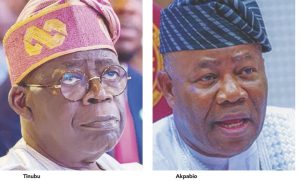
In what I consider a tongue-in-cheek remark, Tinubu extolled the virtues of his administration. He had earlier, in his October 1, 2025, broadcast, said Nigeria had finally turned the corner. “The worst is over,” he had noted.
Akpabio was particularly upbeat. He was quoted to have said that APC now has 32 governors. He added that, in Nigeria, as a result of Tinubu’s good governance, there are only two parties: APC and others. Like bee is attracted to honey, Tinubu and APC’s leadership style of governance is said to be strengthening the ruling party, attracting people to the APC and reducing the influence of the opposition. His reforms, Akpabio affirmed, were driving progress across such key sectors as economy, infrastructure, security and agriculture.
“We are proud of these reforms. You are bringing dignity to Nigeria. Nigeria is returning to the world stage. For members of our great party from all states in the country, we are now 32 governors, and the number is growing. By election day, we may have more. I congratulate you all,” Akpabio enthused.
I have never seen such dishonesty before! The truth is that whoever sets exam for himself will always get 100 per cent. Tinubu, Akpabio and the APC chieftains have set exams for themselves and have awarded pass marks to their very poor performance.
The verdict of the Nigerian masses and some international organizations is that this government has failed. The 2026 World Happiness Report nailed it. From 102 and 105 it ranked in 2024 and 2025 World Happiness Report, respectively, the country slipped back to 106 in 2026. It is also among the worst-governed countries both in Africa and the world. It ranks 112 in the 2026 global good governance index and did not come near the 10 best-governed countries in Africa.
The failure of this administration is more glaring in the security sector. The number one duty of any government is to secure the lives of its citizens. Has this government done this effectively?
The answer is a capital No! Almost everywhere you go in Nigeria, you see deaths, abductions for ransom and displaced people. Hundreds of thousands of Nigerians have been killed. Millions of others have been displaced. According to the National Human Rights Commission, about 2,266 Nigerians were killed in the first half of 2025, higher than 2,194 killings recorded in the whole of 2024. It is not for nothing that the country was adjudged the fourth most-terrorised country in the world in the 2026 Global Terrorism Index. This is worse than in 2024 and 2025 when the country emerged eighth and sixth most-terrorised country, respectively. Without providing security, which is the number one thing a government does for the people, how can anybody claim that Nigeria is doing well in governance?
Welfare of the citizens is another barometer to measure good governance. Can the powers that be beat their chest and proudly say that the citizens are better off today than they were before this administration came on board?
Other News
Again, the answer is a capital No! We may have made some macroeconomic gains in the past few years. The country’s foreign reserves increased to over $50 billion in 2025, said to be the highest in 13 years. States have more money to share as monthly allocations from Federal Account Allocation Committee (FAAC) have increased to over N2 trillion. But how have all these translated into better life for the ordinary citizens?
Statistics do not lie. Nigeria has a poverty rate of over 60 per cent. More than 141 million Nigerians live in abject poverty. Millions of Nigerians are jobless. Over 15 multinationals exited the country between 2020 and 2025 with the attendant job losses. The Nigerian Economic Summit Group (NESG) said about 7.2 million micro and small medium enterprises (MSMEs) closed down between 2023 and 2024.
Hunger is real and a present danger. Many cannot afford even one meal a day. Minimum wage is N70,000. But it cannot even buy a bag of 50kg of rice. The Nigeria Living Standards Survey has progressively recorded a decline in the living standard of Nigerians. In 2018/19, about 40.1 per cent or 82.9 million Nigerians lived in poverty. In 2022/23, the figure increased to 56 per cent or 113 million people. In 2025, about 139 million Nigerians reportedly lived below the poverty line.
Children are the worst hit. Over two million of them below five years suffer from acute malnutrition. According to UNICEF, 11 million Nigerian children under five experienced severe child food poverty in 2024. The country also has the highest burden of stunted children in Africa. Between January and September 2025, the country recorded over 20,811 maternal and child deaths.
Millions of people who live in the cities cannot afford to renew their house rents anymore. Last week, I mentioned the plight of some 40 per cent of lecturers from the University of Lagos who now sleep in their offices because they cannot afford to pay house rent. A two-bedroom apartment around Akoka area of Lagos was said to have been rented for N3.5 million per year. Will such people ever believe Akpabio and APC’s good governance index?
Many of those who can still afford a house do not have electricity to power their electronic gadgets. If you look closely, you will see heat rashes on the bodies of many citizens because many have to endure sleeping all night without fan or air conditioner. Power generation and distribution have never been this low. National grid has often collapsed and thrown the entire country into darkness.
Yet, President Tinubu promised us that he would fix Nigeria’s electricity problems on assumption of office; and that we should not return him for a second term in office if he failed to do as promised. We need to remind the President of this promise in case he has forgotten and to urge him to step down from any contest in 2027.
Unfortunately, African leaders do not have the culture of resigning when they don’t measure up to people’s expectations or fail to fulfill their campaign promises. Once they get into office, many of them are blinded by the goodies that come their way. That is why the President believes that Nigeria is back from the brink.
It may be so for politicians because the major thriving industry in Nigeria is politics. Once you are in the right party or connection, your future is made. Soon after he assumed office, the Presidency acquired a presidential jet that cost the country some $150 million. The Vice-President, Kashim Shettima, moved into a new palatial residence that cost taxpayers some billions of naira. Each member of the National Assembly got sport utility vehicle which cost billions of naira as well. Every month, these lawmakers go home with salaries and allowances running into some millions of naira.
In the states, it is the same thing. The governors are overlords who dispense political patronage to their cronies and praise singers. Many of them award dubious contracts with kickbacks coming to them in billions of naira. Security votes are also there for them to utilize as they deem fit. Many of them ran to the APC, not because the ruling party is doing well in good governance, but because they need to enjoy their loot in peace. It’s so that nobody will question their inanities when they leave office.
If not for FAAC handouts, many of these states would have ceased to exist. Many of them owe arrears of salaries to their workers and cannot even pay the minimum wage of N70,000 a month. Many of them struggle with domestic and foreign loans. Yet, many public health institutions are underfunded and lack basic facilities. In some states, especially in the North, there are no doctors in many hospitals. Most primary health care centres either do not function or they are below standard. Infrastructure in many states is decrepit. In a recent report, the World Bank noted that Nigeria needed about $3 trillion to bridge the infrastructure gap over the next 30 years. This may be a tall dream as providing the needed infrastructure is least on the table of most of the governors.
They have no ideology, no shame, and no principles. What matters to many of them is not the welfare of their citizens. It is their selfish interests. It is sad that Nigeria’s leadership cadre is peopled mainly by evil people. They are doing everything possible to return to power in 2027. But tomorrow is pregnant. No one can actually predict what it will bear. Let’s ask them to hand over to more competent people to handle the affairs of this country going forward.