Follow Us on Google
This is the concluding part of this four-part series on the journey that took me from Jerusalem and the Negev Desert of Israel to Makoda in Kano State. I will share one of the most memorable experiences of my time in Makoda, the remarkable response of the community to the project, and how a simple effort to combat desertification grew into a movement that transformed lives and inspired a new generation of environmental stewards.
Six weeks later, I returned to Makoda and as was usual sent my vehicle back to Kano. Alhaji was there to meet me and we spent most of the day together. Then just before dusk, two other men came to join us, and as discussions were petering out, Alhaji Makoda casually invited me to accompany him for an inspection. The inspection led to the new hut I had seen them building, and just as I was wondering within me why Alhaji never mentioned that he was the one building this hut, he blurted out: “Chief, you know my people have never been satisfied with you sleeping in the open while we sleep in our own houses. This modest hut is a gift to you from the community.”
I stared at him, shifted my gaze to the other two, opened my mouth to speak, but no words came forth. “You must be joking,” I managed to say after swallowing hard several times. “How could you do this, Alhaji and you never said a word to me?”
“I was afraid you would say no, and perhaps stop coming if I insisted,” Alhaji answered, this time beaming with smiles at my obvious consternation.
“Thank you all so much, this is just unbelievable,” I said, hugging each one of them.
We went in to inspect my new home. It had a fairly big courtyard, with a gazebo close to the main hut. This hut is a one-bedroom style apartment with a sizeable sitting room. The bathroom and toilet were two separate rooms adjoining the hut, just after the kitchen. To the far corner of the open courtyard, they had tilled the soil, waiting, as Alhaji explained, for the inevitable garden they were sure I would cultivate. The entire compound was walled round in a circular form.
My joy knew no bounds at seeing how these people had accepted me as a member of their community. The gesture of providing me with a home was not lost on me, for I have, as a young boy growing up in my own village, participated in a number of these community built homes.
I requested to see the District Head the next day to offer my gratitude, and that I did. But they were rather more effusive in their praise for my work and determination. I swore silently that I would not fail them. Yet, they still had the last laugh, because on the eve of the project commissioning, the District Head turbaned me as “Jibrin Makoda.” I could not find the time to internalize this, being full of anxiety at the impending commissioning, which as I said earlier went very well. I still have my home in Makoda, and I am still Jibrin Makoda, ever having fun with my friend and neighbour, Alhaji Makoda.
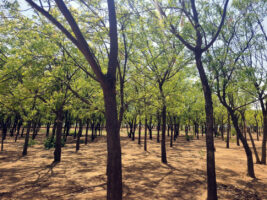
The success of the pilot programme in Makoda was fodder for my advocacy. The governments of Jigawa and Katsina States sent officials to understudy our work. Individuals came to seek advice on establishing Wall of Trees and protecting their farmlands. Alhaji Makoda opened a woodlot farm with time.
Other News
Above all, principals of secondary schools came to inquire how they could replicate similar programmes. With all these happening I decided that this was the time to get the young ones to commit to the protection of the environment. I had to get the students involved in my work in some way.
With my thinking cap on, the “Tree Planting Competition for Secondary Schools” was born; overseen by Cammie Okolo, the coordinator of the programme for the first two years, her relentless commitment to the project during this teething stage made it possible to pull off smoothly. The programme involved getting students in various schools to prepare available land, plant trees provided by FADE, nurture them to independent growth, then grade the schools on competitive basis, and award prizes on state television.
For nurturing, the schools were required to produce compost manure and water the plants for six months. FADE sunk deep boreholes for schools with no public water supply. In one instance, I remember one of the schools within the vicinity of one section of the Hadejia-Jama’are River Basin Development Authority’s irrigated farms. The Principal approached the farm for assistance with water delivery to the school, and was turned down. I decided to wade in.
I received audience from the Senior Special Assistant to the President on Millennium Development Goals, Mrs. Amina Mohammed, who is now a very close colleague of mine and a good friend. Amina, as I call her, escalated the matter to the management of the River Basin Authority. Within a few short weeks, a water line was extended to the school for their use in nurturing the plants and other needs. The school now has constant water supply that they can purify for potable water needs.
On their own, the state Ministry of Environment produced the seedlings, and jointly monitored the performance of the trees with FADE. From the onset, this ministry and its tireless director, Mr. Bashiru Abba, were practically an extension of FADE due to the services they provided. Bashiru was ever ready with his seedlings, and always the one to schedule site inspections, even on weekends. He is a true colleague in the fight against desertification.
The competing schools were judged, among others, in the categories of number of surviving trees, health of the trees, and participating students’ ratio. The prize awarding ceremony was hosted by the Emir of Kano in his palace, every other year, with prizes given to the first two schools from each LGA. So, that was how we set in motion the process of greening school compounds and adjoining villages, a process that continues to this day.
I will always remain grateful for all my sponsors who provided the project funds and the prizes. It is important to note that these prizes were always in the form of school supplies, books, computers, and more seedlings. I have always believed that we should empower our students with the right learning aids for them to excel.
Looking back over the years, I cannot help but reflect on how a personal journey gradually evolved into a lifelong campaign against desertification. In one way or another, my advocacy has coincided with growing global awareness of the threat posed by land degradation, climate change, and the relentless advance of the world’s deserts. The United Nations has declared international days of reflection and action, governments have launched programmes, and communities across the Sahara have undertaken various interventions to halt the spread of the desert.
Yet the harsh reality remains that the Sahara continues its slow but persistent march southward. Despite decades of conferences, declarations, policies, and projects, millions of people still face the loss of farmlands, livelihoods, and hope. The challenge before us is therefore not merely to recognize the problem, but to match our words with sustained action. My experience, from the Negev Desert of Israel to the communities of Makoda in Kano State, has taught me that meaningful change
begins when ordinary people become active participants in the solution. A single borehole can transform a village. A wall of trees can reclaim threatened land. A school can become a centre for environmental stewardship. And a determined community can achieve what many consider impossible.
The lesson I have learned is simple: deserts do not advance overnight, and neither can they be defeated overnight. But with commitment, partnership, innovation, and the involvement of future generations, we can slow their advance, restore degraded lands, and give vulnerable communities a chance to thrive once again.
As the world reflects on this year’s theme, “Rangelands: Recognize, Respect, Restore,” my hope is that we move beyond awareness and embrace action. The future of the Sahara, and indeed the future of our planet, will depend not on what we know, but on what we choose to do with that knowledge.