Follow Us on Google
By Omoniyi Salaudeen

All eyes are now on the ministerial nominees who have been undergoing screening in the Senate for confirmation in line with constitutional requirements. As a follow-up to the 28 nominees earlier submitted to the upper chamber, the Chief of Staff to the President, Hon. Femi Gbajabiamila, Wednesday, submitted an additional 19 for necessary scrutiny by the lawmakers. This brings the total number of nominees to 47. If all of them eventually scale through the hurdles of the National Assembly, this figure will represent the largest cabinet to be inaugurated by any president in the recent past. By constitutional provision, all the 36 states of the federation plus the Federal Capital Territory (FCT) must be represented in the cabinet composition. Precisely, Section 147 (3) of the 1999 Constitution makes it mandatory for the president to appoint at least one minister from each state that constitutes the federation. This added to six other nominees representing the six geo-political zone of the country brings the figure to a maximum of 43 ministers. Already, the insinuation is rife that some new ministries may come onstream in line with the policy direction of the Tinubu administration.
Regardless, the submission of the final list has finally put paid to the prolonged anxiety that has been generated by the perceived delay in the unveiling of the names of the nominees. While the waiting game lasted, a lot of speculations filled the airwaves, as social and conventional media continued to parade different names of would-be cabinet members.
According to the Act of the National Assembly, the president has up to 60 days to submit the names of his ministerial nominees. Tinubu had waited till almost the eleventh hour before he forwarded the list to the Senate for confirmation.
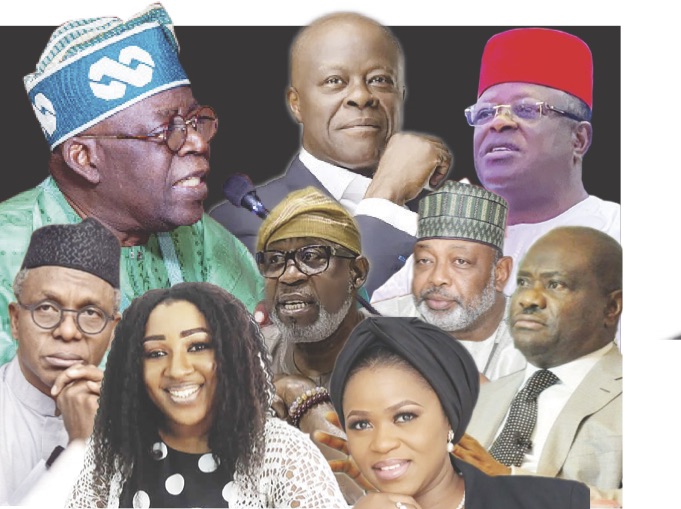
The names of 28 nominees who have already been screened include Abubakar Momoh, Amb. Yusuf Maitama, Architect Ahmad Dangiwa, Hanatu Musawa, Chief Uche Nnaji, Beta Edu, Doris Aniche, David Umahi, Nyesom Wike, Mohammed Badaru, Nasir el-Rufai, Ekperikpe Ekpo, Nkiru Onyejiocha, Olubumi Ojo, Stella Okotekpe, Uju Kennedy, Bello Mohammed Goroyo, Dele Alake, Lateef Fagbemi, and Mohammed Idris. Others are Olawale Edun, Adebayo Adelabu, Imma Suleiman, Prof Ali Pate, Prof Joseph Utsev, Abubaka Kyari, John Eno and Sani Abubakar Danladi.
The list of 19 additional nominees submitted on Wednesday, which completed the slots allocated to each state has other names, Ahmed Tijjani, Bosun Tijjani, Dr Maryam Shetti, Ishak Salako, Tunji Alausa, Tanko Sununu, Adegboyega Oyetola, Atiku Bagudu, Bello Matawalle, Ibrahim Geidam, Simon Bako Lalong, Lola Adejo, Shuaibu Abubakar, Tahir Mamman, Aliyu Sabi, Alkali Ahmed, Heineken Lokpobiri, Uba Maigari, and Zephaniah Jissalo.
Since the first 28 ministerial nominees have been screened by the lawmakers, the process of screening and confirmation of the latest list is expected to continue or probably be rounded off this week. After that, the inauguration of the Federal Execute Council by the president would follow.
As expected, divergent opinions have been expressed on the list of ministerial nominees undergoing screening in the Senate.
Some pundits said that the list of the nominees betrayed the expectations of Nigerians, while others saw it as a perfect blend of all variables. In particular, most critics view the inclusion of some eight former governors in the list as a recycling of old brigades, saying that they are very unlikely to bring anything new to the table or contribute ideas that could lead the country out of its current socio-economic, security, energy crisis, and other developmental challenges. Sentiments have also been running over the perceived negative images some of them are carrying, especially Wike and el-Rufai, whose recent inflammatory and divisive religious comments have elicited public opprobrium.
For Wike, they see his appointment as compensation for the role he played in the victory of Tinubu in Rivers State. There is a strong argument in favour of technocrats who have the requisite competence and capacity for innovative ideas that could lead Nigeria out of its present predicament.
However, a renowned labour activists and former Secretary General of the NUPENG, Chief Frank Kokori, described those expressing negative comments on Tinubu’s choice of ministerial nominees as armchair critics. Baring his mind in a telephone interview with Sunday Sun, he said: “Don’t mind them, they are armchair critics. Are they saying that the man should forget Wike who helped him to win Rivers State which APC has never won before? Are you saying that he will not think about his election? Are they saying he should not put the people who helped him to win the election there?”
According to him, the list of ministerial nominees is a perfect blend of the old, the young, the technocrats, and the politicians.
“He put a lot of young technocrats there. Yet, that is not enough for them. The list is a mixture of different groups in Nigeria. There are young people, technocrats, and politicians like Wike and Umahi who are trying to plead with the Easterners. Are they saying that he should not put el-Rufai who led the governors to insist on a power shift to the South there? It’s a real blend of different interests. So, I don’t support all these critics. Are they politicians? Did they bring votes for him? Don’t they know how crucial that election was? Tinubu is a politician and you can’t be a president without being a politician. He has put technocrats, those he put there are enough. The list is a perfect blend of all variables. We suffered for democracy together in this country. So, Tinubu cannot betray Nigerians because we know what we went through fighting for democracy. I have had discussions with him and he promised Nigerians to make Nigeria great. And I have been monitoring everything, he is not doing badly”, he argued.
He, therefore, expressed optimism that those he selected as ministers would guarantee a good record of performance of the administration, urging the National Assembly to put their eye on the ball.
“I expect good performance from the ministerial nominees. If they don’t perform, we shall all see it. Most of them say they will perform. It is not a secret cult, we shall all see. Some of them are young, but we have not seen anything from them before. Young people have a strong appetite for luxury and wealth. The old ones may be tired, but they have less tendency to steal. If they stole money, what are they going to do with it? Let the National Assembly watch them, let progressive media watch them. What pains me in this country is that some people steal too much money. Tinubu should not spare those people,” he said.
A former Minister of Works, Senator Adeseye Ogunlewe, also speaking in the same vein, noted that critics were making unnecessary issues out of the ministerial nominees, declaring that being a technocrat could be ascribed exclusively to any particular individual or vocation.
His words: “There are many technocrats who are also politicians. They are even in the majority. So, this concept of the technocrat is alien to me. It is as if none of the politicians went to university. We all went to the same university. How can they now say we are not technocrats? The president we have is an exceptionally clever person. There is nothing he would do that he would not have a policy framework. He will set up a committee that will formulate policies for him. It is for the ministers to implement them. He will never allow any minister to formulate any policy for his government. The minister will only implement the policies that are already prepared by him. That will be the difference.
“So, there is no fear as to whether they will perform or not. He will make sure that those appointed will key into the policies of the party. He will not allow any minister to derail his administration as was done in the last dispensation.”
Arguing from the point of view of those looking forward to a lean government as a way of reducing the cost of governance contrary to the usual over-bloated structure that allows for several appointees, he added: “It is a constitutional matter; he must choose one minister per state, one from the Federal Capital Territory and one per geo-political zone. That is the limit he can go. And he cannot reduce it.”
Ogunlewe, however, admitted that the appointment of Wike as a minister was a sort of compensation for the role he played in the last election.
For the record, Wike, a member of the opposition Peoples Democratic Party (PDP), played an active role in the victory of Tinubu of the All Progressives Congress (APC) in the last general elections. He had to collapse the structure of the PDP to give Tinubu the margin of victory he recorded in Rivers State. And for doing so, Ogunlewe explained the expediency of the decision to make Wike a member of Tinubu’s cabinet. “It is so easy to decipher. If you are following the developments that culminated in the last election, you would know the role Wike played, and you must give him compensation for that role.
“And, of course, Wike was not the only politician who worked really hard for the success of Tinubu. Nasir el-Rufai and Dave Umahi as well as other former governors played important roles in his emergence.”
For the honour of being included in the new cabinet, Ogunlewe urged the former governors to bring their wealth of experience to the national level.
He also advised other nominees to ensure undivided loyalty to the party, as any act of sabotage wouldn’t be condoned by the president. “Tinubu will not allow you as cabinet members to mess him up. As such, the nominees should gear up for work,” he declared.
There is a great deal of expectation from President Tinubu who has been described by many as a talent hunter.