Follow Us on Google
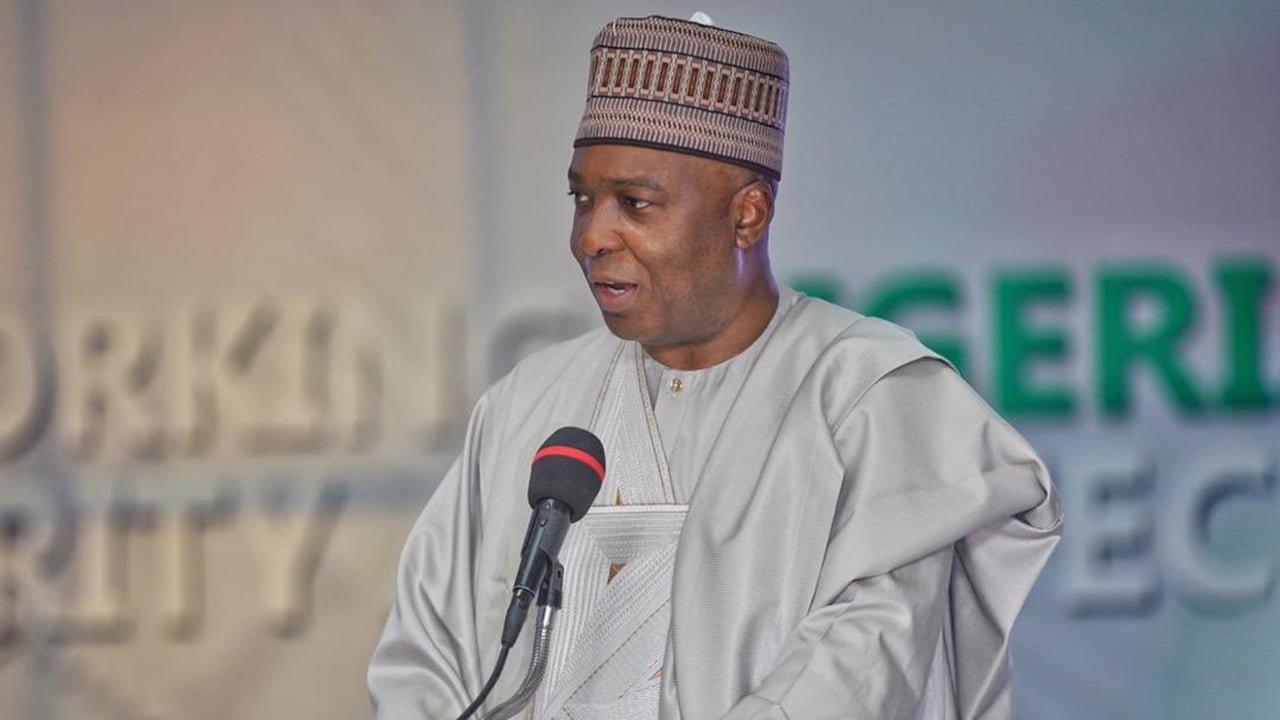
Former Senate President, Bukola Saraki, has complained that the African continent still battles economic colonial design, which is one of the reasons it is backward.
Saraki, who spoke at the Democratic Union for Africa Forum in Nairobi, Kenya, said Africa’s 54 countries operate under varying political models, adding that roughly 20 are presidential democracies, 13 are parliamentary, seven are semi-presidential, six are under military leadership and the remaining are monarchy or hybrid systems such, as in Morocco, and Eswatini.
The former Governor of Kwara State added that leaders of the continent did not only inherit infrastructure but also institutional mindset of extraction rather than empowerment and of outflows rather than reinvestment.
According to him, this legacy remains visible in many governance, economic and institutional practices today.
He said: “Over the decades, many of Africa’s post-independence structures, instead of evolving into instruments of stability and accountability, have matured into sources of institutional weakness.
“The colonial architecture of governance, designed for control rather than development, left behind fragile systems that too often failed to adapt to democratic and developmental imperatives.
“In many states, the judiciary remains under-resourced and vulnerable to political influence, while parliaments are either weak or overshadowed by dominant executives.
“Political parties, rather than being ideological institutions that outlive individuals, often revolve around personalities and patronage networks. Legislative oversight is minimal; executive dominance is the norm.”
To get Africa back on the right track, he suggested that the continent must firmly say no to the automatic export of raw commodities, saying that, “we must invest in processing, manufacturing and finished-goods production.
“From lithium ore to battery production in DR Congo; cocoa beans to chocolate and confectionery in Ghana and Côte d’Ivoire; bauxite to aluminium products in Guinea; cotton to textiles in Benin Republic; Soya bean to animal feed and processed food in Nigeria and timber to furniture and finished wood products in Gabon.
“When African countries export raw materials, whether lithium ore, bauxite, cocoa, beans or timber, we forfeit vast economic and social opportunities ranging from lost jobs to lost income, lost value-chain capture and lost technology development.
“Countries exporting raw cocoa receive the commodity price; but when processed into chocolate or finished foods, the value multiplies several times. By exporting only raw cocoa, a country leaves processing jobs, technology, branding and higher margin profits to others.
Other News
“For example, while Africa accounts for over 70 percent of global cocoa production, it captures less than five percent of the $130 billion global chocolate market.
“Also, Nigeria, which supplies about 40 percent of the world’s raw shea-nuts, holds only about one percent of the global shea-products market (US$6.5 billion). Similarly, Africa exports crude oil and imports refined petroleum at a cost exceeding $20 billion annually, according to the African Refiners and Distributors Association.
“Despite having over 25 percent contributions to world reserve in bauxite, and 23 percent of world’s production of bauxite, only 2.25 percent is being refined in Africa, indicating a loss of value.
“For instance, we export bauxite at $65/ton and import aluminium for $2300/ton; showing we dig for others to profit because we are trapped at the bottom of the value chain while others build on it.
“The Democratic Republic of Congo produces a large share of cobalt, copper and other rare-earth minerals but only refines seven percent locally. The World Bank estimates that Africa loses over $100 billion each year in potential earnings due to lack of local value addition across key commodities.
“This is money that could have built factories, financed education or powered small and medium enterprises. This illustrates how raw-export status limits value capture and employment creation. Other than the obvious economic loss, there are several other socio-economic disadvantages.
“Manufacturing and value chains create far more employment than raw commodity extraction. For every million dollars of mining export revenue, you may get a few dozen jobs; but for a million dollars of finished-goods exports, you could generate hundreds of jobs in processing, logistics, marketing and services.
“Also, the difference between raw exports and value-added lies in domestic retention of profits, taxes, technology transfer and multiplier effects in the economy, including supplier networks, skills development and secondary industries.
“In essence, value-adding within Africa means local communities benefit, ownership increases, supply chains are internalised, economies diversify and dependency declines.
“The impact is that jobs increase locally, export revenues rise through higher margins, technology and brand development become African-led industries. It means Africa shapes its future instead of being shaped by external demand.”
Also, he suggested that Africa should build strength from within by banks, development finance institutions, pension funds and local capital markets, stating that no nation or continent has ever achieved sustainable development on borrowing.