Follow Us on Google
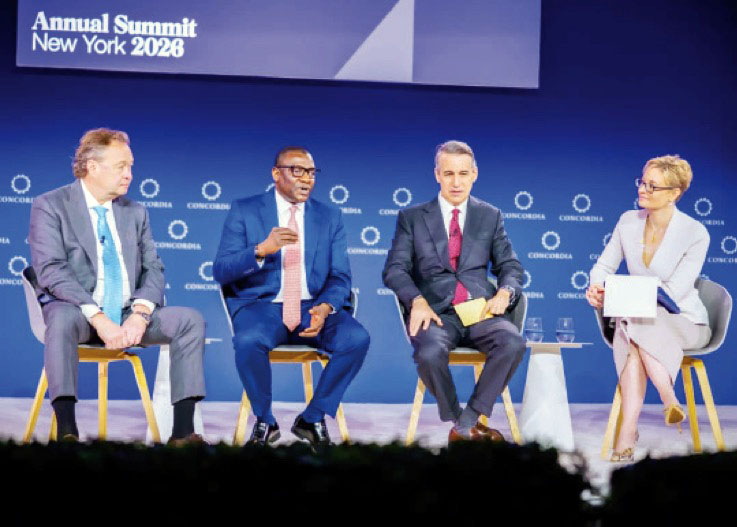
Bala Wunti, Chief Executive Officer of World Energy Council Nigeria, has said the United States’ decision to introduce a price floor of $110 per kilogram for critical minerals could reduce investment risks and help move African projects from geological potential to commercial viability.
Wunti spoke at the 2026 Concordia Annual Summit in New York during a panel titled, “Rare Currency: Critical Minerals in a Shifting Global Economy.”
The panel also featured Alix Steel, principal at DrivePath Advisors and former Bloomberg Television anchor; Steven Fox, founder and executive chairman of Veracity Worldwide; and Scott Monteith, president and chief executive officer of Avalon Advanced Materials.
According to Wunti, America’s emerging role as a price setter, rather than merely a lender, could transform the development of critical minerals in Nigeria and other African countries.
“The urgency and speed of action are crucial,” Wunti said. “Closing the supply gap has become a compelling national priority for the United States, but allies remain indispensable. Domestic production takes decades, and a considerable distance still exists between policy ambition and commercial reality.”
Wunti said Nigeria’s inability to fully develop its estimated 44 critical minerals was largely due to the gap between mineral potential and commercially investable projects.
“Having minerals in the ground is only the beginning,” he said. “We had geological indications, not proven reserves supported by JORC compliant data. We also had good policies, but not clearly defined projects. US investors invest in projects, not potential.”
He identified reliable geological data, clearly defined projects, enabling infrastructure, predictable regulation, credible developers and viable routes to market as the six essential conditions for mobilising private capital.
“For half a century, Nigeria exported crude oil and imported refined petroleum products. That created poverty rather than prosperity. We learned the hard way,” he said.
Wunti said the Nigerian Solid Minerals Company would serve as the country’s flagship investment platform, providing credible commercial projects and counterparties for domestic and international investors.
“The company is moving Nigeria from simply saying, ‘We have minerals,’ to presenting investable projects with clear commercial propositions,” he said.
Other News
“Rare earth elements are not necessarily rare in the ground, but they are rare in the market. Bringing them to market requires capital and technology. The Nigerian Solid Minerals Company is moving the country from potential to bankability by presenting US investors with actual transactions rather than presentations.”
On private sector participation, Wunti said governments must address risks that investors cannot manage independently, including inadequate geological data, regulatory uncertainty, infrastructure deficits and inefficient permitting processes.
“Ultimately, private capital must do the heavy lifting, but governments must make projects investable,” he said.
According to him, reducing project risks alone would not attract the required investment because investors also need competitive economics and confidence that credible buyers exist for the minerals produced.
“Government can make a project bankable, but it cannot permanently make an uneconomic project profitable,” Wunti said.
“Price, not pitch, is the lesson. Investors need four essential things: JORC compliant data rather than mere mineral occurrences, a commercial price, a stable and competitive fiscal system, and a credible buyer.”
Wunti said recent US measures, including Executive Order 14241, development finance initiatives, export controls and bilateral mineral agreements, were beginning to reshape the global critical minerals market.
He described the $110 per kilogram price floor as an important intervention capable of providing the commercial certainty required to attract private capital.
“That price floor closes the gap between policy and commerce,” he said. “It gives investors a commercial price rather than just a policy pitch.”
“Rare earth elements are scarce in the market because the world allowed one country to dominate processing capacity. Give me a credible price, and I will give you private capital.”