Follow Us on Google
Nigeria is an interesting country. It is a place where many things are primed to fail. You may be good or saintly, but certain situations could make you become a prisoner of the country’s institutional and systemic rot.
This is the case with Nigeria’s Independent National Electoral Commission (INEC). There are banana peels lined up on the route to the leadership of that commission. Almost all the umpires have slipped on those peels. But rather than clear the pathway, many Nigerians have continued to scratch the surface of the problem.
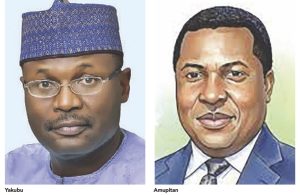
On Tuesday, October 7, 2025, Professor Mahmood Yakubu bowed out as the chairman of INEC. Two days after, Professor Joash Amupitan was announced as Yakubu’s replacement. Many Nigerians have made positive and negative comments about this development.
Some people see Yakubu mainly from the prism of the 2023 presidential election. When the immediate past INEC boss announced the result of that election in the wee hours of March 1, 2023, many people were disillusioned.
“Technical glitches” reportedly crippled the collation of results. The Bimodal Voter Accreditation System (BVAS) and the INEC Result Viewing Portal (IReV) were said to have disappointed. At the end of the day, INEC announced President Bola Tinubu as the winner of the election.
Ironically, the results of the National Assembly election held the same day came out without much fuss. From the results, different parties won in their areas of strength. In the Senate, the All Progressives Congress (APC) won 59 seats; the Peoples Democratic Party (PDP) won 36 seats; Labour Party (LP) won eight, while the New Nigeria People’s Party (NNPP) won two. Social Democratic Party (SDP) also won two. The All Progressives Grand Alliance (APGA) and the Young Progressives Party (YPP) won one each.
Most people, including me, descended on Yakubu over the presidential poll result. We called him names. He took the blame because he was the head. But in blaming Yakubu, we lost sight of the fact that while we pointed one finger at him, the other four fingers pointed elsewhere. Remember that this was an election in which a candidate had boasted about snatching or grabbing power and running away with it.
The people in the corridors of power understand this power game very well. Even after casting his vote, former President Muhammadu Buhari waved his ballot paper for all to see that he voted for the APC. That singular act conveyed a coded message to security agencies and all the bodies involved in the conduct of the election.
Besides, some desperate politicians engaged in vote-buying, violence and manipulation of the process. The situation was particularly bad in some states like Lagos and Rivers. Armed thugs went all out to intimidate and torture those perceived to be supporting opposition parties. Some citizens were even killed.
Our elections have always been like this. For instance, the 2007 presidential election was highly manipulated. Professor Maurice Iwu, who supervised the election, was demonized. The poll was such that its greatest beneficiary, the late President Umaru Yar’Adua, admitted the flaws and pledged to reform the electoral system. Death stopped him from fully fulfilling his promise.
Tragically, almost all the past chairmen of our electoral commission saw hell in the discharge of their duties. From Eyo Esua (1964-1966) to Chief Michael Ani (1976-1979); from Justice Ovie-Whiskey (1980-1983) to Professor Eme Awa (1987-1989); and from Professor Humphrey Nwosu (1989-1993) to Professor Okon Uya (1993); the experience was the same.
For Sumner Dagogo-Jack (1994-1998), Ephraim Akpata (1998-2000), Dr. Abel Goubadia (2000-2005), Professor Maurice Iwu (2005-2010), and Professor Attahiru Jega (2010-2015), the story is the same. None of them came out unscathed.
Other News
Professor Nwosu tried to be diligent. He introduced the open ballot system (Option A4). He also conducted the June 12, 1993 presidential election, seen to be the freest and fairest poll in Nigeria’s history. The military junta of Ibrahim Babangida annulled that election. The winner, Moshood Abiola, was arrested and jailed. He died in detention. Nwosu was betrayed, sidelined and silenced. He died unsung.
Relatively, Jega also performed well in office. He appeared to have succeeded because of the kind of President we had at his time. Goodluck Jonathan is meek and gentle. He said his ambition was not worth the blood of any Nigerian. He threw in the towel and congratulated his opponent, Buhari, even before the final result was announced in 2015. No incumbent President has ever done that in Nigeria.
Despite his perceived shortcomings, Yakubu achieved a lot in office as well. He happens to be the longest-serving INEC Chairman in history, having spent 10 years in office. He supervised two general elections (2019 and 2023), 19 governorship polls and many by-elections. He also expanded polling units from 119,974 to 176,846 to reduce long queues at polling units.
Under this professor of Political History and International Studies, INEC became a technology-driven institution. He replaced manual processes with BVAS, which uses fingerprint and facial recognition to accredit voters and curb multiple voting. He also introduced IReV, which enables Nigerians to view polling unit results real time. This is to strengthen confidence and transparency in our elections. He made INEC the first in Africa to establish an Artificial Intelligence Division to enhance the future of election management.
Yakubu’s INEC also institutionalized Continuous Voter Registration (CVR) to give citizens opportunities to register without any excuse. He introduced online pre-registration portals to empower Nigerians to transfer or replace their voter cards seamlessly. Yakubu also partnered with the National Assembly to enact the Electoral Act 2022 which made room for electronic transmission of election results. He ensured no Nigerian is denied the choice to exercise their franchise by introducing assistive voting devices like Braille ballots and magnifying lenses. He also implemented the legal frameworks to enable Internally Displaced Persons (IDPs) to vote.
He was said to have encouraged inclusivity in INEC by employing persons with disabilities and reserved slots for women in senior management positions. Members of staff of INEC reportedly enjoyed welfare packages such as hazard allowances, bonuses, medical aid and funeral grants. Liberia’s National Electoral Commission honoured him in 2023 for his outstanding contributions to electoral development. There are many other achievements.
INEC’s new helmsman, Amupitan, who hails from Ayetoro Gbede in Ijumu Local Government Area of Kogi State, needs to consolidate on Yakubu’s innovations. He should beware of the banana peels lined along his route. A lot of people have hailed his appointment. He is a reputable law professor and Senior Advocate of Nigeria. He was the Deputy Vice-Chancellor (Administration), University of Jos. He was also the Pro-Chancellor and Chairman of Council of Joseph Ayo Babalola University in Osun State. The verdict of history awaits him in no distant time.
The immediate test of his ability will come on November 8, when the people of Anambra State will go to the poll to elect their governor. Also, Ekiti and Osun State governorship elections will come up in June and August 2026. It is expected that he will not show any atom of partisanship in the conduct of these elections.
Already, the fireworks have started coming. Soon after his appointment, speculations became rife that he was among the legal team that defended President Tinubu after the 2023 election. This has been debunked. I pray he navigates the thorny path of Nigeria’s do-or-die elections and give Nigerians what they truly desire.
My prayer also is that there should be a total overhaul of Nigeria’s electoral system. The idea of a president appointing a referee in a game in which he is a player is awkward. President Tinubu appointed Amupitan. How certain are we that this appointee will not be loyal to him? The President may have consulted with the Council of State before the appointment. But he is not beholden to the body. He can afford to ignore its advice.
We must push for an independent body outside the executive that will be saddled with the task of appointing an INEC Chairman and Resident Electoral Commissioners (RECs). This body should be made up of Nigerians with unquestionable integrity. The President may not support this idea because it will not favour him. He has turned a deaf ear to the outcry over the alleged appointment of some card-carrying members of the APC as RECs in October 2023. One of the appointees is related to the Federal Capital Territory Minister, Nyesom Wike. He supervised the controversial Edo governorship election of September 2024.
In all, the major problem with our elections is not strictly the personalities at the helm at INEC. It is the institutionalized bottlenecks that cripple every poll in the country. Those who collect money to vote against their conscience are part of the problem. The politician who engages in vote-buying and arming of thugs to cause violence during elections is part of the problem. The security agents who look away while thugs wreak havoc at polling stations are the problem. The President who anoints a successor and surreptitiously gives orders to security agencies and the umpire to support him is the problem.
Nigerians must collectively rise up to challenge the system and demand reforms. The legal framework for our elections must be amended to include making electronic voting compulsory. The President must be stripped of the power to appoint the electoral umpire. The National Assembly owes Nigerians the duty to do this. Unless we amend our ways, we should not expect any magic from Amupitan. I will remind you of this statement after the 2027 election.