Follow Us on Google
By Damiete Braide
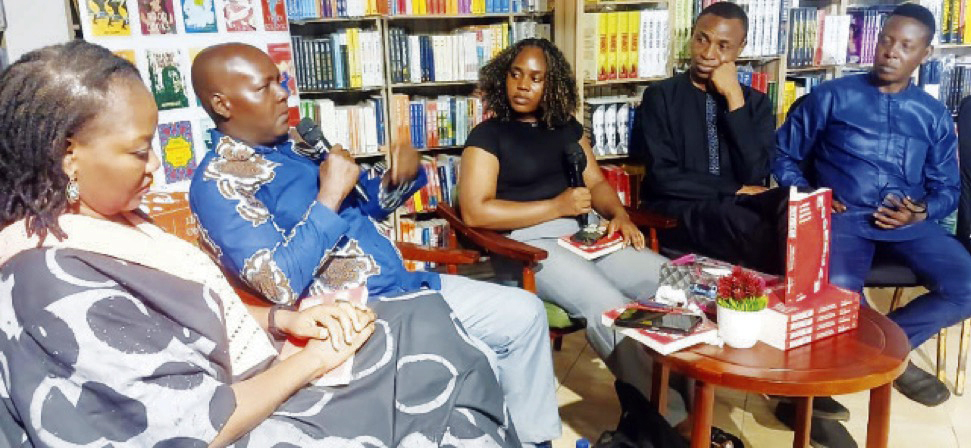
The atmosphere at Rovingheights Bookstore in Lagos on April 11, 2026, was layered with both celebration and grief as Nigeria’s arts and culture journalists gathered for the reading and signing of Moonbeam: An Anthology of Short Stories by Nigeria’s Arts and Culture Journalists. What was intended as a literary event gradually unfolded into an emotional tribute to one of their own, Evelyn Osagie of The Nation Newspapers, whose death on August 17, 2025, continues to resonate deeply within the cultural community.
Osagie, a journalist, photographer, textile artist, performance poet, and contributor to the anthology, did not live to see the publication of Moonbeam, a project widely acknowledged as an extension of her creative vision. Her absence was palpable throughout the event, as colleagues and collaborators reflected on her life, work, and enduring influence.
Of the 15 contributors to the anthology, six were present at the Lagos gathering, joined by other stakeholders in the literary and cultural space. Organised by Narrative Landscape Press, the event doubled as both a book presentation and a memorial, creating a space where storytelling and remembrance intersected.
For Anote Ajeluorou, editor of the anthology, the occasion marked a deeply personal moment. Overcome with emotion, he openly mourned Osagie, underscoring the sense of loss felt across the community.
He explained that Moonbeam was conceived as a unifying creative platform for arts journalists whose works are often dispersed across newspapers, magazines, blogs, and social media. Despite years, sometimes decades, of chronicling Nigeria’s cultural landscape, many of these writers rarely have the opportunity to present their creative voices in a single, cohesive format.
Ajeluorou traced the origins of the anthology’s title to his childhood experiences with moonlight storytelling sessions. Drawing inspiration from folktales shared by his mother, Obafaaruho, elders, and peers, he envisioned Moonbeam as a modern literary equivalent of those communal storytelling gatherings.
In this sense, the anthology becomes a symbolic village square, where multiple voices converge to tell stories, while readers assume the role of a listening audience under the glow of metaphorical moonlight.
The journey to publication, however, was far from straightforward. Ajeluorou revealed that an earlier attempt to publish the manuscript in 2017 had stalled after a prospective publisher quoted nearly one million naira in production costs, forcing him to shelve the project. It was not until 2023, after encountering a submission call from Narrative Landscape Press and receiving encouragement from fellow contributor Terh Agbedeh, that the project regained momentum.
Even then, the process required patience, with a two-year production timeline culminating in the eventual release of the anthology.
Contributors at the event offered insights into the inspirations behind their stories, as well as reflections on the broader challenges of writing and publishing in Nigeria. Okechukwu Uwaezuoke spoke about his story, All for Nothing, which draws from his early career in advertising between 1992 and 1994. He described an industry defined by urgency and creative intensity, where teams often worked under immense pressure only for their ideas to be dismissed, sometimes abruptly and without explanation.
Other News
These experiences, he said, informed his exploration of effort and futility, while also prompting him to consider the often-overlooked pressures faced by clients and decision-makers.
Nehru Odeh, another contributor, explained that his piece, Not All Roads Lead Home, originated from a longer novel he has been developing for years. He described the story as an excerpt that stands independently while remaining connected to a broader narrative.
Odeh noted that his participation in a 2008 creative writing workshop facilitated by Chimamanda Ngozi Adichie significantly shaped his approach to fiction. His Moonbeam contribution engages with Nigeria’s socio-political realities, addressing themes of governance, religion, and freedom of expression through the story of a prophetic figure caught in political controversy.
Molara Wood highlighted the importance of collaborative projects like Moonbeam in consolidating the fragmented body of work typical of arts journalists.
Her story, The House Next Door, employs subtle narrative techniques to examine issues of crime, morality, and perception within urban Nigeria. By focusing on affluent communities, she challenges assumptions that criminality is confined to lower socio-economic groups, suggesting instead that wealth and respectability can mask deeper, more complex realities.
Wood also reflected on the evolving nature of storytelling in response to changing national conditions. Issues such as migration, insecurity, and restricted mobility, she noted, have reshaped narrative priorities, pushing writers to engage more directly with contemporary experiences.
On the relationship between journalism and fictionAjeluorou’s own contribution, Communal Wife, explores gender roles within a patriarchal African context. The story centres on a woman who assumes both traditionally female and male roles pwithin her family, particularly in situations where expectations around lineage and inheritance create pressure for a male heir. He described the narrative as part of a broader exploration of female identities and societal expectations, questioning why patriarchal systems often fail to recognise the multiplicity of women’s roles. The most poignant of the event were reserved for tributes to Evelyn Osagie. Her sister, Amy Osagie, who attended the gathering, described her as a passionate writer who consistently shared her work with family members and aspired to publish both a novel and an autobiography. She expressed both surprise and fulfilment upon learning, after her sister’s passing, of her contribution to Moonbeam, describing it as the realisation of a deeply held personal dream.
Terh Agbedeh and Uwaezuoke also shared memories of Osagie, recalling her vibrant presence at literary and cultural events across Lagos. They spoke of her infectious energy and unwavering belief in the transformative power of the arts, noting that her absence has left a significant void within the community.
As the event drew to a close, contributors reaffirmed the importance of storytelling as a tool for documenting and interrogating societal realities.
They emphasised the unique role of fiction in offering perspectives that extend beyond the factual limits of journalism, enabling deeper engagement with complex issues.
Though not scheduled to participate, Jahman Anikulapo was present to support his colleagues, further underscoring the sense of solidarity within Nigeria’s cultural community.