Follow Us on Google
• Suggests safety measures
From Fred Ezeh, Abuja
Today is another World Day Against Trafficking in Persons. Indeed, the United Nations has set aside every July 30, to raise global awareness,
encourage vigilance and solicit support for realistic and strong action against human trafficking and modern day slavery, which are on the rise across the globe as the perpetrators use different tricks.
It’s also a day to reawaken the consciousness of the global leaders to the need to strengthen the fight against human trafficking, and possibly deploying superior digital tools, as well as stronger offline measures against the human traffickers.
HUMAN TRAFFICKING AS GLOBAL CRIME
Human trafficking has become a global crime as it amounts to trading on people and exploiting them for profit. It is reported to be the second largest crime against humanity involving huge financial profits outside illicit drugs.
People of all gender, age and background can become victims of the crime without knowing, and the crime is recorded across countries of the world irrespective of their level of education, advancement, economic and political status.
Traffickers use different ways and means to lure their victims, hence the need for increased sensitization and advocacy on the antics of these criminals. While some of them appear with violence, fraudulent employment agencies, others present fake promises of education and job opportunities abroad to trick, coerce and deceive their victims.
Unfortunately, the organized network and cartel behind the lucrative crime seem “powerful and rich”, and can clear anyone on their way. They obviously take advantage of people who are vulnerable, desperate or simply seeking a better life.
The UN said that human trafficking involves recruitment, transport, transfer, harbouring or receipt of a person by such means as threat or use of force or other forms of coercion, abduction, fraud or deception for the purpose of exploitation.
In addition to that, the increased access to several social media platforms and other digital tools has become a veritable platform for human traffickers to recruit their victims especially younger people who have knowledge and unfettered access to the social media.
NIGERIA AS A TRANSIT ROUTE
Nigeria was designated as a country of origin, transit and destination for victims of human trafficking, and also confirmed as one of the countries in the world with the highest number of human trafficking victims.
While some of these victims are trafficked to Europe, the Gulf countries, Asia, Russia, others are sent to West and Southern African countries mainly for sexual and labour exploitation.
The fact remains that, while technology has come as a great relief and a major boost in people’s way of life, the same has left much to be desired, because human traffickers have also caught on, to this digital transformation.
The Internet, unarguably, provides easy access to a larger pool of potential victims because geographical limitations no longer exist thereby increasing the ease with which traffickers locate and recruit their victims; control and organize transportation for victims, communicate among perpetrators, and hide criminal proceeds.
NAPTIP IN THE FIGHT
The National Agency for Prohibition of Trafficking in Persons (NAPTIP) has spent the last two decades fighting human trafficking in Nigeria, and the agency recently said that it has succeeded in dismantling some cartels, rescuing trafficked victims, within and outside Nigeria, and also recorded tremendous success fighting sexual exploitation and other gender-based violence.
But as Nigeria joins the world to commemorate the 2023 Day Against Human Trafficking with the theme: “Reach every victim of trafficking, leave no one behind”, there are indications that global crises, conflicts, and the climate emergencies, are making more vulnerable thus further escalating trafficking risks.
Additionally, displacement and socio-economic inequalities are also impacting millions of people worldwide, leaving them vulnerable to exploitation by human traffickers.
NAPTIP’S FEARS
There are also fears that more cases of human trafficking, domestic violence, and related matters would be on the rise in Nigeria because of growing socio-economic inequalities and growing number of people being pushed into poverty pool as a result of some economic policies of government.
However, NAPTIP said that it is equal to the task and had since upped its game. Hence it has discouraged Nigerians from making themselves available for use by the human traffickers, reminding them that poverty or whatever identified factors they claimed fuel domestic violence and human trafficking are not enough reason to embark on an unclear and dangerous journey.
Director General of NAPTIP, Prof Fatima Waziri-Azi, told journalists recently that the agency had intensified its enlightenment campaigns at different levels, but with special interest on schools and young students who are fast becoming the targets of the human trafficking network.
She said that the open meetings with the students were designed to provide a relaxed atmosphere for the students to have free and meaningful interaction with NAPTIP officials.
INTERNET, SOCIAL MEDIA AND HUMAN TRAFFICKING
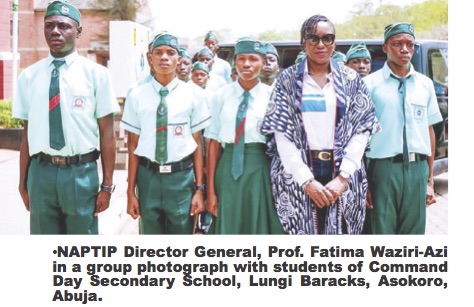
Few months ago, NAPTIP took its enlightenment campaign to Command Day Secondary School, Lungi Barrack, Asokoro, Abuja. This was to herald the commencement of nationwide “invasion” of military schools with campaign messages against human trafficking.
At the meeting, the NAPTIP boss and the school management provided conducive and relaxed environment for the students to freely speak on their experiences and fears, ask questions and get answers.
Some of the questions that came from the students, according to NAPTIP, were funny, educative and expository. Nevertheless, NAPTIP officials were extremely happy to patiently entertain the questions with clear and simple answers, and in some cases, true life stories, to buttressed the points.
Also, officials of NAPTIP from different departments, particularly public enlightenment, were conspicuously present with pictorial and video materials, as well as presentations to further expose the students to the dangers and new tricks of human traffickers.
The NAPTIP boss shared lots of scary stories of young people that have fallen victims of human trafficking due to ignorance or quest for “quick and unclean” wealth.
She said that human trafficking used to be a discussion for matured minds, and was never mentioned in the midst of teenagers because they were never the target of the cartels involved in the crime, but things have changed drastically with increased Internet penetration.
She told the students that human traffickers have invaded the digital space using different tricks and opportunities to, perhaps, woo their targets, most of whom tend to display some level of greed and desire for get rich quick before the act.
She encouraged the students to be vigilant, inquisitive in all offers, and also disregard several unverified job offers, scholarships, and several other “unrealistic” opportunities being marketed in different social media platforms, describing them as tricks by the human traffickers to lure their targets.
She highlighted the dangers of unlimited exposure to social media platforms which the human traffickers often leveraged on, to recruit their victims with unrealistic mouth-watering promises.
She urged the students to always be smart and engage their discerning spirit when interacting with known and unknown persons on different social media platforms, and also report suspicious actions to NAPTIP for proper investigation and action.
“I don’t mean to scare you or discourage you from social media engagements or interactions, or aspire for opportunities abroad, but remember that there’s no free lunch anywhere. If the lunch is free, then you are the product. You have to be careful whenever you are online. Be cautious and have limit to the level of information or interaction you engage on, in the social media.
“Many people, particularly young people of school age have fallen victims because of ignorance or greed. That shouldn’t happen to you because you have access of quality and timely information that those victims of human trafficking never had.
“Please note that victims of human trafficking are not always poor people as many people believe. People of good and strong financial background fall victim too due to ignorance too. You must also know that close family members can initiate or facilitate your being trafficked. So, be careful and report any suspicious actions to your parents and NAPTIP if possible.”
NAPTIP’s Director of Public Enlightenment, Mr Josiah Emereole, in a presentation, used simple terms to define and explain human trafficking, and also exposed the students to some unimaginable tricks being used by human traffickers to lure and recruit their victims, particularly online.
He urged the students to always be vigilant and at alert regarding activities of suspicious persons online, and never hesitate to report any suspicious actions or interactions online or offline.
“Online recruitment activities by human traffickers has been going on for quite a long time. Unfortunately, many young people are falling victim of their antics irrespective of our several campaigns. International Organizations for Migration (IOM) had also confirmed that human traffickers have gained mastery of digital tools and are using that to woo young Nigerians particularly those between ages 18 and 34, for forced prostitution, labour and other illegal activities abroad,” he said.
He narrated several stories with pictures of students of their ages that have fallen victim of human trafficking, thus encouraging the students to be careful and get acquainted with the sensitization activities of their school’s anti-human trafficking vanguard club for more information on the changing tricks of the human traffickers.
APPEAL
NAPTIP appreciated the supports that come the way of the agency from government, IOM, and several of other partners.
However, it solicited the support of parents, religious and community leaders, as well as the media in the fight against human trafficking and other gender-based violence.
The agency said that based on submissions from rescued victims, many people are falling victims of human trafficking because of pressure from their families, society and communities for wealth or other things not minding the sources.