Follow Us on Google
By Ngozi Nwoke
The heavy rain started as a drizzle at Oshodi that afternoon. By the time Mrs Iyabo Adeniran ran for cover, her clothes were soaked, her sandals were splashing, and her phone was drowning in her handbag.

Inside that Tecno Spark phone were over 2,000 customers’ contacts. Records of debtors who took her Ankara on credit. Voice notes from her Aba suppliers with new designs. Screenshots of bank transfers she hadn’t reconciled. No back up tools on the phone. Just a soaked SIM card and a blank phone screen.
Sharing her experience of almost losing her business device, she said: “It was a case of no phone, no business for me. My business would have suffered losses if this phone did not wake up.”

She explained that the incident happened during peak sales hours. Every order, customer contact, and payment confirmation for her Ankara business was on that device.
For nearly three hours, she couldn’t make or take calls, access WhatsApp, mobile banking, or her payment records, and clients were already cancelling. It only came back on after a technician at the Computer Village in Ikeja replaced the battery connector minutes before she would have lost a ₦350,000 bulk order.
This is how Lagos really does business. Sixty per cent of Lagosians runs their activities from a single device. The phone is the office, the bank, the ledger, and the warehouse. When it dies, crashes, or gets snatched, a market woman loses supplier contacts. A keke rider loses his ride-hailing account. A contractor loses proof of payment. A small business loses contracts worth millions.
And when that happens, they all end up in one place: Ikeja Computer Village, a noisy area with generators running nonstop.
“Unlock iPhone! Flash Infinix!” Sales boys shout from every shop corridor. This is where the “data recovery” technicians work. They are not just fixing screens. They are pulling businesses back to life.
The life of Bamidele Ojo, a POS agent at Alaba International Market, almost came crashing when his Samsung A12 slipped from his hand and dropped straight into a flooded gutter during a sudden downpour.
The rain had started while he was counting cash for a customer under a thin umbrella, and one wrong move sent the phone, his entire livelihood, into murky water.
For him, that A12 wasn’t just a phone. His Moniepoint app, transaction SMS alerts, customer contacts, and three weeks of unreconciled daily logs were all in it. Without it, he couldn’t confirm if transfers had landed, couldn’t print receipts, and couldn’t defend himself when two customers accused him of debiting them twice. He borrowed a family member’s phone to keep taking deposits, but it didn’t have his app data or history.
He estimates he lost over ₦90,000 to failed transactions, disputed payments, and customers who walked away rather than wait. The worst part was the helplessness. For 23 days, he went to his store with the phone remaining dead. “I was begging people to trust me, but in this business, no evidence means no money,” he said. He finally scraped together ₦15,000, half his weekly earnings, for a local engineer at Alaba, who managed to extract the memory chip and recover the transaction data from the water-damaged board. He’s back in business now with a fairly used phone, but he keeps it strapped to his wrist.
Emeka Udochi used to be a star on Uber with 4.89 rating until he became a victim of phone circumstances. Uber said: “The screen suddenly went black in the afternoon. That was a phone I used that morning to receive ride orders. I need to log in from the old device to verify. I couldn’t. New phone, new account, back to zero. I lost six weeks of work. The repairer said my motherboard was gone. I lost ₦340,000 in bonuses I was chasing that month.” He paid ₦8,000 to confirm the phone was truly dead and database couldn’t be restored.
Jonathan Afuwape is a phone technician at Computer Village, Ikeja, known for board-level repairs. He works from a cramped stall on Ola-Ayeni Street, surrounded by work tools, and donor phones stacked like bricks.
Narrating his work practice, he said: “Most customers come when everyone else has said ‘buy another one’. But for POS people, another phone doesn’t help if the old data is dead. Their business lives inside the board.”
Sharing how a POS operator came to him with her damaged phone, Afuwape described a Tuesday afternoon last month. The woman had rushed in from Agege, clutching a Tecno Spark with a shattered screen and swollen battery. “She was crying when she brought it,” Afuwape says, lifting the motherboard under a lamp. Her log for June was inside. ₦1.2 million in float. If we don’t get it, CBN will sanction her.
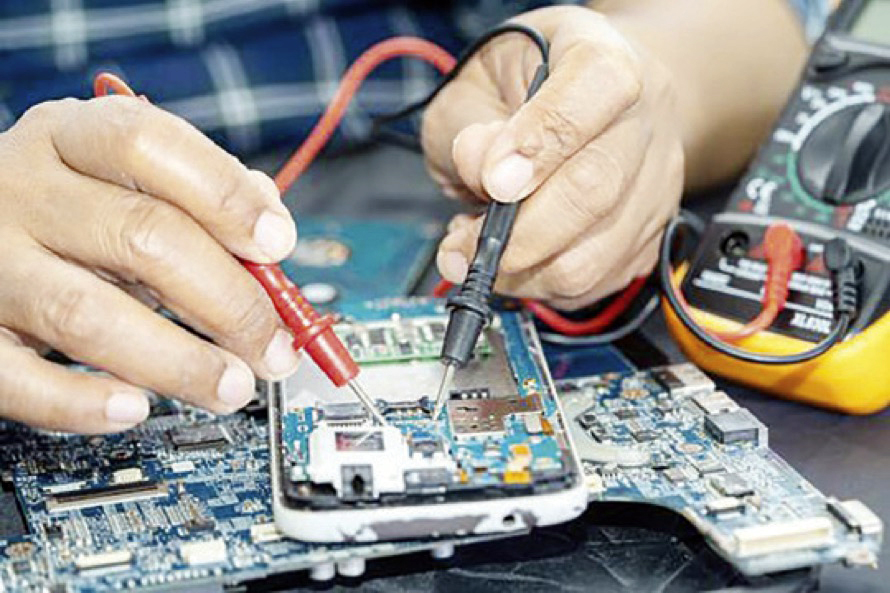
He explained that water had corroded the power IC and the memory chip pins. The phone would never boot again, but the data could still be pulled if he reballed the eMMC and read it with his programmer. He noted that it took him four hours under the microscope, running traces with fine wire because two pads had lifted. “She sat here the whole time, lamenting. No phone, no job. I’m just watching my hands.”
He charged ₦25,000 for the job. The phone wasn’t working again. But the data was restored, transaction logs, agent ID, and float records intact, and he copied them to a flash drive before she left. “She hugged the flash drive like a baby,” he said.
Across the shop corridors, Musa Ibrahim handles phones damaged beyond repair, the ones that have been run over by trailers. “They call me when the phone is bent like a banana. Last month, a building contractor brought a burnt Infinix. His tender documents for a ₦40 million job were inside. He didn’t back up his database despite having such a huge transaction. No email. No Google Drive. Only that phone. We worked 11 days. We got the PDF. He paid me ₦30,000.”
Another technician, Chioma Nwosu, is a young lady and the only woman in her line. Customers trust her with “sensitive” phones.
“A caterer came with a damaged iPhone 11. She had seven catering jobs and was expecting payment from the clients. Her clients had paid deposits for 12 weddings. No phone, no proof of payment, no refunds. I repaired the phone, and she was back in business and paid me handsomely.”
How much do people lose yearly to dead phones? Nobody knows exactly. But the techs keep a mental ledger.
Other News
Nwosu estimates he repairs 25 “business phones” weekly, each carrying ₦50,000 to ₦5 million in trapped value. “Multiply that by 200 technicians in Computer Village alone,” he said. “That’s ₦250 million to ₦1 billion a week stuck in dead phones. Some we save. Some we don’t.”
IT experts say the reasons people don’t care to back up their devices are simple.
Tunde Ajayi, a Lagos-based systems consultant, calls it “the ₦100 problem.” “Google Drive is free for 15GB, yes. But to upload 8GB of videos and receipts, a trader needs data. 10GB is ₦3,500. She’ll rather use that for calls to customers. Backup is a necessity for them.”
Ngozi Okonkwo, a digital inclusion trainer, blames distrust and literacy. “Many SME owners think ‘cloud’ means a white man will see their money or penetrate their secret transactions. Some people don’t know about these backup tools. I train women in Tejuosho. Nine of ten save contacts to ‘Phone’ not ‘Google.’ When the phone dies, everything dies. We teach them that their phones are not safe without backups. Don’t store your life there.”
“We teach them ways to back up their phones. When you change the setting from ‘Phone’ to your Gmail, every new number now saves to the cloud.
“Back up your WhatsApp messages to Google Drive or email yourself key contracts. You can export your database to your gmail.
“Every evening, snap your sales ledger and send it to your own WhatsApp number or email. If your phone dies, your records live. It costs nothing.”
Also speaking, Oluwananumi Dawodu warned that small business owners in Lagos who run their trade on Android phones without cloud backup are making one costly mistake that wipes out their records forever.
The Internet expert said the biggest error is relying only on the phone’s memory and WhatsApp chats to store critical business information.
He said: “Most traders and drivers keep customer contacts, daily sales, waybills, and receipts inside their phones or inside WhatsApp. No Google Drive backup, no memory card. Once that phone is stolen at Oshodi, falls inside water at Apapa, or the battery dies permanently, everything goes. We see it every week.”
He explained that many business owners believe WhatsApp is backing up their data automatically, but the backup often fails because mobile data is switched off at night, or no Google account is linked.
“They check ‘last backup’ and it reads six months ago. By the time the phone crashes, years of orders and supplier numbers are gone. Some even do factory reset to make the phone fast, without removing anything first. The business resets to zero.”
Asked what solution would work for Nigerians with little data and tight budgets, the expert proposed a system built around tools they already use.
“If I were to design it, there would be no new app and no monthly fee. The person simply dials a USSD code to a WhatsApp number. The system then pulls contacts, call logs, and photos of receipts, compresses them very small, and backs up at night using free data bonuses from the networks. We are talking less than 1MB per day,” he said.
According to him, the approach works because it removes complexity, data cost, and the fear of “cloud”.
“Lagos traders don’t trust what they don’t understand. But they trust USSD and WhatsApp. They already visit POS agents daily. The tech must meet them where they are, not the other way round,” he said.
He urged traders to stop treating phones like iron safes. “Your business cannot live and die with one device. If you have not backed up today, you are one mistake away from starting afresh.”
Interestingly, the phone technicians call themselves “Miracle workers.” But while performing these “miracles,” they are overworked, underrated, and underpaid. In a city where 60 per cent of businesses live and die by one device, they are the line between survival and collapse.
But this is the scary and risky part. The hidden danger is that when repairing a customer’s phone, a slip of the hand or a minor error could completely wipe out documents or important data worth ₦10 million.
These technicians handle contracts, crypto wallet codes, nude photos, court documents, and account details in public. What happens when it goes wrong?
Legal practitioners say they could be sued for damages. Allwell Ogunka, a tech-law practitioner in Port Harcourt, was blunt in his stance. “Under the Nigeria Data Protection Act 2023, a phone technician is a ‘data processor’ the moment he opens that phone. If he leaks a client’s customer list or bank alert, the client can sue. But here’s the problem: no written contract, no consent form, no receipt. In court, it’s your word against his. And most customers won’t sue. They just beg.”
People ask what if the technician wipes a ₦10 million contract by mistake.
“Liability still exists,” said Barrister Suleiman Danjuma, a commercial lawyer in Surulere. “Verbal agreements are valid in Nigeria. The issue is proof. Did the customer tell you the data was worth ₦10 million before you started? Did you warn him of the risk? Without documentation, the case is weak. But the reputational damage for the tech is huge. One bad job and Computer Village will finish you.”
Both lawyers agree on one thing: the industry needs basic contracts while sharing a sample of what the agreement letter should be.
“I, technician, will attempt recovery. Success is not guaranteed. I will not copy, share, or store your data and will not be held liable for losses incurred afterwards.”
The legal practitioner advised that phone technicians must ensure that the customers sign on it, noting that right now, ₦10 million deals are handled on trust and ₦500 receipts.