Follow Us on Google
By Adebowale Johnson
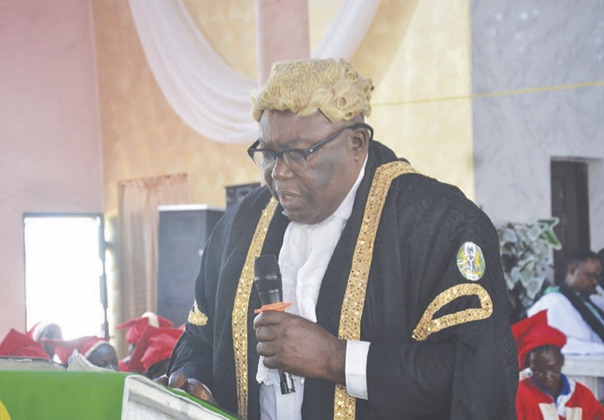
Renowned university law teacher and author, Prof. Agu Gab Agu, has x-rayed the judiciary, saying it should be reformed because there is rot in the system. According to him, the judiciary cannot be exonerated from the political crises in the country because of the conduct of some members of the bar and bench.
Agu also said that there’s nothing wrong in introducing death penalty to serve as a deterrent to the massive corruption in the country.
He said: “You know and I know as Christians that even when Jesus Christ had as few as 12 disciples, one of them broke the ranks and decided to follow a cause that was not good. I’m talking about Judas. So, in every society, you have people who are not properly suited for what they are doing.
“The judiciary is not one family and not one person. It is a conglomerate of people coming from different and diverse families with different orientation and upbringing. So, we still have people who have a carryover of what they had in their family.
“In the villages, there are families who are known to be thieves. That is why we are calling for community police. There are people who steal on impulse and they know them in the villages and keep them at bay.
“So, in the judiciary, there are some very dark characters who are filtering in. We still have shining lights there but there are still others who are doing dirty jobs. In all, it has not fallen too bad that there is no hope. But there is a big need to cleanse the judiciary. Some of them are not living up to their oath. The issue of conflicting judgements could have been avoided if we are more firm and disciplined.”
Agu, who is on sabbatical at Alex Ekwueme Federal University, Ndufu – Alike, Ikwo (AE-FUNAI), Ebonyi State, called for the reformation of the judiciary. He said: “We all are partaking in the issue of justice delivery. Those who give bribe are not less culpable because it takes two to tangle. There must be somebody who will induce the judge. First of all, the society should be educated not to do that. Second, those who see them, the whistle blowers should make it loud and be courageous to stand by their word. And those who the complaints are made to should stand very strongly and throw the books at those who are wrong.
“What I see is that those who are wrong have not been punished; there is not much sanction against those who have gone astray. If those who have gone astray have been punished enough, I think many people would have kept away from wrongdoing. Those who are in charge are not doing enough.
“There should have been serious action to push out those who are bad or are even close to being bad. It’s unfortunate that in this age and time, some judiciary officers are falsifying their age. Maybe they want to die in office or what. It’s very pathetic. It is not something that should be condoned.
“What manner of justice will you deliver if you falsify your age? First of all, you don’t want people to know who you are. I’m sure if much stronger and firmer approach is taken towards dealing with offenders, people will sit and do the right thing.”
Asked if he supports the introduction of death penalty for looters of the economy, Agu answered: “There is nothing wrong with that. That is what saved Indonesia and the rest of Asian Tigers. Nobody wants to die. Anybody who is stealing wants to enjoy it. So, if he knows he will die if caught, that may restrain him from doing that. But that may not even solve the problem. There are people who believe that they can always manoeuvre any system. But that would be a deterrent. But the fear is whether it will be used as witch-hunting. There should be great sanctions that are deterrent to the issue of corruption in this country because it has gone beyond the ordinary.”
On the state of the economy, Agu said: “We are in difficult times. Things are not the way we had expected them to be. And probably because they were a lot that this government is doing which are not palatable. One is not in government to understand the difficulties they encounter but I think they can do better. Things are bad. Things are difficult. The people in the villages are suffering; the masses are suffering. The high cost of fuel has spiral effect on other things in the market. Things are just difficult; there is no other way to put it. But we believe that we will overcome and we are trying to do just that.”