Follow Us on Google

By Durosimi Temitope
For decades, Nigeria’s economy was measured by the ebb and flow of oil prices. But the latest Gross Domestic Product (GDP) rebase opens a new vista for better assessment, especially when input from farmers, small businesses, tech innovators and service providers are recognised as silent drivers of a non-oil revolution that is reshaping the nation’s growth narrative.
After the National Bureau of Statistics (NBS) updated its calculations to reflect 2019 as the new base year, the size of the economy swelled to N372.82 trillion in 2024, up from N314.02 trillion in 2023. The change incorporates more informal and emerging sectors, from digital technology to the creative industries, offering a clearer picture of Nigeria’s economic reality.
The oil sector’s GDP share has dropped to just 3.97 per cent, while the non-oil economy commands over 96 per cent.
Statistician General of the Federation, Adeyemi Adeniran, explained that the rebasing exercise, which now covers data from 2019 to 2023, better reflects the country’s current economic structure.
“In nominal terms, Nigeria’s economy was estimated at N205.09 trillion in 2019, up from the previous base year value by over 41 per cent,” Adeniran stated.
He revealed that total output steadily rose post-2019, reaching N372.82 trillion in 2024. Real GDP growth also rebounded strongly after the pandemic, rising from -6.96 per cent in 2020 to 4.32 per cent in 2022 and 3.38 per cent in 2024.
For the first time, real estate has overtaken oil and gas to become the third-largest contributor to GDP, behind crop production and trade. It now accounts for 10.78 per cent of output, compared to oil’s 5.85 per cent, according to the report by NBS.
Muda Yusuf, CEO of the Centre for the Promotion of Private Enterprise (CPPE) said “Real estate’s rise is not just a statistical quirk, it reflects the growing demand for housing, urban infrastructure, and commercial spaces in a country with one of the world’s fastest-growing populations. Government policy needs to catch up with that reality.”
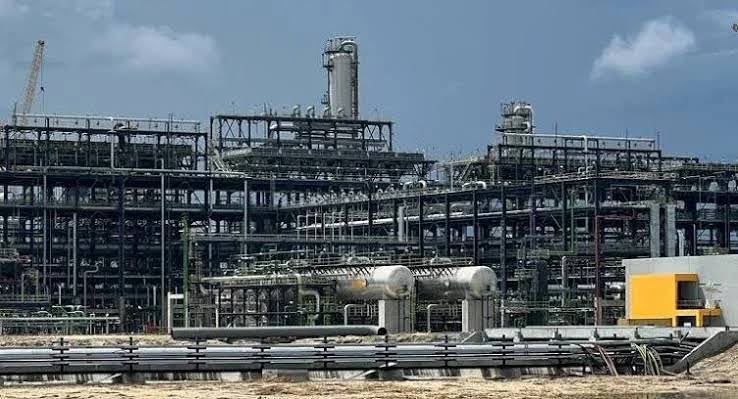
The rebased figures show a country steadily moving beyond petroleum dependence.
The oil sector’s GDP share has dropped to just 3.97 per cent, while the non-oil economy commands over 96 per cent. Yet, experts warn, the dominance of non-oil sectors has not translated into proportionate government revenue, exposing a structural weakness.
In the first quarter of 2025, 37 sectors recorded growth, with standouts including metal ores (25 per cent), financial services (15.3 per cent), transportation (14.1 per cent), and ICT (7.4 per cent). Oil refining also expanded by 11.5 per cent following new domestic capacity.
On the downside, nine sectors contracted, including coal mining (-22.3 per cent), livestock (-16.7 per cent), and textiles (-1.63 per cent). Three sectors; air transport, textiles, and coal mining remained in recession.
Opportunities and policy gaps
Agriculture’s GDP share improved from 22.1 per cent to 25.8 per cent post-rebasing, while services rose from 50.2 per cent to 53.1 per cent, driven by finance, ICT, and trade. But sector growth rates remain uneven: agriculture grew just 0.7 per cent in Q1 2025, and manufacturing only 1.7 per cent, according to analysis by ICIR Nigeria.
A Lagos-based policy analyst, Chioma Agwuegbo said there’s room for optimism in ICT, real estate, and finance, but noted that agriculture and manufacturing are lagging. “If these sectors remain underperforming, the growth we’re celebrating will be uneven and fragile.”
Finance Minister Wale Edun welcomed the figures as a sign of resilience and reform progress, saying the new data “provides a better tool for targeted policymaking” and highlights the contribution of sectors that previously went undercounted (FMINO).
Bigger numbers, bigger questions
Economist Michael Famoroti told the Financial Times (FT) that the rebasing makes Nigeria’s GDP about 30 per cent larger than previously estimated and lowers its debt-to-GDP ratio from 52 per cent to about 40 per cent. While that strengthens the country’s fiscal profile, he warns it could also breed complacency if structural challenges remain unaddressed.
For now, the rebased GDP reshapes Nigeria’s standing in Africa, potentially reclaiming the top spot from South Africa and Egypt in nominal terms. But for most Nigerians, the headline figures matter little without better jobs, infrastructure, and living standards.
“The rebase tells us our economy is more dynamic than we thought,” Agwuegbo said, adding that “the question is whether our policies and politics are dynamic enough to match it.”
The Manufacturers Association of Nigeria (MAN) expressed concerns that the latest rebased GDP figures indicate that the manufacturing sector is underperforming.
MAN Director General, Segun Ajayi-Kadir, urged the federal government to prioritise the manufacturing sector to reflect the real economic situation and gains of the rebased GDP.
MAN’s suggests that the rebased figures, while positive, should not overshadow the need to address persistent challenges such as weak real GDP growth.
MAN’s response implies a need for further analysis to understand the implications of the rebasing exercise and to develop policies that can address the underlying economic issues and foster sustainable growth.