Follow Us on Google

By Juliana Taiwo-Obalonye, Abuja
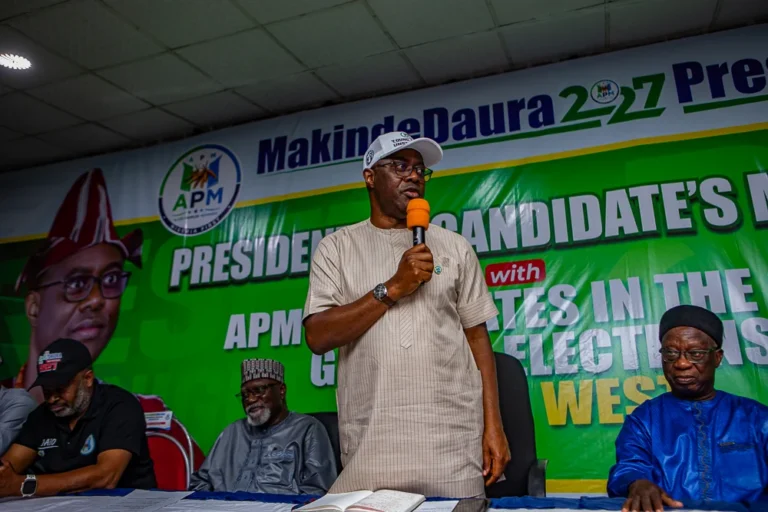
Benue State Governor, Hyacinth Alia, who was guest at the Meet the Press Briefing organised by the Presidential Media Team, said in this interview that his administration is strengthening security through community based support systems, boosting farm productivity with subsidised inputs, and fully complying with the President’s local government autonomy reforms. He also said the state’s improved security and agricultural interventions are helping Benue attract more residents, including patients seeking medical care.
What efforts is your administration making to empower local vigilantes, involve communities, and address the issue of forest guards to strengthen security in Benue State?
You may recall that I said Benue has become a medical tourism hub, and that tells you how much progress we have made. For anyone to come into the state, security must remain a top priority, and we have worked hard to ensure that. In the state, we have the Civil Protection Guard, which we introduced, as well as a separate security unit called Ainnamo. We also have Operation Zenda and community vigilantes, all working together to support the fight against insecurity. If the state were not safe, people would not continue to come there, including vulnerable people such as the sick. That alone shows that the system is working.
There are also other security strategies we would prefer not to disclose publicly. What I can say is that we monitor, track and respond proactively to emerging threats across the frontline areas of the state. We have put several mechanisms in place, and that is part of the reason people continue to come.
Benue is an agrarian state. What specifically has your administration done to support farmers with inputs, improve productivity, and ensure the safety of their families?
We have been doing this every year, and we have sustained it over the last three years. As a state, we are in partnership with fertiliser producers, which enables us to access our own share of the supply. This year alone, we received over 1,000 metric tonnes, while the federal government supplied over 600 trucks’ worth of fertiliser to us. In fact, those are just being distributed. We launched the distribution early last month. Under the arrangement, the state government pays half, while farmers pay the other half. That is one of the reasons we have seen a boost in food production in the state. Since we have maintained this support for the past three years, I have no reason to believe it will not continue. It is working, and we intend to sustain it going forward.
In the past three years, how much has been spent on road projects, Taraku Mill, and agricultural tractors?
On Taraku Mill, you may recall that when I came into office, Benue had many factories that had either collapsed or been sold off. We had to set priorities, and Taraku Mill became one of the key projects because Benue remains Nigeria’s leading producer of soya beans. We knew the revival of the mill was important to sustaining that position and strengthening the state’s industrial base. However, the process was not straightforward. The company owed its workers more than one billion naira in unpaid stipends, and there were also several legal disputes involving the company and the government. We had to resolve those issues one after the other. Now, we are at a stage where a company willing to take over the mill has come forward, and all legal encumbrances have been cleared. It took time, but the goal is clear: to create direct and indirect jobs, boost revenue, and strengthen the economy. It is a project we gave very deliberate attention to, and we are hopeful it will begin to yield results soon.
On the number of tractors we have, I cannot give you the exact figure, but Benue is an agrarian state, and we are now moving from subsistence to commercial farming. That is why we introduced tractors and farm cooperatives to support farmers and expand production. Under the cooperative model, groups of farmers, or even individual farmers with good farmland, can access government support based on their needs. We assess the land, provide part of the required inputs, and help them scale up their farms. We also have a Young Farmers’ Club, which is completely free. Participants present a piece of land, and we support them with seedlings and other farm inputs. At the end of the season, the produce is bought back, helping both the individual farmers and their cooperatives strengthen their economies.
Each local government area has tractors available, and the support is meant for farmers who are ready to move into commercial production. Even subsistence farming can be commercialised, and that is the direction we are taking. The tractors are shared on a time bound basis so that more farmers can benefit. We have done this over the past two years, and as the results continue to improve, we plan to expand the programme further. We are working in collaboration with the company that assembles tractors and other farm mechanisation equipment. The goal is to make farming easier for our people by bringing support closer to them, so they can return to their farms without having to travel far to access the tools they need.
Other News
What are your thoughts on state police, and how would it help your fight against insecurity in Benue?
My thoughts on state security are that it is a very good idea, and I am among the early governors who proposed state policing. The federal police is working, but local people understand their terrain better. People from an area know strangers more easily, gather intelligence faster and are often more effective because they know what is expected of them. That is how communities worked in the past, and that kind of local knowledge still matters. Of course, there are concerns about abuse, especially if people in uniform are drawn from the same local area. But with proper monitoring and clear rules, those risks can be controlled. Every system can be abused, including politics and online spaces, yet we do not abandon them because of that. We improve the regulations and enforce them. We need state policing because local intelligence is essential to tackling insecurity. Stakeholders know the troublemakers in their communities, and if they provide information and support proper intelligence gathering, the bad elements can be identified, prosecuted and peace restored.
I am speaking from the perspective of governance, not politics. If the economic reforms were not working in Benue, I would be the first to say so.
But they are working, and that is why we have been able to buy tractors, provide farm inputs, support IDPs returning to their farms and clear salary and pension obligations.
So yes, we need state policing, but we also need discipline, accountability and collective responsibility to make it work.
What has your government done to rehabilitate victims of insecurity in IDP camps?
You raised concern about the safety of IDPs as they return to their farms. In response, the state has put measures in place to support their reintegration and ensure their protection. We created farms specifically for IDP women and repeated the initiative this year after it proved successful last year. As part of the programme, we provide tractors, farm inputs and seedlings, while the women form cooperatives and take responsibility for the cultivation and management of the farms. At the end of the season, they harvest the produce and benefit directly from the returns. The goal is to help them become self reliant rather than depend solely on handouts in the camps. Now that many of them have returned home, the programme gives them something to fall back on and helps improve their livelihoods.
We also tested the model in communities such as Guma Local Government Area, where farmland was allocated to security agencies. This allowed the security personnel to farm alongside local people while also protecting them. Initially, some IDPs would go out to farm during the day under security escort and return to the camps in the evening. That arrangement worked for a short period before they became confident enough to continue on their own. The system has since been sustained. So, when IDPs now leave the camps voluntarily to continue farming, it is a positive development. Their safety is being addressed, and if the villages were not secure, they would not be returning to farm in the first place.
How far has your administration complied with the President’s local government autonomy reform?
We have complied 100 per cent. When I came in, only the legislature had full autonomy. The first time I met with the judiciary was at the start of their year, and I also made it clear to the local government leaders that autonomy is a law and they have it. I speak so passionately about this because local government autonomy is sacrosanct, and the judiciary also has its own autonomy. These are verifiable facts, so when people talk about non autonomy, I ask why they are not engaging directly with the local governments, the judiciary and the legislature. What is encouraging is that the autonomy is working. As I speak, our local governments have declared a state of emergency on road infrastructure and are turning many areas in their jurisdictions into work sites.
That is a plus not only for us, but also for the autonomy law itself. I encourage other states to follow this path because it works. It has also made governance easier for me. I now have less headache because my role is mainly supervisory. All I do is monitor, cross check and ask questions when necessary. If there is a project, I ask how much was received and how it was spent. If it is security, I need the details. If it is a road project, I need the figures. Once the right people are in those positions, the system runs more smoothly. Benue is, in fact, among the most compliant states on autonomy.