Follow Us on Google
By Adedayo Olalekan
Every rainy season, Lagos holds its breath. Streets vanish under brown water. Cars stall mid-bridge. Families wade home carrying what they can save. And every year, the same question resurfaces: who let this happen and who, if any, is prepared to stop it?
For decades, the honest answer had remained uncomfortable: almost no one. Lagos grew faster than its institutions could discipline it. Canals became building sites. Setbacks became shopfronts. Drainage channels, the very veins meant to carry floodwater safely out to the sea, were quietly strangled by concrete, refuse and neglect. Each administration inherited the mess, patched what it could and moved on. The waterways kept losing.
That pattern is now being tested, forcefully, by the Lagos State Ministry of the Environment and Water Resources, under Commissioner Tokunbo Wahab, working alongside the drainage administration and officials such as Dapo Ajadi. Their approach is blunt, occasionally controversial and increasingly difficult to ignore: enforce the law or watch the city drown in slow motion.
The cost of looking away
Lagos is not merely crowded; it is geographically cornered, a low-lying coastal megacity squeezed between the Atlantic and a lagoon, absorbing more people every year than its infrastructure was ever designed to hold. In that setting, environmental management cannot be reduced to sweeping streets or clearing gutters after the fact. It is a matter of planning, discipline, infrastructure, and above all, respect for the law.
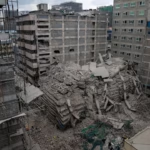
For years, the city has paid the price for the absence of that discipline: indiscriminate construction on drainage alignments, refuse dumped straight into canals, illegal structures erected where water is supposed to flow, developments that ignore environmental requirements altogether. The consequences are painfully familiar — flooded homes, gridlocked roads, ruined property, public health emergencies and a creeping sense that nothing will change.
The ministry’s current answer is that something must change, starting with enforcement.
Clearing blocked channels. Halting construction on drainage alignments. Tearing down structures that constitute environmental contraventions. None of these is comfortable. Much of it generates controversy. But viewed against the scale of the threat, enforcement is not an act of hostility towards residents, it is an act of protection, in a city where one person’s illegal extension can become another family’s flood disaster.
The distinction matters, and it should be stated plainly: a drainage channel is not vacant land waiting for development. A setback is not an extension of somebody’s compound. A waterway is not a site for a shop, a warehouse or a residential building. A drainage system cannot do its job once it has been turned into a foundation, a dumpsite or a storeroom.
That principle has to be non-negotiable because the moment it becomes negotiable, the flood always wins.
The numbers behind the bulldozers
The scale of the ministry’s recent action is not subtle. In 2026, the Lagos State government reported the removal of 1,544 illegal structures obstructing drainage alignments, after identifying more than 2,200 contravening structures across the state. Thousands of additional environmental enforcement actions were logged alongside them.
Numbers alone can numb rather than illuminate. What matters is what they represent: a deliberate attempt to break the behaviour that created the crisis in the first place.
There is little sense in pouring millions of Naira into a new drainage infrastructure only to watch people build over it. There is even less sense in expanding drainage capacity while refuse continues to choke the channels that already exist. Without enforcement, the government simply spends public money twice — once to build and again to repair what irresponsibility destroys.
That is precisely why the drainage department’s work carries such weight. Drainage infrastructure is invisible when it is working. Residents rarely notice the channels running beneath roads, bridges and built-up neighbourhoods — until the rain falls and the system either holds or fails. Whether a community stays passable or goes under can come down to a single blocked culvert or a single channel that was kept clear.
The ministry’s recent interventions suggest a shift from crisis response towards something more deliberate: drainage managed as an integrated system, not a scramble triggered by the last flood. The restoration of the Ajiran channel is a useful case in point — within 48 to 72 hours of the work, the areas reportedly saw a noticeable improvement in stormwater discharge.
That single fact carries a larger truth that Lagos has too often ignored: flood management does not begin when the rain falls. It begins long before, in keeping waterways protected, drainage channels open, illegal structures out of watercourses, developers accountable for the approvals they are meant to obtain and citizens aware that environmental law is not a polite suggestion.
Enforcement not the enemy
One of the most persistent obstacles to environmental governance in Lagos is a simple, corrosive idea that enforcement is inherently anti-people and that idea deserves to be challenged head-on.
Other News
No one wants to lose a property or an investment. No one welcomes an enforcement notice at their gate. But the government also carries a duty to the millions of people, who may be endangered by a single individual’s decision to violate planning or environmental regulations. The rights of a property owner cannot be allowed to outweigh the safety of an entire neighbourhood downstream.
Consider what actually happens when the rules are broken. A building erected across a drainage channel does not only threaten the person who built it — during heavy rainfall, the resulting blockage can flood streets far from that property. When refuse is dumped into a canal, the person who dumped it is rarely the person whose living room fills with water days later. Environmental enforcement, at its core, is about collective responsibility, protecting people from harms they did not create and cannot control.
Commissioner Wahab has repeatedly stressed that the government’s actions target environmental contraventions, not legitimate property ownership — that structures obstructing the free flow of water are being removed strictly in accordance with environmental law. That distinction must be maintained and it must be reinforced with transparency, due process and consistency, every single time.
From demolition to prevention
The truest measure of the ministry’s success will not, in the end, be the number of buildings pulled down. It will be the number of buildings that are never allowed to become contraventions in the first place.
That means stronger monitoring. It means developers knowing the rules before the first foundation is poured, not after a demolition notice arrives. It means better public education and an approval process predictable enough that compliance becomes the easier path, not the harder one.
The real goal is a cultural shift from “build first and regularise later” to “obtain approval, comply and build responsibly.” That shift alone would save the government enormous resources, freeing personnel and equipment currently spent tearing down illegal structures for drainage expansion, maintenance, waste management and environmental restoration instead.
This is where the ministry’s waste-management agenda becomes an essential companion to drainage enforcement. A clean city is not built by deploying more trucks or more sanitation workers. It is built by a system in which households, markets, businesses and communities understand and accept that indiscriminate dumping carries real consequences. The state’s stated ambition of a cleaner, flood-resilient, environmentally sustainable Lagos through improvements in waste management, landfill operations, recycling and waste-to-energy initiatives is not a side project. It is the other half of the same fight.
The Wahab-Ajadi approach: Discipline before disaster
The work being carried out by Tokunbo Wahab and the drainage team, including the officials responsible for enforcement and management on the ground, deserves to be judged beyond the immediate optics of bulldozers, cleared channels and enforcement notices. The larger question is whether Lagos is finally building the institutional discipline required to function as a modern megacity.
There is no modern city without rules. There is no functioning drainage system without setbacks and maintenance. There is no sustainable waste-management regime without enforcement. There is no responsible urban development without planning approval. And there can be no meaningful environmental protection if the law exists only on paper, ignored the moment it becomes inconvenient.
Lagos has grown too large and become too economically important to keep managing its environmental future through improvisation. The city needs institutions willing to say no when development threatens public safety. It needs officials who understand that preventing a flood is always cheaper, in money and in lives, than compensating its victims. And it needs residents who accept that while the government has a duty to enforce environmental standards, citizens carry an equal duty to obey them.
The ministry’s aggressive posture will keep attracting criticism and that criticism should be welcomed wherever it exposes genuine concerns about due process, fairness or the treatment of affected residents. Enforcement must always be lawful, transparent and consistent, anything less, undermines the very legitimacy it depends on.
But criticism should not be allowed to obscure the larger reality confronting every Lagosian.
A drainage channel blocked today can be a flooded neighbourhood tomorrow. A building permitted to encroach on a waterway today can become a multimillion-Naira public liability tomorrow. A refuse dump tolerated today can become an environmental crisis tomorrow.
So, when the Lagos State Ministry of the Environment and Water Resources clears a channel, halts an illegal structure before it takes root, removes an obstruction or simply insists that residents and developers obey the law, it is doing far more than enforcing a regulation.
It is buying Lagos time it does not otherwise have.
And that, ultimately, may be the truest measure of the ministry’s performance, not how many people applaud an enforcement exercise today, but whether millions of Lagosians are safer, healthier and less exposed to environmental disaster tomorrow.
For a city surrounded by water and increasingly tested by climate change and relentless urbanisation, environmental discipline is not a luxury the state can postpone. It is survival.
• Olalekan, a public affairs analyst, writes from Lagos