Follow Us on Google
By Damiete Braide
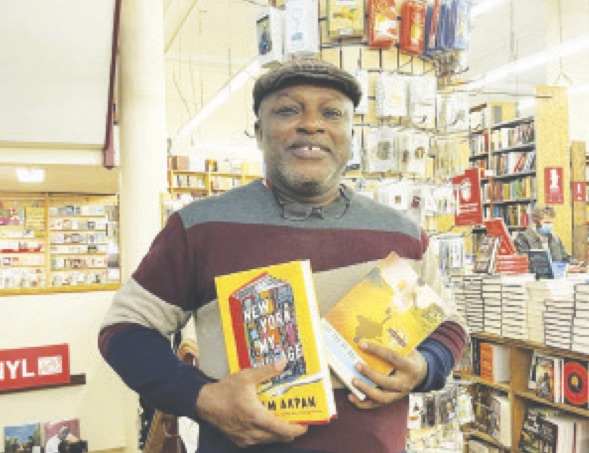
Born in Ikot Akpan Eda, a peaceful town in Akwa Ibom State, Uwem Akpan has evolved into one of Nigeria’s finest literary exports. Known for his poignant storytelling and deep emotional resonance, Akpan writes fiction in a way that holds up a mirror to society, making us confront difficult realities through the lens of vulnerable characters, often children. His work is steeped in humanity, and his voice has earned international acclaim, positioning him as a unique chronicler of pain and hope in African storytelling.
His rise to literary prominence came in 2008 with the publication of his debut book, Say You’re One of Them. Released by Little, Brown, the collection features five stories narrated from a child’s perspective, a bold and emotionally charged choice that brought depth and innocence to narratives centered on conflict, religious violence, and survival.
The book was enthusiastically embraced around the world: it became a 2009 Oprah Book Club selection, topped bestseller lists like The New York Times and Wall Street Journal, and was translated into 12 languages. It also won multiple awards, including the Commonwealth Writers’ Prize (Africa Region), the Open Book Prize, the PEN/Beyond Margins Award, and the Hurston/Wright Legacy Award.
However, Uwem Akpan’s journey did not begin on global stages. “I grew up in Annangland where stories were important, whether fables or Bible stories,” he recalls. He experimented with creative non-fiction and poetry before discovering his love for fiction at age 28. The journey was not only creative, it was also spiritual and reflective. Akpan credits influential texts like Rainer Maria Rilke’s Letters to a Young Poet for shaping not only his approach to writing but also for grounding him emotionally. “It taught me patience and endurance and introduced me to solitude, almost like a long, lonely prayer,” he said.
That ability to sit in quietude, meditate on life’s complexities, and speak for the marginalized through fiction is central to Akpan’s writing. His characters are often caught on the fringes, children facing war, street kids wrapped in trauma, or people navigating religious conflicts. It is a writing of witness, of seeing and naming injustice through the eyes of those least able to escape it.
“I have lived and worked with the poor, the rich, the powerful, the weak. I once lived and worked with lepers,” he shared. These experiences continue to shape his narratives. “Anybody who seriously and sincerely goes to help the poor sooner or later realizes they’re also receiving from the poor.”
Akpan’s creative process is a blend of discipline, spirituality, and something close to grace. “I pray for serendipity, for grace, for luck, choose your spiritual language,” he says with a smile. Yet he insists that writing, though beautiful, is also difficult: “Creating characters is tough, getting them to interact with others and the environment is tough. There is a gift, but I also try to develop this gift.”
In 2021, Akpan released his first novel, New York, My Village, a deeply personal and layered work that weaves humor with searing observations about identity, otherness, and the immigrant experience. Based partly on his life in New York City, the book reinvents the age-old narrative of newcomers confronting a bustling megacity while grappling with homesickness, cultural shock, and discrimination. Readers and critics have praised the novel’s accessible voice, blending satire with heartfelt commentary on cultural encounters and conflict memory.
A decorated academic, Akpan has held teaching fellowships at the Black Mountain Institute, the Cullman Center, and Loyola University Chicago. Today, he teaches in the MFA program at the University of Florida, where he says mentoring young writers fuels his purpose. “I do my best to encourage the young. To help them develop their worldviews. To help them develop their voices,” he says, acknowledging that even in giving, he continues learning.
In 2025, Uwem Akpan’s latest literary achievement placed him on the longlist for the Nigeria Prize for Literature in prose fiction. How did he take the news? “My publisher, Azafi Omoluabi, told me about it. I was excited,” he admits. Being longlisted for one of Africa’s most prestigious literary prizes is no small feat, but for Akpan, the recognition also brought a fresh wave of connection with readers in Nigeria. “It has introduced me to many here,” he said. For a writer whose stories transcend borders, this moment feels like a homecoming of sorts.
Akpan’s reflections on Nigerian literature carry both pride and a note of disquiet. “We’re just lucky to have great writers!” he enthused. Yet there’s a sting in his observation: “It’s quite an irony that upon this flow of great literature, things seem to be getting worse in Nigeria.” He points to neighboring African countries like Benin Republic, which despite having fewer internationally acclaimed writers, boast better infrastructure and stability. “We’re all running away from Nigeria today. My question is: how can we get this literature to develop our country?” It’s a question with no immediate answer, but for Akpan, it underscores a deeper tension between art and the lived realities of the people it represents.
Institutional support for writers in Nigeria, he believes, could be stronger. “It could be more. But every sector is suffering,” he notes pragmatically. He challenges young Nigerians, especially writers, to see their craft as a way to contribute, even amidst uncertainty.
For leisure, Akpan is refreshingly grounded. He reads the poetry of Rilke and the Psalms, reviews student stories, takes long walks, and watches soccer. Long road trips also bring him joy, like his epic drive from Gainesville, Florida, to Saskatoon, Canada, which took 34 hours. “I used to drive around Nigeria, but insecurity has robbed me of that joy,” he laments softly.
As for what’s next? Akpan hopes his next book will come together soon. “If it comes together, you will see,” he says simply, the words tinged with humility and patience. For a writer whose body of work continues to stir deep emotions and ignite difficult conversations, his legacy may well be found in the quiet persistence of his storytelling, a storytelling deeply rooted in empathy.
Uwem Akpan remains a vital voice in African literature, bridging continents and human experiences through fiction that is as soulful as it is necessary. His journey from the quiet towns of Akwa Ibom to international acclaim illustrates not only his personal evolution but also the promise of African stories, stories that grapple with pain, faith, tragedy, and the small yet powerful glimpses of hope that refuse to die.