Follow Us on Google
By Doris Obinna
Stakeholders have declared that Nigeria is facing a child-welfare emergency, warning that worsening indicators in health, education, nutrition, water access, and protection demand urgent and coordinated reforms.
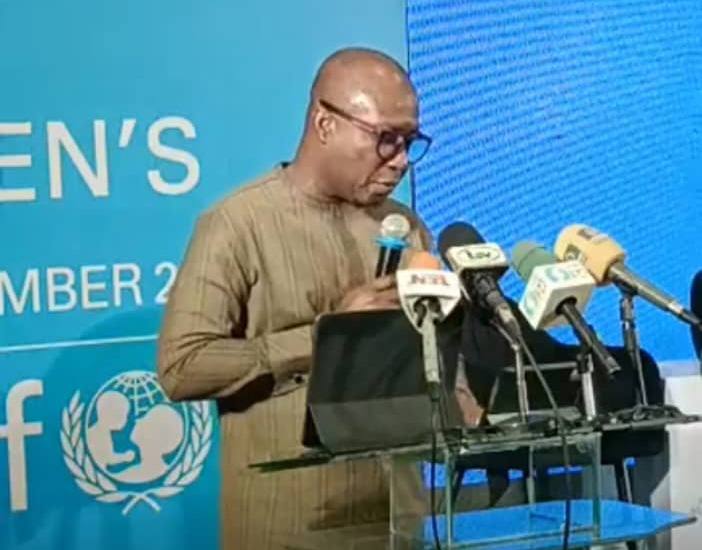
The alarm was raised at a symposium jointly organised by the United Nations Children’s Fund (UNICEF) and the Nigerian Guild of Editors (NGE) in Lagos to mark World Children’s Day.
The symposium held in Lagos, with the theme “Equipping the Nigerian Child for the Future: How Prepared Are We?”, drew representatives from UNICEF, government ministries, civil society, development partners, and senior media executives, all of whom agreed that the country must accelerate actions to safeguard children amid rising insecurity and declining social services.
President, Nigerian Guild of Editors, Mr Eze Anaba, said Nigeria was in a “state of emergency” over the conditions confronting children, citing persistent insecurity, school disruptions, and weak health and education outcomes. He warned that recent attacks and abductions across states showed children had become primary victims of violence.
“If we did not know before, we should know now. At no other time in our history, except during the Civil War, has the condition of our children been this uncertain,” he said. He lamented that schools were increasingly turning into “centres of war” and cautioned that the crisis threatened the nation’s future. With half of Nigeria’s 220 million population being children, he said, “What happens to our children happens to Nigeria.”
Anaba expressed concern that Nigeria now has the world’s highest number of out-of-school children and urged journalists to prioritise evidence-based reporting on child rights. He called for solution-driven journalism, accurate data use, and stronger collaboration among media, civil society, government, and UNICEF. “As long as I remain an editor, I will continue to advocate for the rights and protection of Nigerian children,” he vowed.
UNICEF’s representative in Nigeria, Ms Wafa Saeed, said millions of children remained unvaccinated and malnourished, while three in four 10-year-olds were unable to read and understand a simple text. She urged full implementation of the Safe School Declaration and stressed the need to scale up interventions in immunisation, education, nutrition, and protection. “Nigeria has made progress over the last two decades, but at the current pace, it will take far too long to reach acceptable results,” she said.
Other News
The Consul General of the Kingdom of the Netherlands in Lagos, Mr Michel Deelen, decried the poor state of many public schools, noting that several lack roofs, water, sanitation, and teachers. “Education is the engine of national progress,” he said, reaffirming his government’s support for UNICEF’s work in Nigeria.
Chairman of the Diamond Awards for Media Excellence, DAME, Mr Lanre Idowu, said the Nigerian child remained vulnerable despite pockets of progress. He urged media organisations to adopt more development-oriented reporting that provides context, analysis, and human-centred storytelling.
A panel session moderated by Dr Chinonso Egemba, popularly known as Aproko Doctor, examined Nigeria’s child-rights challenges. UNICEF Deputy Country Representative, Ms Ronak Nkan, noted that the organisation allocated resources strictly based on data, highlighting stark regional disparities. She said almost 90 per cent of households in Lagos had access to safe water, compared to just three per cent in Kebbi State. “A child in Kebbi or Maiduguri deserves the same chance as a child in Lagos,” she said.
Representing the Federal Ministry of Women’s Affairs, Mrs Mariam Fitumi Shaibu outlined programmes aimed at reducing the number of out-of-school children, including the National Commission for Out-of-School Children, the AGILE initiative, and the Lumina Project, which links women’s economic empowerment to girls’ schooling. She also announced progress on a National Policy on Menstrual Health and Hygiene expected to reduce absenteeism among girls.
The National Orientation Agency’s Director of Public Communication, Mr Henshaw Ogubuike, said the Ministry of Information had intensified nationwide sensitisation on child rights and safety, using its state offices and information centres to counter misinformation.
Senior editors at the event, including Mr Ehi Braimah and Mrs Ijeoma Popoola, urged governments to prioritise safe schools, healthcare access, and the domestication of the Child Rights Act. They also stressed the importance of parenting and the need for the media to interrogate policy implementation rather than relying on official declarations.
UNICEF Ambassador and youth advocate, Master Tinafi Akau, called for the deployment of technology to strengthen school safety, including AI-powered early-warning systems to prevent kidnappings, and urged government-funded digital training for vulnerable children.