Follow Us on Google
• Says they threaten free speech, democracy
• Urges lawmakers to withdraw them
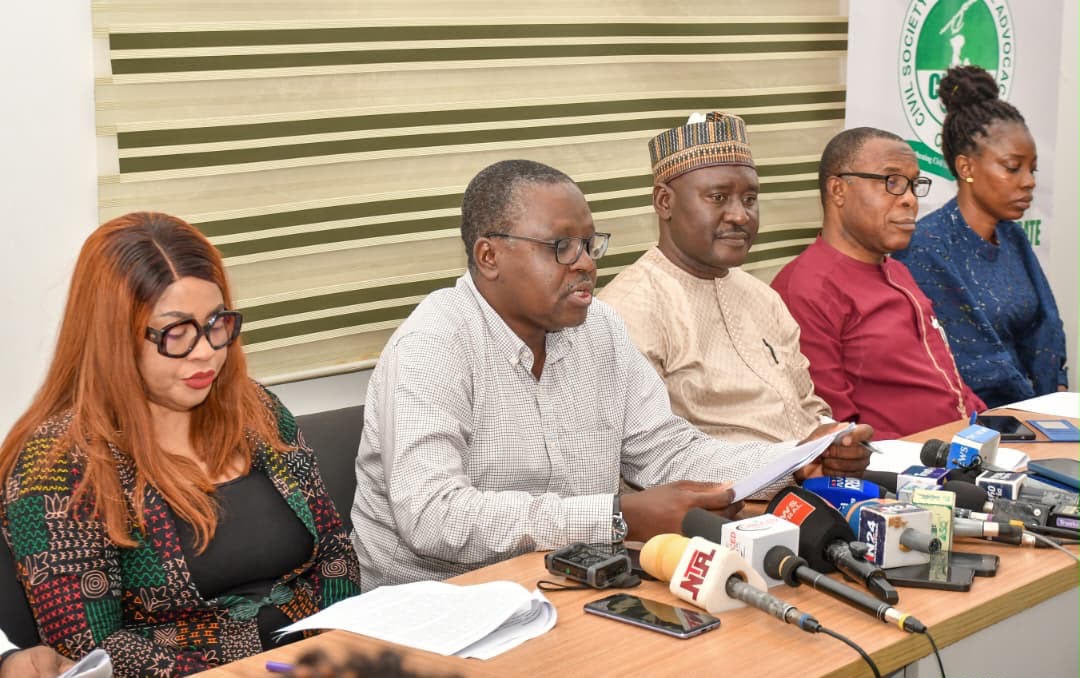
A coalition of Nigerian, African and international civil society organisations on Monday raised the alarm over what it described as an “increasingly coordinated legislative assault” on civic freedoms, warning that a series of bills before the National Assembly could deepen executive control, stifle dissent and undermine Nigeria’s democracy ahead of the 2027 general elections.
The groups, speaking at a joint press conference in Abuja, were represented by the Executive Director of the Civil Society Legislative Advocacy Centre (CISLAC), Awwal Musa Rafsanjani, alongside Dauda Garuba, Director of the Centre for Democracy and Development (CDD); Lydia Odeh, Chief Executive Officer of Triple C; and Isa Sanusi of Amnesty Nigeria. They said their position was backed by a coalition of 90 civil society organisations in Nigeria and across the international community.
The coalition urged lawmakers to immediately withdraw the proposed Foreign Aids (Regulation, Transparency and Disclosure) Bill, 2026 (SB.1034), the bill seeking to compel social media companies to establish physical offices in Nigeria, and other legislation they said threatened constitutional freedoms.
They argued that the proposed laws come at a time when civic space in Nigeria is shrinking rapidly and warned that their passage would further erode freedom of expression, association, peaceful assembly, media freedom and democratic participation.
“We, the undersigned Nigerian, African and international human rights organisations and civil society organisations, are gravely concerned by the growing number of restrictive and repressive bills currently before Nigeria’s National Assembly,” Rafsanjani said.
“If enacted, these bills would significantly expand executive control over civic life and further undermine the rights to freedom of expression, peaceful assembly, freedom of association, media freedom, access to information, democratic participation and the rule of law.”
The coalition said the legislative proposals were not isolated initiatives but part of a broader pattern of democratic backsliding under the current administration.
According to the groups, “these legislative proposals are being considered at a time when civic space in Nigeria is experiencing one of its most serious periods of decline since the country’s return to democratic rule in 1999.”
They alleged that since President Bola Tinubu assumed office in May 2023, authorities had increasingly relied on restrictive laws, arbitrary arrests, politically motivated prosecutions, intimidation and judicial harassment against journalists, activists, bloggers, civil society organisations and ordinary citizens exercising their constitutional rights.
The coalition cited what it described as the continued prosecution of activist and publisher Omoyele Sowore, actions against the Socio-Economic Rights and Accountability Project (SERAP), and the use of the Cybercrimes Act against journalists and government critics as examples of the deteriorating civic environment.
It also referenced findings by the Committee to Protect Journalists (CPJ), which reportedly documented 91 cases of journalists being arrested, attacked or harassed across 13 states and the Federal Capital Territory during the first three years of the Tinubu administration.
Warning that the timing of the proposed legislation was particularly troubling, the organisations said Nigeria was approaching a crucial electoral cycle.
“The timing of these proposals is particularly concerning as Nigeria prepares for the 2027 general elections,” Rafsanjani said.
“Rather than creating an open environment where citizens, journalists, civil society organisations and political actors can participate freely, these measures risk entrenching fear, self-censorship and intolerance of dissent.”
He added: “Independent advocacy, investigative journalism and public scrutiny are not threats to democracy; they are essential safeguards of constitutional governance and accountability.”
A major focus of the coalition’s criticism was the Foreign Aids (Regulation, Transparency and Disclosure) Bill, which it said would create a powerful new regulatory body capable of monitoring, sanctioning, suspending and even shutting down organisations receiving international funding.
The groups argued that although the bill was presented as a transparency measure, it would effectively hand the government sweeping powers over independent organisations.
Other News
According to them, the proposed Foreign Aid Regulatory Commission (FARC) would duplicate the responsibilities of existing agencies such as the Corporate Affairs Commission (CAC), the Economic and Financial Crimes Commission (EFCC) and the Special Control Unit against Money Laundering (SCUML), while exercising broad discretionary powers over civil society organisations.
“The Bill fails to demonstrate that these existing legal and institutional frameworks are inadequate or incapable of achieving its stated objectives,” the coalition said.
It warned that provisions compelling recipients of foreign assistance to register with the commission, submit extensive reports, undergo mandatory audits and align projects with government-defined national priorities could open the door to political interference in human rights advocacy, anti-corruption campaigns, election observation, public interest litigation and humanitarian work.
The organisations also faulted proposals requiring social media platforms to establish physical offices in Nigeria before operating in the country, arguing that such legislation could increase government leverage over digital platforms.
“Conditioning access to Nigeria’s digital market on physical establishment, backed by the threat of prohibition, is neither necessary nor proportionate to any legitimate regulatory objective,” Rafsanjani said.
“Such measures risk facilitating censorship, restricting access to information, discouraging innovation and investment, and encouraging private companies to prioritise political pressure over internationally recognised human rights standards.”
The coalition insisted that both bills conflict with constitutional guarantees contained in Sections 39 and 40 of the 1999 Constitution, as well as Nigeria’s obligations under the African Charter on Human and Peoples’ Rights, the International Covenant on Civil and Political Rights and other international human rights instruments.
It further argued that international cooperation and foreign funding remain essential to the work of many Nigerian civil society organisations involved in election observation, legal aid, anti-corruption advocacy, humanitarian assistance and human rights monitoring.
“International support enables organisations to undertake human rights monitoring, anti-corruption advocacy, humanitarian assistance, legal aid, election observation, public interest litigation and other activities that strengthen constitutional governance,” the statement said.
“Such support is a legitimate form of international cooperation, not evidence of foreign interference.”
The coalition urged the Senate President, the Speaker of the House of Representatives and all members of the National Assembly to immediately withdraw the controversial bills and ensure that any future legislation affecting civic freedoms fully complies with constitutional and international human rights standards.
It also called for broad consultations with civil society organisations, journalists, professional associations, digital rights groups and development partners before any reforms affecting civic participation are adopted.
In a final warning to lawmakers, the coalition said the National Assembly stood at a historic crossroads.
“The National Assembly now faces a defining constitutional choice,” Rafsanjani declared.
“It can enact legislation that expands executive control, shrinks civic space and accelerates democratic decline, or it can uphold the Nigerian Constitution, honour Nigeria’s binding regional and international human rights obligations, and reaffirm the country’s commitment to democratic governance, accountability and the rule of law.”
The organisations urged legislators to reject what they described as “repressive bills in their entirety” and instead enact laws that strengthen transparency, accountability, public participation and Nigeria’s democratic institutions.