Follow Us on Google

•What to do when someone collapses
One moment, a person is standing, talking, walking or going about the ordinary business of life. The next, the person suddenly loses strength, slumps and falls to the ground. It could happen in a bathroom while bathing, in an office during working hours, on a staircase, at a religious gathering or on a football pitch.

Though some victims could recover, others die before receiving medical attention. VFor witnesses, the first reaction is often shock, followed by confusion.
Some rush to sprinkle water on the victim’s face, fan the person or attempt to lift the individual. Some other people would bring out their phones for photographs and video recording.

Also, some others pour water into the person’s mouth or administer whatever medication is available. But medical experts have warned that such actions could waste precious time or cause further harm.
Dr. Kehinde Abraham Ojifinni, a consultant emergency physician and head of the Emergency Department at the University College Hospital (UCH), Ibadan, says sudden collapse can result from several medical conditions, some of which require intervention. He identifies heart problems, stroke, dangerously low blood/sugar, dehydration, internal bleeding, drug overdose and fainting among the possible causes.

Ojifinni, a Fellow of the College of Emergency Medicine of South Africa, stresses that an apparently healthy person can also collapse suddenly.
“When an apparently healthy person collapses, it is even more of an emergency because something is happening that the body cannot cope with,” he explains.

Why people suddenly slump
One possible cause is syncope, commonly called fainting. It occurs when blood flow to the brain temporarily decreases, causing a person to lose consciousness briefly. A sudden drop in blood pressure, including when someone stands up for a long time, can trigger fainting. Pain, emotional distress and receiving shocking news may also provoke a fainting episode in susceptible individuals. However, not every collapse is an ordinary faint.

Heart problems
Serious cardiovascular conditions are among the most dangerous causes of sudden collapse. A heart attack occurs when blood flow to part of the heart muscle is interrupted, usually because of a blocked coronary artery. Symptoms may include chest pain or pressure, breathlessness, sweating, nausea and discomfort spreading to the arm, back, neck or jaw.
Some people experience chest tightness or heaviness rather than obvious pain. Dangerous heart rhythm disturbances can also cause sudden collapse by preventing the heart from pumping sufficient blood to the brain.
Cardiac arrest occurs when the heart suddenly stops pumping blood effectively. The victim may become unresponsive and stop breathing normally or begin gasping. Heart failure, meanwhile, occurs when the heart cannot pump blood adequately to meet the body’s needs. It commonly causes breathlessness, fatigue and fluid accumulation, although severe deterioration can lead to collapse.
Ojifinni also lists inherited heart conditions that may remain undiagnosed until a person collapses, including during physical activity. Sudden collapse during exercise, particularly when accompanied by chest discomfort, palpitations or breathlessness, requires urgent medical assessment.
Stroke and other brain conditions
A stroke occurs when blood supply to part of the brain is blocked or a blood vessel ruptures, causing bleeding into or around the brain.
Some victims suddenly develop facial drooping, weakness on one side of the body, slurred speech, confusion or loss of coordination. Others may experience severe headaches, seizures or reduced consciousness. Research revealed that the FAST warning signs are important. In the concept, F stands for Face (One side of the face droops), A stands for Arms (The person cannot raise both arms equal), S stands for Speech (Speech becomes slurred or difficult to understand), and T stands for Time (Seek emergency medical attention immediately). A sudden, unusually severe headache or abrupt loss of balance or vision can also indicate a serious neurological emergency.
Diabetes and dangerously low blood sugar
Findings showed that a person with diabetes may collapse if blood glucose falls dangerously low, particularly after taking insulin or certain glucose-lowering medications without eating adequately.
Warning signs include sweating, trembling, palpitations, confusion, unusual behaviour and, in severe cases, seizures or unconsciousness.
High blood glucose can also cause serious complications, particularly when accompanied by severe dehydration and metabolic disturbances.
A bedside blood glucose test, according to experts, is an important early investigation for an unconscious or confused patient.
Dehydration, heat and electrolyte disturbances
Dehydration can reduce circulating blood volume and lower blood pressure, causing dizziness, weakness or fainting. Hot weather, strenuous activity, fever, vomiting, diarrhoea and inadequate fluid intake can contribute.
Ojifinni warns that dehydration can also disturb the body’s electrolyte balance, potentially affecting muscles, nerves and heart function.
Adequate fluid intake is important during hot weather, although people with certain heart or kidney conditions may need individualised advice about how much they should drink.
Heatstroke, which can cause confusion (altered mental status), seizures or collapse, is a medical emergency requiring immediate cooling and urgent treatment. But Ojifinni earned that heat or dehydration should not automatically be blamed whenever somebody collapses. A serious cardiac or neurological event may occur in the same circumstances.
Internal bleeding and other causes
Dr. Kehinde Ojifinni, a consultant emergency physician, draws attention to ruptured ectopic pregnancy, in which a pregnancy develops outside the uterus and may rupture, causing potentially fatal internal bleeding. A woman may not yet know she is pregnant. Sudden abdominal pain, dizziness, fainting or collapse, particularly when pregnancy is possible, requires immediate medical assessment.
Severe anaemia, pulmonary embolism, serious infections, severe allergic reactions and certain electrolyte disturbances can also cause collapse.
Drug overdose, alcohol intoxication and other toxic substances may impair consciousness, breathing or circulation.
Cases of people who slumped and died
Reports of people collapsing and dying in Nigeria and elsewhere have drawn attention to the potentially fatal consequences of sudden medical emergencies. According to Ojifinni, the circumstances of a collapse do not establish its medical cause. Some cases have documented findings, while others remain unexplained in publicly available reports.
Toluwanisings: Questions over emergency care
The death of a gospel singer, Toluwanisings, whose real name was Olayemi Bayonile Bolaji, has raised concerns about access to emergency healthcare in Ibadan, the Oyo State capital, and other parts of the country.
Media reports stated that the 41-year-old collapsed on October 14, 2026. His personal assistant, Babadunni Gbolabo, reportedly said efforts to obtain medical attention involved between seven and eight hospitals. The aide alleged that some facilities could not provide the required treatment. The singer’s precise medical cause of death has not been publicly confirmed.
Reacting to the case, Ojifinni expressed sympathy for the family but cautioned against automatically blaming individual healthcare workers without examining the wider emergency-care system.
He argued that patients need a coordinated chain of care beginning where the emergency occurs, continuing during transport and extending to the receiving hospital.
Samuel Okwaraji, Super Eagles star collapses, dies on pitch
Another tragic case that remains etched in Nigeria’s sporting history is the death of a footballer, Samuel Okwaraji, who collapsed and died while playing for the Super Eagles against Angola in a 1990 World Cup qualifying match at the National Stadium, Surulere, Lagos, on August 12, 1989.
Okwaraji, a Germany-based professional footballer, suffered a fatal cardiac event during the match, which Nigeria won 1-0. Reports on the findings after his death indicated that he had an enlarged heart and high blood pressure, with congestive heart failure identified as the cause of his death.
Onyeka Onwenu slumps, dies in Lagos
Celebrated singer, Onyeka Onwenu, died on July 30, 2024, after she collapsed, following a performance at a birthday party in Lagos. She was taken to a hospital, where she was pronounced dead.
Senator Ifeanyi Ubah slumps, dies in UK
Senator Ifeanyi Ubah died in the United Kingdom in July 2024. Reports citing family sources said he suffered cardiac arrest in his hotel room.
Hotelier slumps, dies at wife’s 60th birthday thanksgiving
A Lagos-based hotelier, Otunba Kunle Akinyele, slumped and died while giving a testimony at a church thanksgiving service, marking his wife’s 60th birthday in April 2025. Efforts to revive him were unsuccessful.
Other News
Other reported local and international cases
Former Nigerian international footballer, Mike Eneramo, collapsed and died during fitness training in Kaduna in April 2026. In another reported incident that month, a Covenant University student Toluwase Jesutunmise reportedly died after collapsing during football training.
Also, Oreoluwa Emmanuel Adewole, a Part IV student in the College of Health Sciences at Obafemi Awolowo University, Ile-Ife, reportedly died in April 2026 after experiencing chest pain during a clinical viva examination.
Anslem Ojodomo, a lecturer at Kogi State Polytechnic, Lokoja, collapsed and died while teaching in March 2026. In December 2025, Assistant Commissioner of Police Ogbon-Inu Taiwo Popoola collapsed during a management meeting at the Ebonyi State Police Command headquarters. Media reports stated that preliminary medical findings indicated cardiac arrest associated with hypertensive heart disease.
Internationally, American performer, Fatman Scoop, died in August 2024 after collapsing onstage. The Connecticut medical examiner determined that his cause of death was hypertensive and atherosclerotic cardiovascular disease.
American YouTuber Philip Enewally, 26, died in March 2025. The Los Angeles County Department of Medical Examiner determined that his cause of death was sudden cardiac dysfunction associated with solitary papillary muscle hypertrophy, a subtype of hypertrophic cardiomyopathy.
Bathrooms, offices and staircases
Sudden collapse can occur almost anywhere, including places people ordinarily consider safe.
Bathrooms present risks because a person may fall against hard surfaces, sustain head injuries or remain undiscovered if alone. Findings further revealed that hot water and heat may contribute to fainting in susceptible individuals by lowering blood pressure. Standing up suddenly can also trigger a temporary drop in blood pressure.
However, bathing itself cannot be assumed to be responsible for every collapse in a bathroom. A heart attack, slippery floor, stroke or another emergency may occur during bathing without being caused by it. In offices, colleagues may initially attribute a collapse to fatigue, hunger or stress. Although the factors can contribute to some episodes, a sudden loss of consciousness may indicate a serious medical condition. Staircases also present additional dangers because a victim may sustain fractures, head injuries or possible spinal injuries during the fall.
Why every second counts
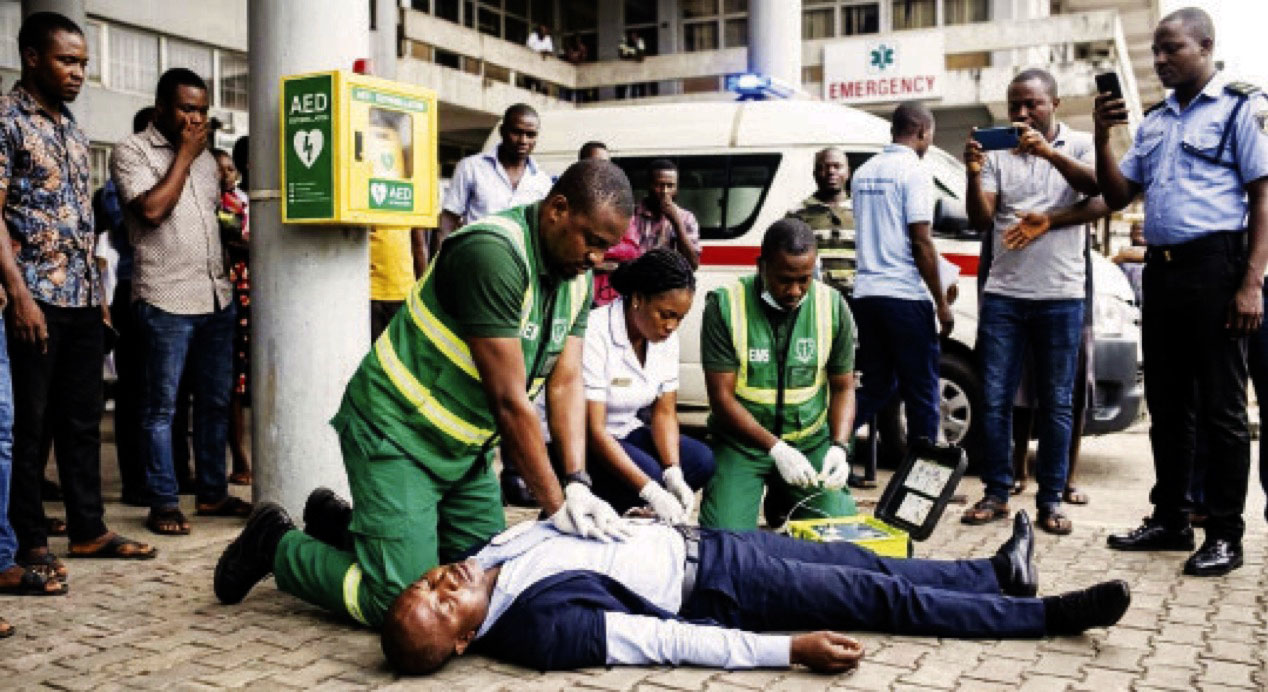
For cardiac arrest, immediate Cardiopulmonary Resuscitation (CPR) which is an emergency lifesaving procedure performed when a person’s heart stops beating effectively and they stop breathing normally, can help maintain blood flow to the brain and other vital organs until further treatment becomes available. Early defibrillation, it was stated, can restore an effective heartbeat in certain dangerous heart rhythms. Ojifinni emphasises that bystanders should not wait passively for the victim to recover.
“If we delay in starting chest compressions, we lose valuable time that could have been used to help the person recover,” he says. The longer cardiac arrest continues without effective CPR and defibrillation when indicated, the greater the risk of death and permanent brain injury.
What to do when someone suddenly slumps
The first priority is to act quickly without putting oneself or the victim in further danger.
Dr. Kehinde Ojifinni, a consultant emergency physician, advised that he first thing people around a person that slumped is ensure the surroundings are safe before approaching the person. Speak loudly and gently tap the shoulders to check for a response. He stated that the next thing that should be done is to ask someone to contact the local emergency service, obtain an automated external defibrillator (AED) if available and arrange transport or an ambulance.
“If the person is unresponsive, check whether they are breathing normally. Occasional gasps or irregular snorting sounds are not normal breathing.
“If the person is unresponsive and not breathing normally, begin chest compressions immediately,” he said. Medical experts advised that for an adult, place the heel of one hand in the centre of the chest, place the other hand on top and press hard and fast at a rate of 100 – 120 compressions per minute, to a depth of approximately 5–6 centimetres. Allow the chest to recoil fully between compressions.
If trained to provide conventional CPR, give 30 compressions followed by two rescue breaths. If untrained or unwilling to give rescue breaths, perform hands-only CPR while following the emergency dispatcher’s instructions.
Ojifinni also counselled that an AED should be used as soon as possible.
“Switch on the device, attach the pads as instructed and follow its voice prompts. Do not touch the victim while the AED analyses the heart rhythm or delivers a shock,” he advised.
He further stated that if the person is unconscious but breathing normally, his or her airway should be protected and urgent medical help should be sought. Where appropriate and no spinal injury is suspected, place the person on their side in the recovery position and continue monitoring breathing.
“Do not pour water, palm oil, milk or other substances into an unconscious person’s mouth. Do not force-feed the victim, slap the person or attempt to make them stand,” he added.
Ojifinni says delays in summoning help, initiating CPR and obtaining a defibrillator can cost lives.
He also urges the public to learn basic life support, noting that CPR training can be provided to ordinary adults and children old enough to learn the appropriate techniques. The aim, he said, is to ensure that witnesses can take useful action before professional help arrives.
AEDs should be available in public places
An automated external defibrillator (AED) analyses a person’s heart rhythm and determines whether an electrical shock is advisable.
When cardiac arrest involves a shockable rhythm, prompt defibrillation can be lifesaving.
Ojifinni advocates making AEDs accessible in places where large numbers of people gather, including shopping malls, supermarkets, stadia, restaurants and major motor parks. The devices are designed to provide voice instructions and can be used by members of the public who follow those instructions. However, AEDs do not treat every cause of collapse. They complement CPR and other emergency interventions rather than replacing them. The consultant also stresses the need to train members of the public, including students, in recognising cardiac arrest and responding appropriately.
Which hospital should receive a patient who has slumped?
Findings showed further that it is not every healthcare facility has the capacity to manage a life-threatening emergency. An appropriate destination should have an operational emergency department, personnel trained in resuscitation, essential medicines, monitoring equipment and access to the investigations and specialist treatment required.
Where an ambulance is available and can respond promptly, it is generally preferable for an unresponsive patient or someone with severe breathing difficulty to be transported by emergency personnel. When an ambulance cannot arrive promptly, arrange the fastest safe transport to an appropriate emergency facility, while following emergency personnel’s instructions. Hospitals should also have arrangements for referring patients, whose conditions require services unavailable at the initial facility. However, referral should form part of a coordinated system rather than leave families to search from one hospital to another without guidance.
What can save lives inside the hospital
Ojifinni identifies several essential components of an effective emergency service.
These include a functioning defibrillator, oxygen supplies, suction machines, equipment to support breathing, emergency medicines and a crash cart containing essential resuscitation supplies.
Hospitals also need electrocardiogram machines and cardiac monitors to assess heart rhythms, as well as blood pressure monitors, pulse oximeters and bedside glucose testing equipment.
Ojifinni states that a critically ill patient may require assisted ventilation, intravenous access, appropriate fluids and other treatment based on the suspected cause. He also emphasises access to laboratory investigations, including blood glucose, blood counts, electrolytes, kidney function and cardiac markers, that can help clinicians identify the underlying problem. Patients with suspected stroke, according to him, may require urgent brain imaging, while those with severe bleeding may need blood transfusion and emergency surgery. Some critically ill patients also require intensive care, specialist neurological assessment, advanced cardiac treatment or other interventions.
The consultant stresses that equipment alone is insufficient. Hospitals need trained doctors, nurses and other healthcare professionals who understand their roles during resuscitation.
Ojifinni compares effective emergency teamwork to a Formula One pit crew, in which each member knows what to do and performs the assigned task quickly. During resuscitation, he notes, personnel may have designated responsibilities for airway management, breathing support, circulation, medication and monitoring. The consultant says regular simulation exercises help staff practise these procedures so they can respond efficiently when an actual emergency occurs.
He adds that a functional emergency department should operate around the clock, with access to laboratory services, blood transfusion, operating theatres and intensive care, either directly or through dependable referral arrangements.
Why patients may struggle to access emergency care
The circumstances surrounding Toluwanisings’ death have raised questions about why a critically ill patient might be taken to several hospitals before receiving appropriate treatment.
Ojifinni argues that the problem must be examined within the broader context of emergency healthcare provision. He says an effective system should include pre-hospital emergency services, particularly ambulances capable of reaching patients where emergencies occur.
Under such a system, a call centre receives a report, identifies the location and dispatches the nearest available ambulance. Emergency personnel begin appropriate treatment at the scene and communicate with the receiving hospital before arrival.
“This allows the hospital to prepare for the patient’s condition rather than learn about the emergency only when the patient arrives,” he says.
Ojifinni advocates stronger ambulance services and better coordination among emergency call centres, transport services and hospitals.
He also points to challenges involving infrastructure, communication, security and inadequate resources. The consultant cautions against automatically blaming an individual doctor or nurse when a hospital cannot provide a particular intervention.
A healthcare worker may recognise what a patient needs but lack the equipment, personnel, medicines or specialist support required to deliver it.
That does not remove the need for accountability when negligence occurs. Rather, it underscores the importance of investigating individual incidents fairly while addressing systemic weaknesses.
Hospitals must communicate clearly, provide whatever stabilisation is within their capacity and use effective referral arrangements when higher-level treatment is required. A coordinated emergency system, he avers, should prevent patients and relatives from having to navigate these decisions alone during a crisis.
Prevention begins before collapse
Although not every emergency can be prevented, some risks can be reduced. The consultant advises that people living with hypertension should monitor their blood pressure and take prescribed medication as directed. Those with diabetes should understand the symptoms of low blood sugar and follow their treatment plans.
People who experience recurrent fainting, unexplained palpitations, chest pain or breathlessness should seek medical evaluation.
Adequate hydration is important during hot weather, while physical activity should be appropriate to an individual’s health and fitness. He further counsels that anyone experiencing sudden chest discomfort, facial drooping, speech difficulties, severe breathlessness or unexplained collapse should receive urgent medical attention.
Families, workplaces, schools and religious organisations should identify suitable emergency facilities and learn how to summon assistance.
Public CPR training and wider access to AEDs could also strengthen the response to cardiac arrest outside hospitals, he advised..