Follow Us on Google
By Lukman Olabiyi
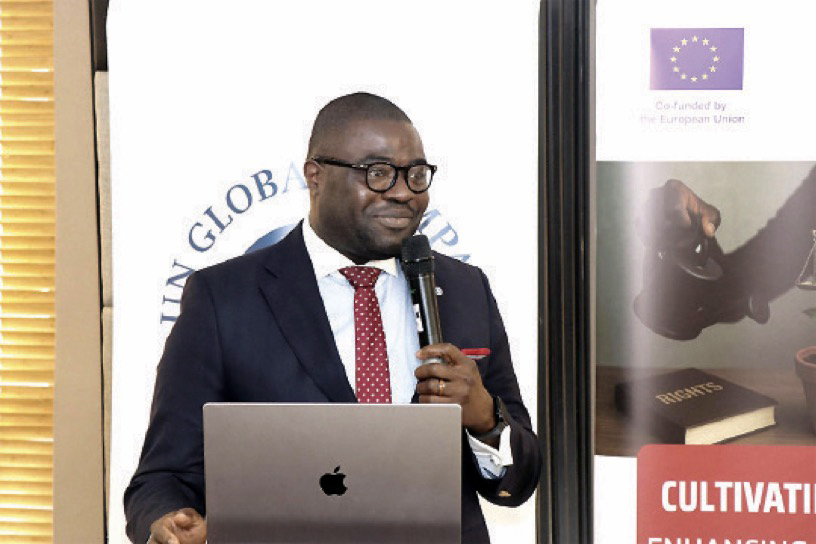
Chairperson of the United Nations Working Group on Business and Human Rights, Professor Damilola Sunday Olawuyi, a Senior Advocate of Nigeria, has called on governments, businesses and development stakeholders across Africa to accelerate efforts toward building accountable, sustainable and rights-centred supply chains that align with global standards.
Olawuyi made the call while delivering a high-level keynote address at the second edition of the East and Horn of Africa Business and Human Rights Dialogue held in Nairobi, Kenya.
The forum, themed: “Beyond Compliance: Strengthening Accountable and Rights-Centred Supply Chains in East and Horn of Africa,” was convened by DanChurchAid (DCA) in partnership with the United Nations, Denmark’s Ministry of Foreign Affairs and other regional partners.
The gathering brought together policymakers, development experts, business leaders, civil society organisations and academics from across East Africa to examine strategies for promoting responsible investments and strengthening human rights protections within key economic sectors.
Speaking at the event, Olawuyi urged African businesses, investors and entrepreneurs to move beyond policy commitments and embrace practical implementation of human rights standards throughout their operations.
According to him, businesses must integrate human rights due diligence into their supply chains, procurement processes and investment decisions if they are to remain competitive in an increasingly rights-conscious global economy.
He noted that the growing adoption of rights-based legislation around the world, including the European Union’s Corporate Sustainability Due Diligence Directive (CS3D), signals a new era in international trade and investment.
“Africa is rising as a major destination for investments in critical minerals, infrastructure, agribusiness and green technologies.
“At the same time, communities, indigenous groups and other stakeholders are demanding a model of development that embeds environmental, social and governance principles across supply chains, particularly in the sourcing, production and distribution of natural resources and consumer goods,” Olawuyi said.
He stressed that consumers worldwide are becoming increasingly conscious of how products are sourced, adding that goods linked to exploitation or environmental degradation face growing resistance in international markets.
Other News
“No one wants tea, coffee or even critical minerals sourced from exploitative value chains. This is not only about regulatory compliance; it is also about responding to increasing consumer demand for green, ethical and responsibly sourced products,”he said.
The UN expert, therefore, called on African governments and businesses to deepen their commitment to sustainable economic growth that combines environmental protection with social inclusion and respect for human rights.
Olawuyi commended Nigeria, Kenya, Uganda, Liberia and Ghana for emerging as pioneers in Africa through the adoption of National Action Plans on Business and Human Rights.
However, he maintained that stronger efforts are required to translate policy commitments into measurable outcomes for workers, communities and vulnerable groups.
He also highlighted the critical role of technology in promoting transparency and accountability within supply chains, noting that digital tools can help businesses track, monitor and address human rights risks more effectively.
According to him, increased investment in innovation, education and capacity building will be essential to achieving lasting progress.
He urged governments and private-sector actors to provide greater financial and technical support to youth innovators, digital entrepreneurs, higher education institutions, national human rights institutions and civil society organisations working to advance ethical business practices across the continent.
Such support, he said, would help promote awareness of responsible investment principles, reduce workplace inequalities and contribute to sustainable development across African societies.
The dialogue featured contributions from representatives of the Office of the United Nations High Commissioner for Human Rights (OHCHR), the United Nations Development Programme (UNDP), the UN Global Compact, UNICEF, the African Union, the African Commission on Human and Peoples’ Rights, and the Network of National African Human Rights Institutions, among other dignitaries.
As Chairperson of the UN Working Group on Business and Human Rights, Olawuyi is expected to present a report to the UN Human Rights Council during its 62nd Session in Geneva, Switzerland, scheduled for June 15 to July 7, 2026. The report will assess global progress and persistent challenges in ensuring respect for human rights across key economic sectors and regions.