Follow Us on Google

•Separated by political barriers, communities in Nigeria and Niger are united by Hausa language and a market where Naira, CFA are legal tenders
From Olanrewaju Lawal, Birnin Kebbi
Jantulu-Kare, a village in the Argungu Emirate of Arewa Local Government Area of Kebbi State, shares many common things with the people of Dosso Region of Niger Republic.
Apart from Jantulu-Kare sharing land border with Dosso, the people of both places have a common language – Hausa, and a vast majority of them are Muslims. On both sides are Hausa and Fulani tribes, which spread across Kebbi and Sokoto states, as well as Niger Republic.
History of the area shows that people of Kare migrated from their old town to the present town now called Kare. But the people always prefer to be called Jantulu-Kare, which literally means ‘people who settle around red mountains.’ Those red mountains still stand along the Yeldu-Kare Road today.


Since the pre-colonial era, their people have spread across the old Kabi Kingdom which was later cut off by the colonialists during the amalgamation of Nigeria. Yet, they have not lost their kinsmen as interactions continue beyond mere visitations across the borders.
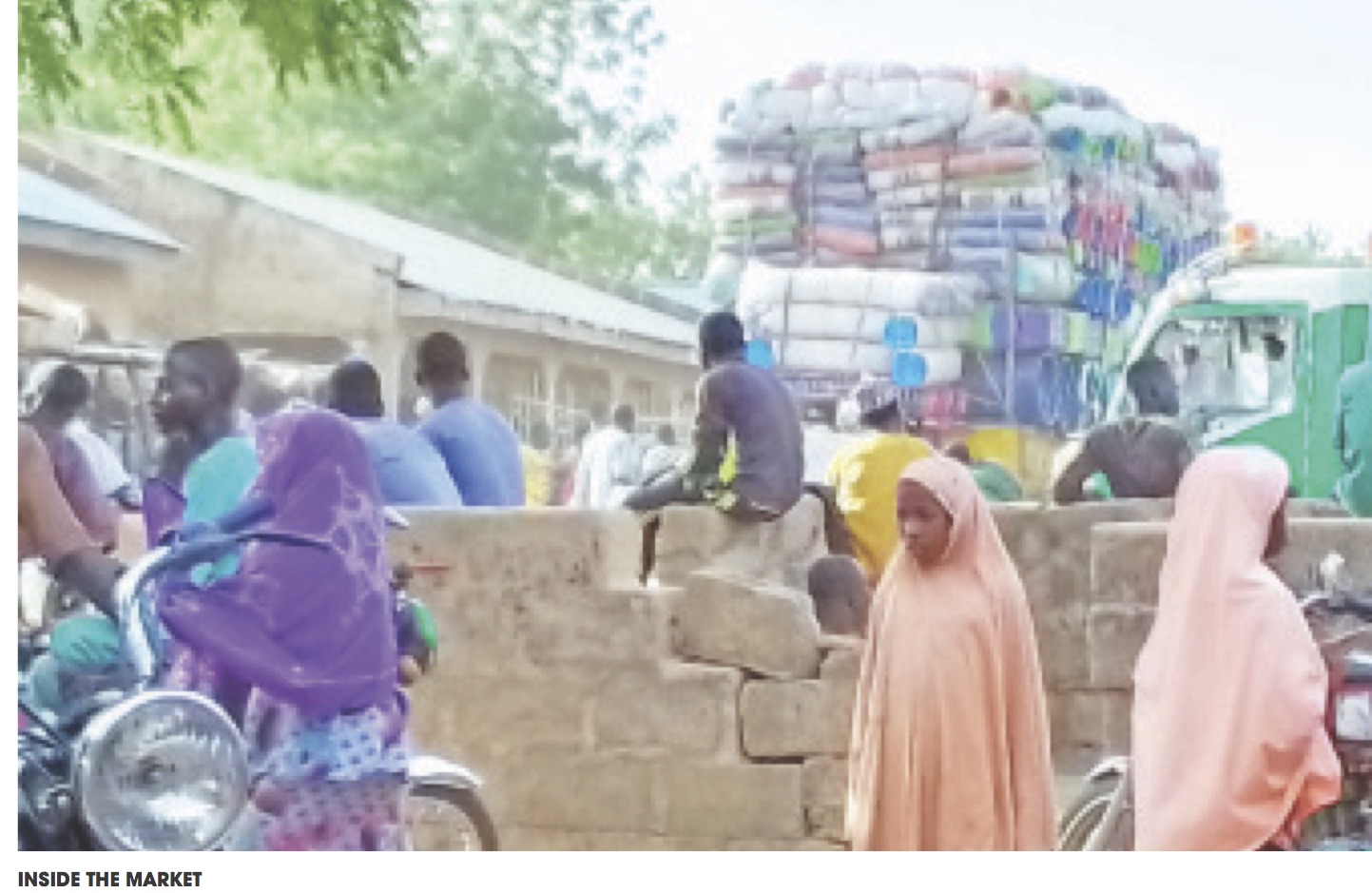
However, a big market located at the Northern part of Jantulu -Kare, popularly call Dadin-Kowa, which means “enjoyment for everybody,” has being serving as a meeting point for the Hausa and Fulani people from both sides of the countries on every Tuesday for business transactions without barrier.
While traders and buyers arrive at the market, investigations by Saturday Sun show that currencies of Nigeria and Niger Republic are legal tender for trading in the market.
At the checkpoint on the border with Niger Republic, a ten-minute drive from the Dadinkowa Market, Nigerien Immigration officers were properly positioned at the post to check the movement of people and goods without restriction.
The Nigeriens also have their currency exchange unit located at the axis of Niger Republic which is merely divided by a road.
While speaking with Saturday Sun, Alhaji Samaila Yakubu Awazaka, a grains dealer in the market who has been in the market since 1990, described the market as an ancient place where Hausa and Fulani from both Nigeria and Niger Republic usually meet for business transactions freely.
His words: “They do bring goods from Niger and we too, we are selling Nigeria goods here. We accept naira and CFA from our customers. We don’t have a problem with currencies because all of us know the exchange rate here. We don’t have language problems too, because all of us around this border are Hausa-speaking people.
“What I can tell you is that the market is freely operating because those from the Nigerian side know the rule of the Niger Republic if at all you want to cross the border through that road over there. That road is what divides us and if I don’t tell you as a visitor, you can’t know it at all. We are brothers and sisters. I have relatives in Dosso. They do visit us here in Kare and we too do visit them.”
Awazaka, while shedding more light on the pattern of trading in the market, disclosed that a bag of Nigeria’s rice was being sold at the rate of N34,000, which is equivalent to 26,000 CFA, the Niger Republic currency. He also revealed that a keg of groundnut oil is being sold for N20,000 and 16,000 CFA, while a bag of beans goes for N38,000 which is 30,000 CFA.
“We have good relationship among ourselves. We have no problem because we are good people. We do our businesses peacefully. Even e-tranfer of money for goods purchased is always delivered without hiccups.
“The only challenge we are facing from the Nigerian side is that the checkpoints from here to Argungu are too much. Drivers of articulated vehicles who used to convey huge number of goods to this market are not coming again. We are only seeing small, small cars. The trailers stopped coming because of too much checkpoints by security agencies.
“Now, the increase in the prices of petrol has worsened the situation. Before, from here to Argungu was N1,000. But now, commercial vehicles charge N2,000 for a passenger and they will charge you again on your goods.
“The bad road from Yeldu Town to Kare is another challenge. The road is not good to allow big trucks to convey goods to this market. We hope government would complete this road which was abandoned about eight years ago,” he stated.
Another trader in the market, Sani Usman, a 33-year-old trader, told Saturday Sun that his shop and house are located inside the Dadinkowa Market within the Niger Republic, even though he is a Nigerian from Kare. Usman sells soft drinks in the market.
Usman, while narrating his experience at the Nigerien side, said that he follows the Niger Republic rules and regulations and his relationship with them is much stronger.
He said: “We Nigerians on the side of Niger Republic here in the market obey their rules and regulations. We are one people here. Even though the boundary between us have divided us, we still see ourselves as one people. If any customer brings Naira, I will accept it and if they bring CFA, I will accept it. We are all speaking Hausa language, so there is no language barrier.”
Usman said he gets his soft drinks supply from Nigeria (Argungu) while other items like groundnut oil, bags of sugar, bags of rice are being supplied from Niger Republic.
However, when Saturday Sun checked activities at the border post of Niger Republic, documentations of motorists and motorcyclists entering the market through the Niger border were properly being done by the country’s Immigration/ Police officers attached to the checkpoints.
It was gathered that those who are visiting the country for personal reasons were given a pass, which should be returned while returning through the same checkpoint.
At the borehole point, where traders draw water, different currencies of the two nations were seen dropped inside the water box, which also has propeller meter/turbine meter measuring the amount of water fetched by an individual.
Speaking to Saturday Sun, a security man at the post, who didn’t want his name in print, said they were doing their job professionally because the people of Niger and Kebbi are the same people.
“We treat everybody who pass through this post professionally. Here, we don’t harass anybody, because we believe we are all Africans. We have a common language which is linking us with people of Kebbi and Sokoto in Nigeria.
“But the problem we are facing here is about Immigration Officers along Kare to Argungu Road. Anytime or day our officers here from Niger Republic are travelling to Argungu or Sokoto, they will collect money from our officers. The one that happened recently, the security officer insisted that he must collect N1,500 from our officer after he showed them his identity card, that he is an officer with Niger Republic. They asked him to either pay money or stay in his country. But we here, anytime or day, Nigeria’s Security Officers are passing through here, we accord them respect. There is ‘esprit de corps.’ They will go freely without any problem,” the officer alleged.
A Nigerien trader, who identified himself as Abubakar Yousefu, a plastic dealer told Saturday Sun that he usually comes to the Dadinkowa market every Tuesday to buy plastics and food items which he takes to his village in Dosso Region because the market is very close to him.
He said: “We are Hausawa. We are the same people. If not because of division through boundaries, we are not supposed to be described as Nigeriens and Nigerians. We all understand Hausa and that is the mode of communication during our business transactions. We even intermarry now among ourselves. The people of Jantulu-Kare have relatives in Dosso Region and we too have relatives in Detulu -Kare, even in Argungu and Sokoto. Our great grandfathers are brothers, uncles and cousins.
While speaking with Saturday Sun, Secretary, Kebbi State Association for Peace and Good Governance, Comrade Usman Muhammed Anache, who is also an indigene of Detulu -Kare explained that the people around that community shares a common culture and heritage since time immemorial.
Anache noted that those from the two areas are one people who are still interacting with one another in the areas of trading, festivals, marriage, farming and chieftaincy titles.
He said: “I don’t think any barrier or obstacle could separate our people from each other. In one part, they are Francophone and in this other side, we are Anglophone. Despite this division, the Hausa language has joined them and this Dadinkowa Market too has being serving as a meeting point for them,” he said.