Follow Us on Google
By Adanna Nnamani, Abuja
The Trade Union Congress of Nigeria (TUC) has backed the ongoing industrial action by aviation workers and demanded the remittance of about N25 billion in five per cent Ticket Sales Charges (TSC) allegedly withheld by airlines, as the industrial action disrupted more than 80 flights and caused losses estimated at over N1 billion to three domestic carriers.
TUC President, Festus Osifo, disclosed the position of the congress yesterday in Abuja at a press briefing on the state of the nation, saying the strike followed the failure of efforts to resolve disputes over workers’ right to unionise and the remittance of statutory charges.
The strike, led by the National Union of Air Transport Employees (NUATE), Air Transport Services Senior Staff Association of Nigeria (ATSSSAN) and National Association of Aircraft Pilots and Engineers (NAAPE), with the backing of the Nigeria Labour Congress (NLC) and TUC, began in the early hours of Tuesday.
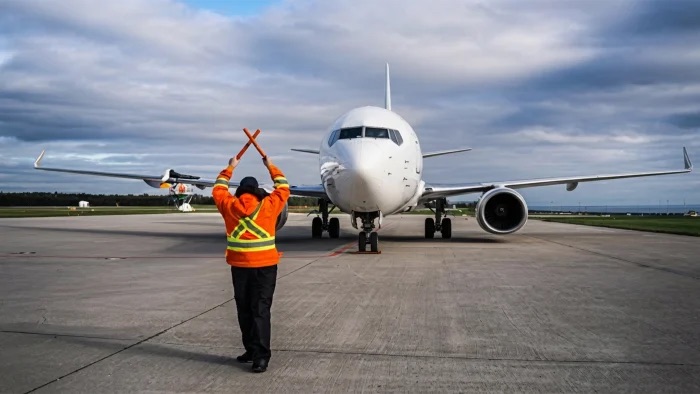
The unions shut down operations at major airports, including Lagos and Abuja, barricading terminal access and leaving thousands of passengers stranded.
Air Peace, United Nigeria Airlines and Enugu Air suspended or rescheduled flights as the disruption spread, while the three carriers were estimated to have lost more than N1 billion following the cancellation of over 80 flights.
Osifo said the unions embarked on the strike after negotiations over the issues failed, accusing some airlines of preventing their employees from joining trade unions.
He described the alleged restriction on unionisation as a violation of workers’ rights guaranteed under International Labour Organisation conventions and Nigerian law.
He said TUC had fully endorsed the strike and would continue to support the aviation unions until the underlying disputes were resolved.
“We have endorsed what they are doing 100 per cent, and we are giving them total support to ensure that these issues are resolved,” Osifo said.
He said about N25 billion in five per cent ticket charges due for remittance remained unpaid by airlines, adding that TUC would continue to engage the relevant authorities and stakeholders to recover the funds.
The TUC president warned against securing a temporary suspension of the strike without resolving the issues that triggered it.
“If you try to placate the issues without resolving them, and we call off the strike today, tomorrow there will be another strike again. So it is better we go to the root cause and resolve the issues once and for all,” he said.
The unions’ grievances also cover alleged non-remittance of Cargo Sales Charges and Charter Sales Charges which airlines are required to remit to the Nigerian Civil Aviation Authority (NCAA).
The unions had issued a notice of picketing on August 4, followed by a three-day strike ultimatum, after an earlier 14-day notice and subsequent seven-day ultimatum issued on July 28.
The NCAA Director-General, Capt. Chris Najomo, yesterday appealed to the unions to suspend the strike and return to negotiations, saying the Minister of Aviation and Aerospace Development, Festus Keyamo, was working to resolve the dispute.
The NCAA also blamed some airlines for the escalation, saying some carriers failed to attend a meeting convened by the minister the previous week.
However, the Airline Operators of Nigeria (AON) rejected the unions’ claims, arguing that airlines had no direct transactional relationship with the unions regarding TSC remittances.
Other News
The airline body described the strike as being based on misinformation and said domestic carriers were already operating under severe financial pressure caused by rising aviation fuel costs and multiple regulatory charges.
The Aviation Safety Round Table Initiative (ASRTI) also condemned the industrial action, particularly the targeting of Air Peace, describing it as disruptive and selective.
ASRTI said the recovery of statutory charges owed to regulatory agencies was the responsibility of government institutions rather than organised labour.
It further argued that the action could contravene provisions of the Civil Aviation Act and Trade Disputes Act governing strikes, picketing and blockades at aerodromes.
According to the group, Section 29 of the Civil Aviation Act designates services connected with safe flight operations, passenger embarkation and cargo handling within aerodromes as essential services, while Section 18 of the Trade Disputes Act restricts strikes where a dispute is undergoing official mediation or statutory dispute-resolution procedures have not been exhausted.
“The enforcement of statutory penalties and the recovery of debts owed to regulatory agencies remain the exclusive statutory mandate of the Federal Government and its empowered institutions,” ASRTI said.
The group urged the unions to pursue their grievances through established legal and dispute-resolution mechanisms, warning that continued disruption could undermine confidence in the aviation sector and affect investor perception.
Meanwhile, Osifo called on President Bola Tinubu’s administration and the National Assembly to accelerate the establishment of state police, arguing that concerns about possible political abuse should not delay reforms to address insecurity.
He said politicians constituted less than 0.1 per cent of the population and should not be allowed to prevent the majority of Nigerians from benefiting from a decentralised security architecture.
“How can we, because of less than 0.1 per cent of the Nigerian population, allow 99.99 per cent to suffer? That is not logical,” he said.
He also called for the deployment of modern technology and appropriate equipment to strengthen the country’s security architecture, describing insecurity as an emergency.
On the economy, Osifo said improvements in some macroeconomic indicators, including inflation and the exchange rate, had yet to translate into improved living conditions for workers and other Nigerians.
He said the naira remained undervalued and urged the government to work towards an exchange rate of between N900 and N1,000 to the dollar.
He also advised the Federal Government to continue food imports until domestic production was sufficient to meet national demand, warning that ending imports prematurely could trigger another increase in food prices.
According to him, farmers must first be able to return safely to their farms and increase production before the policy is discontinued.
On the petroleum sector, Osifo opposed the outright sale of Nigeria’s refineries, proposing that government retain a 49 per cent stake while competent private investors take 51 per cent.
He said the arrangement would reduce political interference and ensure that decisions on the refineries were based on commercial and technical considerations.