Follow Us on Google
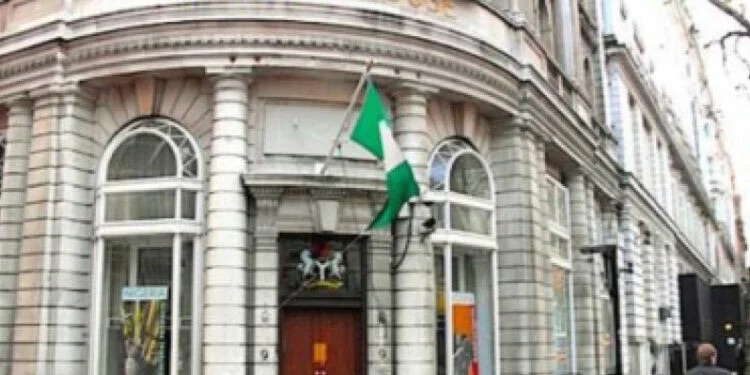
A commercial court in London has granted Zhongshan Fucheng Industrial Investment Co. Ltd final charging orders on two residential properties owned by Nigeria in the UK. The ruling by Master Lisa Sullivan came after Nigeria’s unsuccessful attempt to contest the court’s jurisdiction over the matter.
Zhongshan Fucheng seeks to enforce a $70 million investment treaty award against Nigeria. The case dates back to 2010 when Zhongshan, through its parent company Zhuhai Zhongfu Industrial Group Co. Ltd (Zhuhai), obtained rights to develop a free trade zone in Ogun State, Nigeria. In 2011, Zhongshan established Zhongfu International Investment (NIG) FZE (Zhongfu), a Nigerian entity, to manage the project with the Ogun state government’s approval.
However, in July 2016, the project took a contentious turn when Zhongshan accused the Ogun state government of attempting to terminate its management role and install a new operator for the free trade zone. This led Zhongfu to initiate an investment treaty arbitration against Nigeria under the bilateral investment treaty between China and Nigeria (the China-Nigeria BIT).
The arbitration panel found Nigeria in breach of its obligations under the China-Nigeria BIT, awarding Zhongshan compensation of approximately $70 million. In January 2022, Zhongshan began legal proceedings to enforce the arbitration award. Nigeria claimed state immunity, but this defense was rejected by High Court Judge Sara Cockerill, who noted that Nigeria had abused the time frame for appealing the arbitral award.
In July 2023, the UK Court of Appeal upheld the $70 million arbitration award against Nigeria. Subsequently, Zhongshan obtained interim charging orders on two properties in Liverpool owned by the Nigerian government. Nigeria opposed making these orders final, arguing that the properties were protected by sovereign immunity as they served consular functions and housed diplomatic personnel or events.
Despite these arguments, Master Sullivan ruled that the properties, leased to residential tenants, were not being used for consular activities. She referenced evidence of the poor condition of one property, indicating it had not been used for diplomatic purposes for 34 years. Sullivan dismissed Nigeria’s claims of improper service of the interim charging order applications and insufficient disclosure by Zhongshan.
Nigeria also argued that Zhongshan’s multiple enforcement actions made it difficult to ascertain the exact recovery amount. However, Sullivan stated that creditors are entitled to pursue various enforcement actions to recover their debt, noting that Nigeria had not yet paid any portion of the award and that the value of the seized properties was a small fraction of the total award.
Timi Balogun of Squire Patton Boggs, representing Nigeria, criticized Sullivan’s decision, arguing that it overlooked complex issues of public international law, state immunity, and the rights of foreign states to own and manage assets in England and Wales. Balogun indicated plans to appeal the decision to higher courts to address these significant issues thoroughly.
Treaty breach: UK Court authorizes Chinese firm to seize Nigeria’s properties in London
25 June 2024 7:19 pm WAT
 By
Rapheal
By
Rapheal
UK Court
Stay connected with The Sun Newspaper
Get breaking news, exclusive stories, and live updates delivered straight to your phone. Join thousands of readers already following us on Whatsapp Channel and Telegram.
Stay connected with The Sun Newspaper
Get breaking news, exclusive stories, and live updates delivered straight to your phone. Join thousands of readers already following us on Whatsapp Channel and Telegram.
Latest News

Broda Shaggi opens up on survival after stray bullet injury
21st October 2026


NMCN inducts 111 pioneer nursing graduates of MAAUN Kano
21st October 2026

Ekiti Assembly passes state police bill
21st October 2026

Related News