Follow Us on Google
From Abdulrazaq Mungadi, Gombe
When it comes to healthcare delivery in Nigeria, the statistics rarely inspire confidence. The country continues to grapple with high maternal and child mortality rates, overburdened tertiary hospitals, underfunded primary health centres, and an exodus of health workers seeking better opportunities abroad.

Against this backdrop, Gombe State is charting an ambitious new course. With the state’s maiden Health Summit, held on October 2nd to 3rd, 2025, proven to be more to a mere ceremonial gathering; it was a policy statement and a blueprint for systemic transformation.

Themed, “Transforming the Healthcare System in Gombe State: Accomplishments, Challenges, and the Next Frontier,” the two-day summit convened an unprecedented mix of national and international stakeholders. The presence of Nigeria’s First Lady, Oluremi Tinubu and the Coordinating Minister of Health, Prof. Muhammad Ali Pate, underscored the summit’s national significance.
Declaring the summit open, Sen. Oluremi Tinubu hailed Gombe’s “trailblazing and transformational” health policies, crediting Gov. Muhammadu Inuwa Yahaya for repositioning the state as a model for country’s healthcare system.
“What I have seen here is impressive. Even Bill Gates once acknowledged Gombe’s problem-solving mindset, and today we see that in action again. The governor’s commitment to expanding access, modernising hospitals, and tackling child malnutrition is exemplary.”
Her remarks came as Gov. Yahaya announced sweeping reforms, including the approval of the CONMESS and CONHESS salary structures for all state health workers, effective November 2025, an investment of N250 million monthly (N3 billion annually). “This commitment comes with a call to all health workers to match our effort with renewed dedication and professionalism,” the governor declared.
In his keynote address, Gov. Yahaya reflected on the state of the health sector when he assumed office in 2019. “Health was in crisis, facilities were dilapidated, personnel overstretched, and only 3.5 percent of the state budget was allocated to the sector, far below the 15 percent Abuja Declaration benchmark,” he said.
According to him, his administration’s first major decision was to declare a state of emergency in the health sector, setting in motion a decade-long reform process under the Development Agenda for Gombe State (DEVAGOM).
The results are tangible, he assured. According to the 2023 National Demographic and Health Survey, immunisation coverage in Gombe has surged from 18 percent in 2018 to 49 percent; DPT3 coverage rose from 26 to 60 percent; deliveries by skilled birth attendants increased from 21 to 38 percent; and contraceptive use among women doubled from 16 to 30 percent.
The state has revitalised 228 Primary Healthcare Centres (PHCs), each equipped for 24-hour operation with solar power, boreholes, and staff quarters. Major hospitals in Kumo, Bajoga, and Kaltungo have been remodelled, while the Gombe Specialist Hospital has been upgraded into a postgraduate training facility. The new 200-bed hospital in Kumo has also been converted into a Federal Medical Centre, affirming federal endorsement of the state’s progress.
Beyond infrastructure, the Yahaya administration has introduced strong governance and accountability mechanisms. The establishment of a Hospitals Management Board and biometric attendance tracking uncovered 440 ghost workers, saving the state N4.5 billion.
The governor also launched the Gombe State Contributory Health Scheme (GoHealth), which has so far enrolled more than 380,000 residents, including over 100,000 vulnerable individuals. Complementing this is GoPharma, a state-owned pharmaceutical company aimed at improving access to affordable drugs and eventually enabling local production.
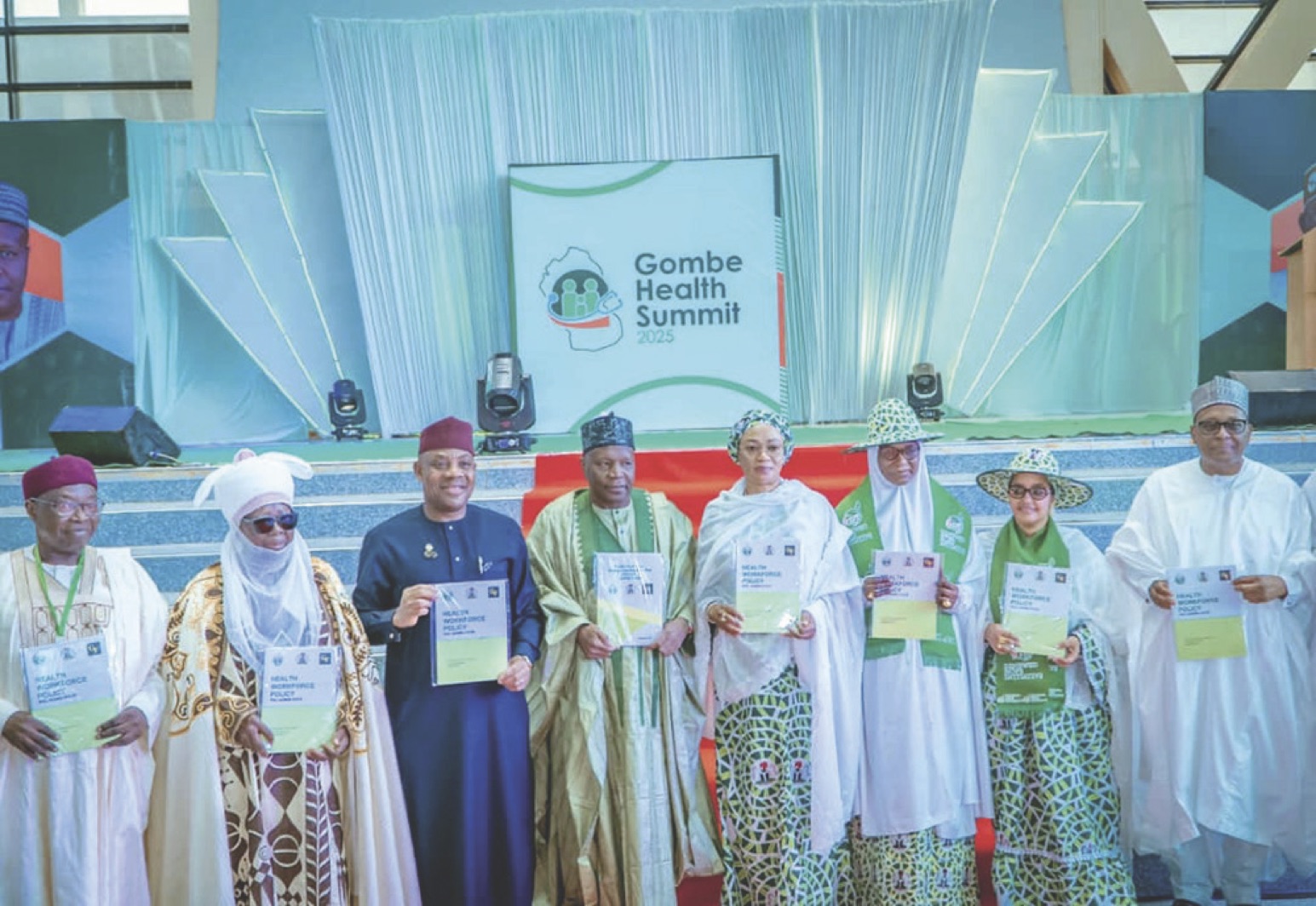
The new Gombe State Health Workforce Strategic Development Plan (2025–2030), unveiled by the First Lady, seeks to address the workforce crisis through structured recruitment, equitable deployment, and retention strategies, critical as Nigeria continues to lose thousands of health professionals annually to migration.
The summit placed emphasis on sustainable financing amid declining donor funding. The deputy governor, Dr. Manassah Daniel Jatau, who declared the event closed, stressed that “health is too important to be left in the hands of health personnel alone.”. He urged all sectors to share responsibility for health financing and delivery.
Panel discussions on “Financing Health in the Midst of Donor Funding Uncertainties” featured experts such as Dr. Emmanuel Emedo, who traced the history of donor dependence and the urgency of building self-reliant systems. Speakers advocated for innovative financing, public-private partnerships, health insurance expansion, and community-based funding models to cushion the effects of donor withdrawal.
The communiqué adopted at the close of the summit catalogued remarkable achievements: revitalised infrastructure, expanded workforce capacity, enhanced remuneration, and budgetary commitment of nearly 15 percent to health, meeting the Abuja target.
However, the summit also confronted enduring challenges: workforce shortages, urban-rural disparities, weak community engagement, donor fatigue, and limited local government financing.
To address these, delegates proposed data-driven workforce planning, expanded community health worker programs to boost health-seeking behaviour, rural posting incentives, and the integration of donor interventions into state-led programs. They also recommended leveraging technology for transparency, establishing a Tertiary Health Training Fund, and exploring the business potential of healthcare to attract investment.
Pate’s participation reinforced the link between federal and state-level reforms. He commended the progress made by Gombe in reducing maternal and child mortality, strengthening service delivery, and demonstrating measurable outcomes.
“The Gombe experience proves that effective leadership, planning, and accountability can transform health outcomes, even with limited resources,” he noted.
For Gombe, this visibility carries both prestige and responsibility. As other states battle donor dependence and workforce attrition, Gombe’s example illustrates how subnational innovation can drive national reform. But the test of sustainability will lie not in conference communiqués but in execution, whether PHCs in Nafada, Funakaye, and Shongom Local Government Areas (LGAs) receive trained staff, drugs, and functional ambulance services, and whether health workers remain motivated to serve.
Closing the summit, the deputy governor assured that all recommendations would be reviewed and implemented. “The administration will carefully consider every outcome and translate them into actionable policies to strengthen healthcare delivery across the state,” he said.
The mood among participants was cautiously optimistic. The consensus: Gombe has raised the bar, but follow-through will define success. If the reforms translate into tangible improvement, better maternal outcomes, faster emergency response, wider insurance coverage, then the summit will mark the beginning of a new chapter in the state’s development story.
In the end, Gombe’s bold health reforms have done more than convene experts; they have challenged the national narrative of failure in public healthcare. The task now is to turn momentum into measurable impact. If sustained, the Gombe model could become a reference point for how political will, smart policy, and accountability can redefine healthcare delivery in Nigeria.