Follow Us on Google
• ‘We’re innocent victims of FG, Lagos govt feud’
From Jude Chinedu, Enugu
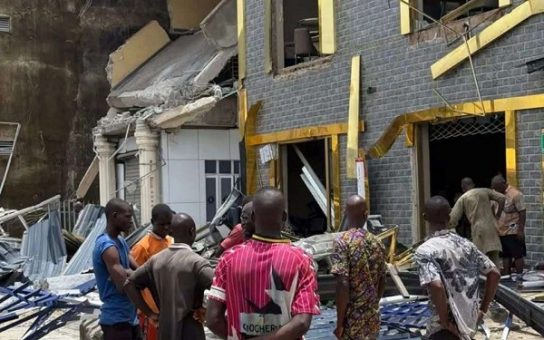
The morning sun had barely broken through the thick air of the Lagos International Trade Fair Complex on Thursday, September 25, 2025 when Magnus Ike realised his life’s work had been reduced to rubble. His white building, the flagship of Magnum Merchandise Limited, stood for years as a symbol of hard work, vision, and the stubborn resilience that defines the Igbo trader spirit.
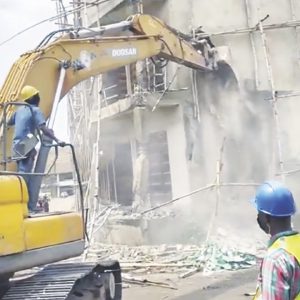
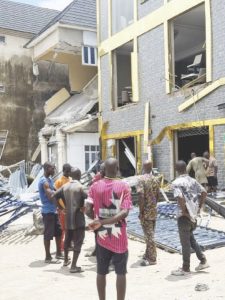
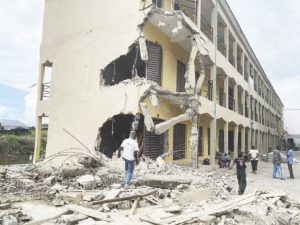
Now, it was a heap of concrete and twisted metal. “In all honesty, we are victims of when two elephants fight,” he said, his voice trembling as he stood before the ruins. “I have lost millions. Even if we are part of the problem, due process should have been followed.”
All around him, the air carried the bitter scent of dust and disbelief. Traders stood in clusters, many of them clutching documents, lease agreements, payment receipts, Federal Government approvals, like shields against an unseen enemy.
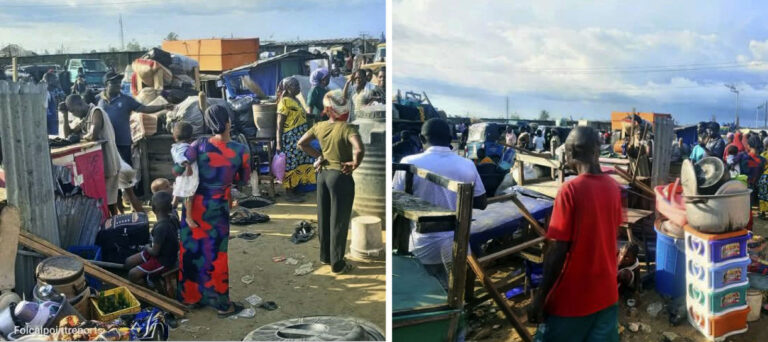
The New Mandela Plaza, once a humming market of commerce and hope, was now a scarred landscape. Nineteen buildings had been pulled down in a demolition that left hundreds of livelihoods upended. Men stared blankly at their flattened shops, women wept openly, and others simply watched in silence as bulldozers idled nearby under the watch of heavily armed security operatives.
The demolition, carried out under tight supervision by Lagos State officials and backed by task force operatives, Rapid Response Squad officers, and tactical teams, came without warning. The traders, mostly of Igbo origin, said there were no notices, no dialogue, no mercy. They described it as “willful, malicious, and illegal.”
The chairman of the Stakeholders’ Forum at the Trade Fair Complex, Chief Eric Ilechukwu, still struggles to make sense of what happened that morning. “State officials stormed the complex in commando style. They destroyed several structures without issuing any contravention notices. The lease agreements we signed clearly state that the Board is the approving and supervising authority for all constructions here. At no time were we served contravention notices,” he said.
For the traders, the demolition was more than a physical loss; it was a shattering of trust in governance, in fairness and in the fragile dream of coexistence that has long defined the relationship between the Igbo community and their host city of Lagos.
The complex, they pointed out, is not just another commercial space. It is federal property, established by law and governed by the Lagos International Trade Fair Complex Management Board Act. “The Trade Fair Complex is a federal property established by law and governed under the Act. Its ownership cannot be usurped by the state,” they insisted, accusing the Lagos state government of overreach and disregard for due process.
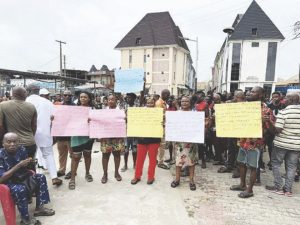
When the traders took to the streets in protest on September 29, their placards told their story in simple, searing words: “Stop destroying our properties,” “Our buildings are FG approved,” and “This complex is regulated by the Federal Government.”
From her office nearby, the Executive Director of the Lagos International Trade Fair Management Board, Vera Safiya Ndanusa, watched the protests unfold. She later came out to meet the aggrieved traders. “It is unfortunate that we were not carried along before this incident,” she said quietly, her tone sympathetic but weary. “But I assure you that all relevant ministries and agencies have been notified. The property belongs to the Federal Government, and we intend to resolve this matter amicably.”
But for many of the displaced, the damage runs deeper than what any meeting can repair. The demolitions have revived long-held fears among Igbo residents in Lagos, fears that their economic success continues to attract suspicion, resentment, and in moments like this, institutional hostility.
Deputy Speaker of the House of Representatives, Hon. Benjamin Kalu, voiced what many were thinking when he addressed the issue at a public event in Aba. “Mr. President,” he pleaded, “the destruction and demolition of the houses and offices of our brothers in Lagos make our hearts bleed. For some of them who have not gotten the right documents, my plea to you is to appeal to the governor of Lagos State to keep accommodating our brothers and allow them to rectify their documents instead of destruction. Let them come into the room, find a way, and regularise some of these documents. It bleeds our hearts that houses are being destroyed in these hard times.”
In his appeal, Kalu spoke to the heart of the matter, not merely the legality of structures, but the need for empathy in governance. “I know that Mr. President, who cares for the Igbo, who made the Igbo one of the first commissioners of finance in his administration, will listen to the yearning of Igbo,” he added.
That same note of compassion resounded in the words of Peter Obi, the 2023 Labour Party presidential candidate, who visited the demolished Auto Spare Part and Machinery Dealers Association (ASPAMDA) section of the market on October 30, alongside federal lawmakers including Senators Enyinnaya Abaribe, Austin Akobundu, and Victor Umeh. “Since then I have carefully followed the reactions trailing the demolitions, our visit, and feel that other extraneous variables are affecting our compassion for each other as Nigerians,” he said.
In a statement one week later, Obi drew from a personal story. “I recall an incident in the nineties when I bought a house in the UK at 66 Donnington Road, NW10. While the building was still being refurbished, some squatters moved in.
“When I consulted my lawyer, he advised that I should write to them formally and approach the court. It would have been unthinkable for the state to simply wake up one morning and demolish people’s houses, especially when such houses were neither used for crime nor taken for any overriding public purpose.
“Even if, for the sake of argument, some of the affected traders failed to obtain the proper approvals, which is unlikely, was demolition the only option? Does it truly serve justice to destroy billions of naira worth of investments and livelihoods when less destructive remedies could have sufficed? It is like punishing a man who stole a bicycle with death instead of imprisonment — a sentence grossly disproportionate to the offence. That is what these demolitions represent: a punishment that far outweighs any alleged infraction.”
He concluded by saying that “Governance must always balance law with compassion. A government should not pride itself on being legally correct if, in the process, it becomes morally wrong. Justice, to be just, must be tempered with mercy. These demolitions are a test of our collective humanity, justice, and compassion. Power must always be exercised with empathy, for it is in how we treat the vulnerable that the true character of leadership is revealed.”
The Lagos State Government has remained firm in its defence. Olumide Oluyinka, the Commissioner for Physical Planning and Urban Development, dismissed the accusation that the demolitions were ethnically motivated. “The affected buildings had no valid approvals. They were pulled down over safety concerns. The exercise was not targeted at Igbo traders,” he said.
That official explanation has done little to assuage public anger. Many point to a recurring pattern, a slow erosion of Igbo economic spaces in Lagos through demolitions, fires, forced relocations, and bureaucratic pressure.
The National Publicity Secretary of Ohanaeze Ndigbo Worldwide, Dr. Ezechi Chukwu, spoke for many when he described the demolitions as part of a larger “pattern of targeted economic sabotage.”
In his words: “Ohanaeze is deeply concerned about the willful destruction of Igbo-owned businesses and investments, particularly in Lagos and other parts of the country, under flimsy and unjustifiable pretexts. This pattern of targeted economic sabotage is unacceptable in a country we all call ours. We cannot, on one hand, call for national investment and, on the other, create a hostile and insecure climate for hardworking entrepreneurs who are helping to build the nation from the ground up.”
He continued: “The truth is that Ndigbo, irrespective of any part of the country they reside and the world over, have remained industrious and resilient. They have contributed immensely to the socio-economic fabric of our country especially through commerce, innovation, education and culture. However, it is still obvious that they remain burdened by systemic exclusion, unaddressed wounds of history, and the shrinking space for political and structural inclusion.”
The words of Ohanaeze evoke not just outrage but exhaustion – the fatigue of a people who have spent decades proving loyalty and belonging, only to be reminded that their success can be seen as encroachment.
Chief Abia Onyike of the Alaigbo Development Foundation (ADF) was less diplomatic. He said that, “Only those who are carrying out the destruction can say what motivated them to engage in such bestial and lawless destruction of properties.
“Unless the government is promoting anarchy, then that will be state-sponsored terrorism. It calls for a national emergency which President Tinubu should address, otherwise such acts of destruction if not checked can constitute a major threat to constitutional rule in Nigeria. This issue has nothing to do with Igbo or Yoruba leaders, it is a case of threat to public peace and citizen rights.
“Citizens are accusing the government of being behind the destruction of their properties for political reasons. Ethnicity and tribalism have always been there, but this is the most brazen, the most backward, and the most primitive step ever taken to score political points,” Onyike concluded.
On his part, a veteran scholar of political science, Professor Obasi Igwe, is of the opinion that what is happening in Lagos is not an isolated event but part of a sustained campaign.
He said: “These include direct demolitions, ‘strange’ market fires, frequent forced relocation of Igbo businesses to unconducive areas, targeted special taxes, rates and levies, officially overlooked or sponsored tout attacks, levies and robberies.
“This is an unlawful and cruel campaign of hunger, destitution, frustration, death and ethnic-cleansing against the Igbo by the Lagos State government, encouraged by a federal government’s body language that seems to say, ‘go on, nothing will happen.”
He described the situation as “a campaign of hunger, starvation, impoverishment and ethnic-cleansing against the Igbo in Lagos” and warned that “there is no other name than disguised genocide to what is being orchestrated against the Igbo in Lagos.”
Yet, even in his critique, Igwe urged restraint: “Igbo should do nothing to antagonize the Yoruba. Thousands if not millions of Igbo are married to them. It is only a marginal albeit powerful political tendency and a small fraction of the Yoruba that see the Igbo as their enemy number one. Apart from marriage, Igbo and Yoruba attend the same churches, make friends, children play together, and, above all, the future is unknown.”
The Coalition of South East Youth Leaders (COSEYL), the apex socio-political youth body in the region, echoed the same pain but tried to channel it toward dialogue.
Its President-General, Goodluck Ibem, said: “The Coalition of South East Youth Leaders stands in solidarity with the affected Igbo traders whose properties, goods, and shops were recently destroyed at the Lagos State International Trade Fair without any prior notice. This distressing incident not only highlights a serious violation of the rights of our traders but also raises crucial questions regarding the treatment of Ndigbo in Lagos State, a critical hub for commerce and trade in Nigeria.”
He went on: “We deeply condemn the actions taken by the Lagos State government which has left many Igbo traders in disarray. These traders had legal approvals and valid building plans for their properties, and the abrupt demolition of their shops and properties is not only unjust but also injurious to their livelihoods. The rights of citizens to conduct lawful business must be respected and protected.”
COSEYL warned that the incident “has further strained the already fragile relationship between the Igbo community and their host community in Lagos” and called for urgent engagement with the Lagos State Government to rebuild trust.
“We fear that continued disregard for the rights of Igbo traders will lead to escalating tensions and fuel further divisions between Ndigbo and their host community in Lagos. Igbo traders deserve reassurance and protection, and we urge all stakeholders to prioritise dialogue over actions that can provoke unrest.”
Beyond the immediate anger, the group proposed a series of reforms – regular forums between Igbo leaders and Lagos officials, better communication protocols, and empowerment initiatives for affected traders.
“We believe that through these initiatives and a renewed commitment to dialogue, we can rebuild trust, strengthen relationships, and ensure the thriving existence of Igbo businesses within Lagos State,” Ibem said.
Meanwhile, the Association of Igbo Town Unions (ASITU), led by Chief Emeka Diwe, took the matter beyond Nigeria’s borders.
In a strongly worded statement from Owerri, Diwe revealed that ASITU had petitioned the United Nations and ECOWAS. “The Association of Igbo Town Unions condemns in the strongest possible terms the ongoing, systematic demolition of lawfully acquired properties belonging to Igbo people in Lagos State,” he declared.
“The demolition of trading plazas belonging to Igbo businessmen at Ebute Ero Market in Lagos on February 14, 2025, amounts to a calculated expropriation of our people from their legitimate businesses. It represents an assault on justice, equality, and the fundamental principles of property rights.”
He continued: “Despite repeated appeals for fairness and adherence to the rule of law, the Lagos State Government has continued its brazen campaign of selective demolition, disproportionately targeting Igbo-owned properties under various pretexts. It must be noted that the buildings and business complexes being demolished were never illegally built. They all came into being through the authorisation of this same government masterminding their destruction today.”
For ASITU, the demolitions are not just local acts of injustice but violations of international human rights norms. “We have formally petitioned the United Nations Human Rights Council, the African Commission on Human and Peoples’ Rights, and the ECOWAS Court of Justice,” Diwe said. “This is not just a legal battle, it is a fight for justice, dignity, and equal citizenship in a country that belongs to all Nigerians.”
In the heart of Lagos, however, far from the rhetoric and resolutions, the human cost continues to mount. Traders who once paid rent and taxes now sleep in their cars or on bare floors, their stock ruined, their confidence shaken. “This is not about tribe, this is about humanity,” said a trader who gave his name only as Obinna. “We came to Lagos to trade, not to fight. But every few years, something reminds us that we are guests, not citizens.”
For decades, Igbo traders have formed the backbone of Lagos’s commerce, from Alaba to Ladipo and to Balogun. They have built markets, created jobs, and turned once-deserted areas into bustling centres of trade. Yet, the demolitions have reopened an old wound, the fear that no matter how much they invest, Igbo success in Lagos will always be precarious.