Follow Us on Google
It doesn’t matter where a man comes from. North, south, west or east of the Niger River—none of that matters to me. What matters is the content of a man’s heart: his humanity, his kindness, his brotherliness, his refusal to let the politics of tribe and tongue stain the purity of friendship. That is why, today, I celebrate my friend and brother, Dr. Poly I. Emenike, MON—an extraordinary Nigerian who has risen above the limitations of birth, background and war to become one of the shining lights of our entrepreneurial firmament.
Seventy years. Three score and ten. It is not a walk in the park. It is a marathon. A journey through valleys and mountains. Through thick and thin. Through sun and rain. Through storms that would have broken a weaker spirit. But here he stands: unbroken, unbeaten, unbowed. A man who has tasted the bitterness of poverty and the sweetness of success; who has seen war at close range and still kept his heart tender; who has endured darkness yet walks today in the fullness of light.
His life reads like a fable—one of those fairy-tale stories you tell children at bedtime to inspire hope. But this one is real. Very real.
When Nigeria went to war in 1967, Poly was just a child in Nanka, Anambra State. A child forced to grow up too quickly—robbed of innocence by the horror of bombs, hunger, fear and loss. War does not negotiate; it does not apologise. It strikes, and its scars linger for life. Whenever Poly talks about the war, he does so with a voice heavy with memory. War, he warns, is not something to joke about. It is trauma. It is deprivation. It is retrogression. It is a thief of childhoods and dreams. Little wonder that anytime he hears reckless drums beating today, he shakes his head like an elder who knows what the young do not: that war is absolute waste—of lives, of futures, of destinies.
In 1971, the newspaper Renaissance published the names of pupils who passed the entrance exam into secondary school. Poly’s name was there. But there was no money. His parents simply could not afford to send him. His dream of education went up in smoke. Instead of a classroom, he found himself in Onitsha, serving a lawyer—his maternal uncle—as a houseboy and office assistant. For two years, the young Poly washed plates, swept floors, served guests, and ran errands. Many in his shoes would have resigned to fate. But not Poly. He had a dream, however faint, however distant.
After leaving his uncle, he began selling slippers in Onitsha Market—one of Africa’s biggest universities of street wisdom. There, he learnt hustle, negotiation, customer psychology, resilience. But more importantly, he learnt to dream.
Then came the turning point—the day he walked into a bookshop and picked up a book by the legendary Napoleon Hill. That moment changed his life forever. He didn’t understand the book at first. The words were big. The concepts difficult. But Poly refused to be defeated. With a dictionary by his side, he read. And read. And read. Until Hill’s principles began to sing in his soul. Think and Grow Rich. The Law of Success. And many others. He devoured them. They became his gospel. He became an apostle of Napoleon Hill in Nigeria—armed not with theological doctrine but with the principles of vision, self-belief, discipline, persistence and controlled attention. Hill planted a seed in him. And that seed grew into a forest.
One of the most astonishing chapters of Poly’s life is his return to school as a married man with five children. While his mates were attending PTA meetings, he was wearing the uniform of a secondary school student—sitting among teenagers, some young enough to be his children. But did he care? No. His eyes were on the prize. He passed his exams. Went to the University of Lagos. Graduated with Bachelor’s and Master’s degrees in Business Management. Then travelled abroad to earn a PhD. A man who once couldn’t afford secondary school became a doctor of philosophy. If that is not the triumph of the human spirit, then nothing is.
Before academia, Poly was grinding at Idumota, the bubbling commercial underbelly of Lagos Island. He sold pharmaceuticals. He hustled. He learnt. He failed. He rose again. His adventurous spirit took him around the world—to Brazil, China, Vietnam—in search of opportunities. It was in Viet Nam that he discovered artesunate, a powerful anti-malaria drug. That discovery became his own sesame—the magic door that opened into industrial greatness. Today, his company, NEROS Pharmaceuticals, based in Sango Ota, Ogun State, is a major player in the Nigerian pharmaceutical industry—producing artesunate and other essential medicines, providing jobs, contributing to economic development and touching lives across the country.
Poly is not just a businessman. He is a philanthropist. He built a stadium in his hometown of Nanka. He supports education, health, community development. He believes that success without giving back is failure in disguise. Little wonder his people honoured him with the chieftaincy title Odenigbo Nanka. And the Federal Government of Nigeria honoured him with MON—Member of the Order of the Niger.
Other News
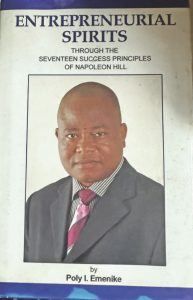
Many do not know that Poly Emenike is also an author. A passionate one. Napoleon Hill didn’t just change him—he inspired him to write. His books include Think and Grow Rich—African Perspective and Entrepreneurial Spirits: Through The Seventeen Success Principles of Napoleon Hill, a book so compelling that it earned forewords and endorsements from global names like Dr. J.B. Hill (Napoleon Hill’s grandson), Dennis Kimbro, Sharon Lechter and Professor Pat Utomi, who described Poly as a living testimony to the triumph of the human spirit.
My late friend and brother, Dimgba Igwe, and I met Poly while researching entrepreneurial success stories. What drew us to him was not just his success but his humility. His simplicity. His infectious love for books. His capacity to laugh and to inspire. His refusal to let bitterness from the past define his future. That friendship has endured. And today, it deepens as I celebrate him at 70.
Dear Poly, you have lived a life of courage, resilience and faith. You have turned adversity into advantage. You have rewritten your destiny with your own hands. Your story is a beacon for millions of young Nigerians who think their background is a barrier. You prove that it is not where a man starts but where he is going that matters.
At 70, may God grant you peace, strength and fulfilment.
May you never hear the drums of war again.
May your light continue to shine.
May your story continue to inspire.
May Nigeria—your country of hope and heartbreak—learn from men like you, men who believe in possibility, in unity, in peace.
Happy 70th birthday, my Eastern brother.
One nation. One people. One destiny. One God.