Follow Us on Google
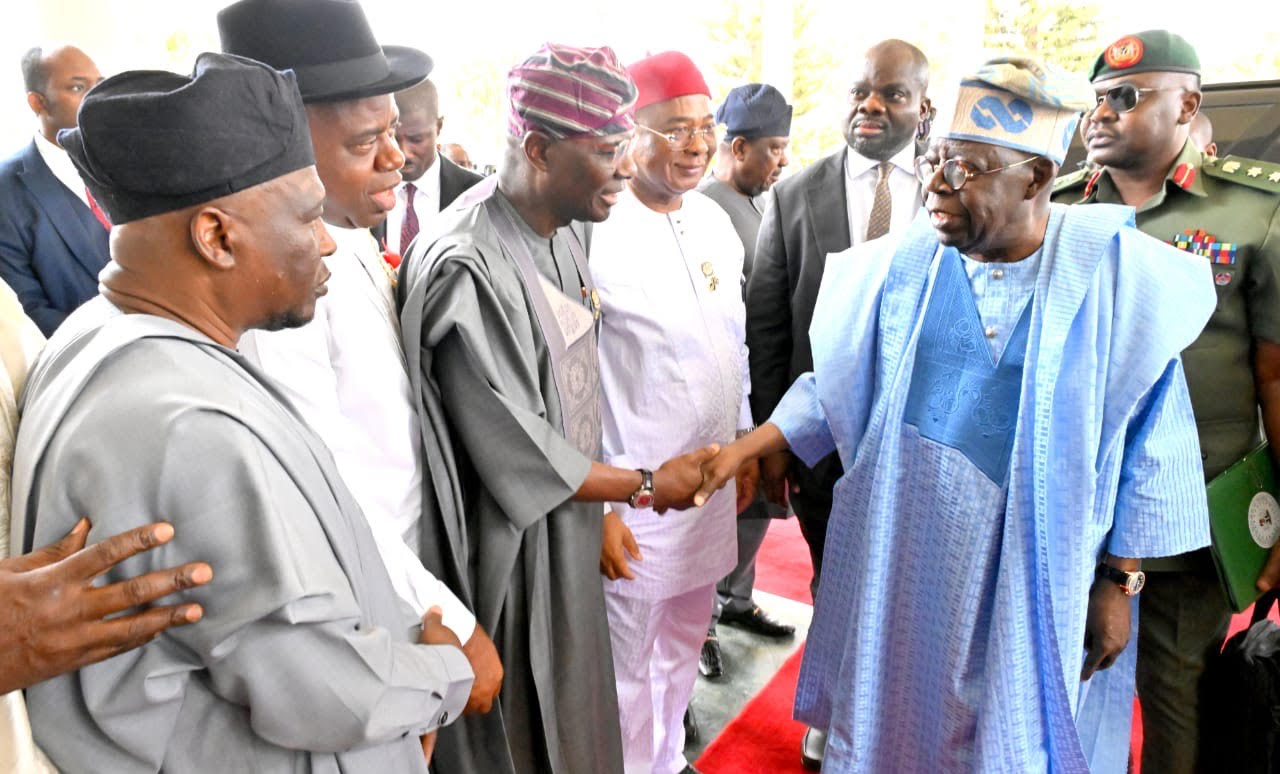
• Private sector, devt partners back reforms, pledge support for $1trn economy, security
_______________________________________
From Juliana Taiwo-Obalonye, Abuja
President Bola Tinubu on Monday vowed to decisively defeat terrorism and banditry, declaring them “unacceptable” and “foreign” to Nigeria’s culture, as he opened the second National Economic Council (NEC) Conference in Abuja.
Addressing governors, ministers, and diplomatic stakeholders at the State House Conference Centre, Presidential Villa, Tinubu positioned security as a non-negotiable foundation for the nation’s economic transformation under the theme, “Delivering Inclusive Growth and Sustainable National Development: The Renewed Hope National Development Plan (2026–2030).”
“I believe we are here again to further find means to strengthen our security forces, to defeat terrorism and combat banditry,” Tinubu pledged. “That, I promise you, is what affects all of us, keeps us sleepless at night, but I assure you that we will win with determination and resiliency.”
He stressed that “we will overcome this unacceptable terrorism and banditry; it is not part of our culture. It’s foreign to us,” adding, “So it’s an economic hindrance if we do not find immediate solution to it.” Tinubu commended frontline governors, particularly from Borno and Kaduna states, for their efforts: “I commend many of you, particularly the governor of Borno State, governor of Kaduna, and many of you who have done so much… to defend our freedom, liberty, and our commonwealth.”
Linking security to prosperity, the President emphasised coordinated action across federal, state, and local governments. He promised continued investment in modern equipment, intelligence, and training, underscoring that such threats must be neutralised to unlock growth.
Tinubu framed these vows within broader reforms, noting macroeconomic gains such as a more stable exchange rate and moderating inflation under Central Bank Governor Olayemi Cardoso, alongside increased federal allocations to states for salaries and infrastructure. He outlined the Renewed Hope Plan’s focus on diversification—including seven new mechanisation zones for agriculture and livestock—while insisting NEC members shift “decisively from declarations to implementation.”
“The Renewed Hope agenda is a national contract, a promise that the sacrifices of Nigerians will lead to a stronger, fairer, and more prosperous nation,” he declared, formally opening the two-day gathering.
In his keynote, Vice President Kashim Shettima hailed NEC as the “engine room for consensus building and coordinated action,” crediting its vitality to robust debate rather than mere agreement. “It is not the size of a membership that gives a union its confidence, neither is it the frequency of agreement that defines it. What fully gives meaning to a union like ours is the quality of ideas that animate it,” he said. “Month after month, we have disagreed, we have debated, we have tested one another’s assumptions. We have agreed. Yet what has kept the National Economic Council alive and relevant… is our shared awareness of what is at stake if we fail.”
Shettima emphasised NEC’s role in inclusive growth amid global challenges, praising President Tinubu’s reforms: “No one here will deny the sincerity with which His Excellency, President Tinubu, has honoured his promise to insulate the Nigerian economy in a world increasingly shaped by geopolitical tensions and rising economic protectionism.” He urged action so “a child born in Lafia… has the same chance to thrive as one born in Lagos,” and called for fiscal reforms, inter-regional trade, and translating resolutions into “legislative and executive action.”
Noting the absence of the Kwara governor due to security issues, Shettima led a minute of silence for victims nationwide “from Anambra to Sokoto,” and saluted the armed forces: “May the souls of all the victims of insurgency and banditry rest in perfect peace and may God give our armed forces the courage and protection to confront the challenges at the front lines.”
Minister of Budget and Economic Planning, Senator Atiku Bagudu, on his part, described NEC as “an important constitutional advisory body… that gives voice to all the federating units and generates confidence and consensus,” praising Tinubu’s engagement: “It is noteworthy that in the last two years, Mr President has attended several meetings of the National Economic Council, a reflection of his respect for our federalism.”
Other News
He highlighted global acclaim, noting that a World Bank delegation last week declared “Nigeria’s reforms had become the world’s reference material,” while an IMF report ranked Nigeria among the “Tip Top 10 countries contributing to global growth.” The Economist, he added, appreciated that “the difficult choices that Nigeria has taken under the leadership of President Bola Ahmed Tinubu are beginning to pay off.”
Urging focus on implementation, he asked: “How do we sustain the momentum? How do we ensure it works for everyone? How do we equip our populace with requisite skills to compete?… How do we eliminate poverty and generate a $1 trillion economy by the year 2030?” He called for mobilising all tiers of government, stressing that “true federalism lies in our ability to recognise the potentials of the lowest levels of government… closest to the people.”
Chairman of the Nigerian Governors’ Forum (NGF) and Kwara State Governor, AbdulRahman AbdulRazaq, represented by Ogun State Governor, Dapo Abiodun, positioned states as central to Nigeria’s economic reset, stressing intergovernmental coordination amid security challenges.
AbdulRazaq hailed post-2023 reforms: “Our country has engaged in a deliberate economic reset, adjusting old assumptions, confronting inherited constraints, and making necessary choices even when they are difficult.”
He emphasised subnational roles: “Macroeconomic outcomes are ultimately produced at the sub-national level through state investment decisions, tax administration, service delivery, security outcomes, and human capital development.” Fiscal federalism, he said, “is not an academic conversation. It is a practical imperative. States are not peripheral to economic management. They are central to competitiveness, growth, and social stability.”
He linked growth to everyday realities: “National transformation ultimately happens at the community level… where citizens experience the economy… as jobs, prices, security, schools, healthcare, and opportunities.” Stressing unity, AbdulRazaq declared: “No single tier of government can deliver inclusive growth alone. Federal policies require state-level execution. State initiatives require national coherence.”
The NGF, he added, seeks “frank conversations and practical solutions… for inclusive, resilient, and trusted growth” toward a $1 trillion economy.
Leaders from the organised private sector and development partners also reaffirmed commitment to Nigeria’s economic transformation, praising President Tinubu’s reforms while prioritising inclusive growth, security, and partnerships.
The President of the Nigerian Association of Chambers of Commerce, Industry, Mines and Agriculture (NACCIMA), representing the organised private sector, stressed execution: “Sustainable economic progress is achieved not only through sound policy formulation, but through capacity to operationalise those policies, mobilise capital, scale enterprise, and deliver measurable outcomes.” He positioned NACCIMA as “central… bridging strategy and execution, strengthening implementation, and ensuring that national and sub-national priorities translate into growth, jobs, and productivity.”
Highlighting NACCIMA Global as a platform for “economic diplomacy… into practical commercial partnerships,” he pledged: “NACCIMA reaffirms its commitment to working with NEC, the federal government, and state governments to support implementation-focused reforms that deepen competitiveness and attract investment as well as deliver inclusive economic outcomes nationwide.”
UNDP Resident Representative, Elsie Attafuah, speaking for the Nigeria Development Partners Group, commended the Renewed Hope Plan (2026–2030) and the “$1 trillion economy” ambition: “We commend the Government of Nigeria for grounding this process in ambition, consultation, and a clear focus on delivery.” She praised Tinubu and Vice President Shettima for “landmark reforms that provide a strong foundation,” especially the “people-centred” ward-based system to “strengthen accountability and improve service delivery.”
Attafuah outlined four priorities—“inclusive growth; governance and democracy; security and stability; and finance and development”—urging sustained government ownership: “Progress in these areas will be critical to translating reform momentum into tangible improvements… particularly in strengthening security, harnessing Nigeria’s diversity… and accelerating economic diversification to reduce poverty.” She proposed “a high-level strategic engagement with [NEC]… once a year to jointly reflect on progress [and] deepen collaboration.”