Follow Us on Google
By Steve Agbota
Last week, President Bola Tinubu marked three years in office and Nigeria’s maritime sector presents a picture of both progress and unfinished reforms.
Since assuming office, Tinubu has introduced a series of policy initiatives aimed at addressing long-standing challenges that have constrained the growth of the maritime industry for decades.
For years, Nigerian ports lagged behind their counterparts across West and Central Africa in efficiency, cargo throughput, and overall competitiveness.
The sector also operated without a dedicated ministry, remaining under the Federal Ministry of Transportation despite repeated calls from industry stakeholders for a standalone institution to drive its development.
Successive administrations largely ignored those appeals, leaving the industry without a clear strategic direction and burdened by numerous operational bottlenecks. Industry estimates indicate that persistent inefficiencies, poor policy alignment and weak implementation have cost Nigeria approximately N7.97 trillion annually in lost economic opportunities.
A major turning point came in August 2023 when Tinubu established the Federal Ministry of Marine and Blue Economy. The move was designed to diversify national revenue sources beyond crude oil by harnessing Nigeria’s vast maritime resources and unlocking an estimated $296 billion in untapped economic potential.
The creation of the ministry was widely welcomed by stakeholders, who viewed it as a long-overdue step toward unlocking the sector’s enormous potential. However, three years into the administration, assessments remain mixed, with many industry players arguing that several expectations are yet to be fully realised.
Supporters of the administration point to notable achievements, including efforts to attract foreign investments and financing for port infrastructure, Nigeria’s successful return to the International Maritime Organization (IMO) Council, the appointment of an experienced customs leadership team, progress toward implementing the National Single Window project, and improved foreign exchange stability.
Yet, critics contend that the sector continues to grapple with deep-rooted challenges. Corruption, the absence of a national shipping line, weak local content implementation, inadequate holding bays and functional quays, insufficient truck parks and chronic traffic congestion around Lagos ports remain significant obstacles to efficiency and growth.
One of the most glaring gaps is the absence of a national shipping fleet.
Despite its status as a major maritime nation, Nigeria still relies heavily on foreign vessels to transport its cargo, resulting in an estimated annual freight outflow of about $10 billion.
Industry stakeholders had expected the Tinubu administration to prioritise solutions to such challenges within its first three years. A key issue has been the long-delayed disbursement of the Cabotage Vessel Financing Fund (CVFF), established to support indigenous shipowners but left dormant for more than two decades.
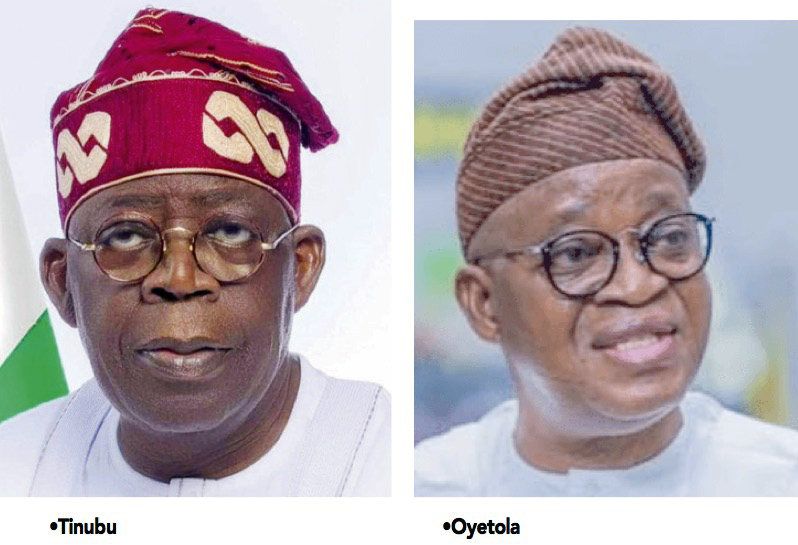
In what many regard as a significant policy breakthrough, the Minister of Marine and Blue Economy, Adegboyega Oyetola, recently directed the Nigerian Maritime Administration and Safety Agency (NIMASA) to commence the long-awaited disbursement process.
Describing the move as a departure from years of inaction, Oyetola said: “Successive administrations failed to operationalise the fund until now. Under President Bola Tinubu and my determined stewardship, the federal government has signalled a deliberate course correction.”
Beyond financing, stakeholders maintain that corruption remains the sector’s biggest challenge. They argue that comprehensive digitalisation of port operations is essential to reducing human interference in cargo clearance processes, which often creates opportunities for rent-seeking and delays.
According to industry operators, expanding digital systems across the maritime value chain would not only minimise human contact but also improve transparency, boost government revenue, and accelerate cargo clearance procedures. While some progress has been recorded, many insist that full digitalisation remains critical to unlocking the sector’s true potential.
Key performances
While some stakeholders criticised President Tinubu for not meeting their expectations, others praised him for recent policies aimed at repositioning the maritime industry. They believe that if these policies are well implemented, the sector will significantly improve for all involved.
According to stakeholders, the maritime industry is in the right direction as Tinubu’s reforms signal growth. They highlighted the implementation of the long-stagnated National Single Window, Comptroller General of Customs becoming the Chairman of the World Customs Organisation, the Managing Director of the Nigerian Ports Authority becoming the Chair of the Port Management Association of West and Central Africa (PMAWCA), the clearing of deadly gridlock along the nation’s ports and many others as key performances of Tinubu in three years in the maritime industry.
Just recently, the World Bank ranked Nigeria’s two busiest seaports, Tin Can Island Port and Apapa Port, among the world’s top 20 most improved container ports.
Tinubu approves Nigeria’s 10-year National Policy on Marine and Blue Economy
In three years of Tinubu in office, President Tinubu approved Nigeria’s 10-Year National Policy on Marine and Blue Economy, spanning 2025 to 2034. The policy, backed by a robust implementation plan, is designed to harness Nigeria’s vast marine resources to drive economic growth.
This approval comes amid growing global interest in the blue economy. Anchored in a comprehensive framework, the policy aims to leverage Nigeria’s extensive marine resources, including over 853 kilometres of coastline, as a key driver of sustainable economic growth, environmental stewardship, and job creation. A notable achievement of the policy is its role in stabilising the naira-dollar exchange rate, unlike previous periods of dollar fluctuation that slowed importation and discouraged importers from operating in Nigeria’s ports.
Furthermore, 16 years after previous failed attempts, Tinubu approved Nigeria’s hosting of the long-awaited Regional Maritime Development Bank (RMDB) and appointed a Nigerian, Mr Adeniran Aderogba, as the Bank’s first President and CEO.
This approval marks the historic launch of a project that has been in progress since 2009, when member states of the Maritime Organisation of West and Central Africa (MOWCA) first approved the bank’s establishment.
The RMDB is envisioned as a dedicated financial institution providing long-term funding for port infrastructure, fleet acquisition, shipping logistics, and intermodal transport systems.
Under Tinubu’s administration, China and Nigeria also renewed a 15 billion yuan ($2 billion) currency-swap agreement aimed at enhancing trade and investment between the two nations.
The renewal of the currency-swap deal is expected to deepen economic ties, facilitate cross-border trade, and encourage investment by reducing reliance on third-party currencies such as the US dollar.
The arrangement is also anticipated to bolster financial cooperation and promote broader use of the yuan and naira in bilateral transactions.
Nigeria reaches a £746m deal with the UK to upgrade ports
Under Tinubu, Nigeria has entered an export finance deal of £746 million with the United Kingdom, aimed at modernising two of its major seaports, Lagos Port Complex and TinCan Island Port Complex, and positioning them to be globally competitive.
The UK Export Finance is guaranteeing the fund, which will enhance maritime logistics and trade efficiency at the country’s busiest seaports.
The deal came during President Bola Tinubu’s state visit to King Charles of Britain at Windsor Castle.
“Together, the two ports handle more than 70 per cent of Nigeria’s imports and exports and serve as the central arteries of the nation’s maritime trade,” a statement by the Federal Ministry of Marine and Blue Economy said.
The loan was arranged by Citibank and will enable British companies to facilitate £236 million of the supply. British Steel will handle a £70 million contract in the course of the project. The push, which supports the deepening of harbour channels, fortification of quay walls and installation of state-of-the-art cargo-handling machinery at the ports, will also advance trade between Nigeria and the UK, currently estimated at £8.1 billion annually.
Digital transformation aimed at increasing efficiency in the operations of the ports is central to the redevelopment projects, which are anticipated to span 48 months, with the first quarter of 2026 set as the commencement date.
“What we are set to do is not merely an upgrade, but a comprehensive transformation that will bring our ports into alignment with international best practice,” said Gboyega Oyetola, the minister of marine and blue economy.
“Modern infrastructure supported by digitalised and automated processes will significantly enhance efficiency, transparency, and operational reliability. Our objective is clear: to create a port system that is modern, competitive, and capable of serving as a strategic maritime hub for West and Central Africa,” he added.
The upgrade will include an automation of customs clearance processes as well as an integration of the National Single Window platform, an initiative aimed at implementing a centralised electronic trade platform. It is also planned to support an expansion of port capacity and curb operational bottlenecks that have hampered cargo movement at the ports.
Stakeholders’ views
A Customs broker and Managing Director of Mikky Excellency Nigeria Limited, Alhaji Abdulazeez Babatunde Mukaila, said the impact of President Tinubu in the maritime industry has been so huge in the last three years.
Other News
“We now have the Ministry of Marine and Blue Economy, which we have never had before. We now have just a ministry returning some revenue to the government coffers.
“We have the Nigeria Customs Service having a huge mileage in increasing their revenue generation. That has never happened before as well. We have the Nigeria Customs Service that is doing everything to digitise and make our activity more seamless with the advent of the B’Odogwu and the National Single Window. In a nutshell, it has never been so good. And I believe they can still do more.
“As a practitioner, I think we are moving in the right direction. The recent agreement with the UK to renovate our port to the tune of about 700 million pounds. The major issue has been the structural depreciation of port equipment and superstructures. We have a government that is looking into that. So far so good. I think it has been a jolly good ride.
However, he urged the Nigerian government to beam a searchlight on the concessionaires, saying that the concessionaires are making the kind of money that they would not necessarily pick up in any other part of Africa.
According to him, nobody is compelling them to give back, and the government needs to beam a searchlight on them because they are not providing the equipment and the capacity to match the pace the Nigerian government is going.
“The issue of digitalisation as well. We need fast internet to complement what Customs are trying to achieve. We need electricity to be up and running properly so that the port can be light 247. With that, there won’t be anybody closing by 4 o’clock, 5 o’clock, going home. While the process reaches an abrupt end.
“There can be a shifting of officers provided when the port is lighted properly. These are the key areas that I think we need to do more. Corruption still needs to be tackled. When digitalisation is enhanced, human contact will be reduced. And corruption can be reduced to some very appreciable level.
Presently, human contact is still there. This means the government could have made more in terms of revenue. And the cargo clearance procedure would have been more seamless if we had been able to tackle those human elements,” he said.
The Head of Research, Sea and Empowerment Research Centre (SEREC), Dr Eugene Nweke, said that, looking at the contributions of Mr President in the maritime industry from a critical point of view, he said that the first thing Mr President did was to extract the marine and blue economy from the transport ministry, whereby giving the maritime industry a special designation.
According to him, that new ministry now has a particular minister who oversees the workings and management administration of the marine ministry, and all the agencies within the maritime industry are now under direct ministerial administration.
“This is why you also see that as soon as stakeholders crafted what we call a national marine and blue economy development policy, Mr President also got accepted to it and got the working document for us to advance and develop the maritime sector.
“Now, what is the content? The content is for us to leverage in looking at our marine domain, to leverage all resources as far as it concerns the maritime industry, be it the underwater beds, aquatics, the surface movement of crafts, the ship administration, port expansion, and of course, the mineral resources that we have to also tap from the ground and the fishing.
“This is a new area for us to explore. And for us to look at it, if we properly put it in place, that will create and give us more employment, job creation, which is in line with the New Hope agenda of Mr President.
“So, this key effort by Mr President is a focus-looking achievement. Next to it is the effort to put in place to disburse the Cabotage Vessel Financing Fund (CVFF), which is now under his administration. We have seen a reasonable approach to disbursing that fund after being kept for over 12-15 years.
“So, this is also laudable if this money is eventually disbursed, so that local shipping arrangements by ship owners will increase and add value to our waterways. Then, you also see that under the present administration, the present table was able, in the recent time, to attract financial investments or foreign investments in our port system.
“One is the high-tech, the other one is now the British loan and the decision to help in expanding the Western ports. Now, this is a key milestone achievement any president will have achieved within the space of time, while also having a good minister who has a listening ear. So, this to me, as a research fellow, who considers it noble that within the three years of President Ahmed Bola Tinubu, we see meaningful changes and impact-setting policies that will actually drive the process going forward,” he said.
He said that through the working arrangement with the National Assembly, he was able to give development commissions regionally. He said that the West has its own, the East has its own, and the South has its own, and even the North has its own.
“Now, if you look at what the West is doing, the West has devoted effort. That commission is at the point of concluding the interlink between the eastern states, linking them to Lagos. That is for transport, making transportation much easier. Now, going forward, interconnectivity and a multimodal transport system should be the focus line.
“I’ve also seen, under President Tinubu, the efforts he has put in place to ensure that the Africa-Continental Trade Agreement, which is ongoing, receive a boost by assigning billions of Naira for exporters to maximise. So, to me, this is a positive drive as a maritime person.
“Of course, you cannot jettison the idea that under his administration, the minister-galvanise, and Nigeria is now occupying the third seat and the IMO seat, IMO seat Category C. So, all these things, any sound mind in the industry will look at us and say, Mr President is actually putting his best. Of course, you know there has been a backlog. So, even when you look at the best, it takes somebody that has an appreciative mind to say, “Yeah, gratitude to Mr President,” he said.
The President of the Shippers Association of Lagos State (SALS), Comrade Nicodemus Odolo, said that President Tinubu really has impacted the maritime industry, but there is an opportunity to do better.
“He did well. And when I talk about doing well, for instance, I’m talking about the National Single Window. The National Single Window Project is a fantastic project. The only problem Nigerians are having is that they are not thinking, they are not researching to know how to finish what they started. They don’t have the spirit of perfection. So, the Single Window is a good project that the President put in place.
“I gave it to him, but the implementation was not perfected. Because people are there, I don’t think they research enough, and they are not knowledgeable enough. I asked them several questions. You can see in Nigeria today that communication failure is a problem. Electricity power is a problem. So, in a country where we are having this kind of problem, it is difficult to have a good digital system in operation.
“So, that is a challenge. And as I said, they do not have the spirit of perfection. The program here is drawn in, and they need to research how to carry it out. And that is why we had some hook-ups when they started. And even when you are going to start such a programme, there should be a technical committee that is sound. In research work, ICT work, and all those things. That will be so dynamic that they work ahead of every problem. Problems that might arise, they will be known, and solutions will be provided. That is how you work,” he added.
He said that the government cannot just put the people in place, which is a problem Nigeria is having, saying that putting the right people to do the right thing is rare.
“Those who know how to do the thing, they will not be allowed to be there. So, that is a problem. Tinubu has tried. The Blue Economy Ministry is also trying.
But like I said, yes, no man is an island of wisdom. Some people have knowledge of this thing. Get the right people to research it.
“Maybe advise the minister on how they will do. So that they will have a deep understanding of the blue economy. The blue economy alone can feed Nigeria and take care of Nigeria’s economy. It all depends on who is in the driver’s seat. What are they doing? How do they go about it? So, that is just what I can say. He has impacted and done well,” he said.
But in some areas, he expects the government to do something in the shipping line, saying that Nigeria will not benefit from the volume of cargo that it generates or receives in the country if it is still foreign shipping lines that are carrying the nation’s cargo.
“So, we are losing. Serious revenue leakage. We should have our own national shipping line coming back to life. National airlines should come back. These are some of the things they need to do. For the government you have in Nigeria, this is the richest government. They have more money than you know, but they still go about borrowing money. And they are obliging them to get more money to spend. So, that is what I have to say,” he said.
Also speaking, Managing Director of Harsecom Logistics Limited, Haruna Omolajumo, said: “If you consider human and the Nigerian factors, I would give kudos to President Tinubu. Because why I would give kudos is that, as a human being, he is still trying his best to make sure that the maritime industry is up to the world standards. And I will give you examples. To me, I can give him about 75% credit for what we have achieved so far in the maritime industry.
“First of all, for the first time in over 30 years, as we take a look at the fighting for the Ministry of Marine and Blue Economy, Tinubu established. He not only established it, but he also put a very versatile person in charge as the Minister. And that one is performing exceedingly well as far as the maritime industry is concerned,” he said.
He said that stakeholders in the maritime industry are all witnessing the achievement of Adegboyega Oyetola as the Minister of Marine and Blue Economy, saying that for years, Nigeria could not get a seat at the International Maritime Organisation (IMO) but was able to achieve that under Oyetola through the kind of politics they played.
“This is part of the good news that we are witnessing under Tinubu. Another aspect where Tinubu has done well is the aspect of Customs. We are aware that even under his regime, the Customs Comptroller General, Adewale Adeniyi, became the current chairman of the World Customs Organisation (WCO). So this is a very big achievement, not only for him, but for Africa as a whole,” he said.
However, he said if Tinubu had not appointed a seasoned and serving officer like Adeniyi, Nigeria wouldn’t be the chairman of the World Customs Organisation.
“And not only that, if you look at West Africa too, you discover that Customs has put in a lot of the initiatives that the West African countries are really getting a lot of the advantages from. We all saw that, even when it comes to different reputations, a lot of positive things are happening in West Africa, as far as the maritime is concerned, we can give kudos to Tinubu,” he said.
According to him, another area is the area of restructuring that is taking place in the Nigerian Ports Authority (NPA); they seek assistance to fix infrastructure at Tin Can and Apapa Ports.
He said that the dollar is a bit stable now as exporters and importers can easily predict what to pay while exporting their produce or clearing their goods, saying, unlike before, when the value goes up or down, now there is stability,
However, he urged Tinubu to look into the aspect of local content, saying that stakeholders have not seen many changes in the areas of local content.
“Because of the local content, when it comes to business, like SME, this is the area that I want Tinubu to actually look into. As bonded terminal operators now, we are still suffering from local content because they don’t allow the concessionaires to totally invest in the bonded terminal operations.
“In Lagos alone, we have over 40 bonded terminals. And each bonded terminal, I can rightly tell you that by employing them, they employ no less than 250 people. The implication is that it is skilled labour.
“We are not talking about unskilled labour. In totality, if Tinubu can look towards solving the problems of bonded terminals, it can generate employment of over 10 million,” he said.
He added that what the government really needs to do is to put a cautious policy in place to allow the concessionaires to ensure that whatever comes into the country, at least a minimum of 40 per cent should be given to the bonded terminal so that they could survive.