Follow Us on Google
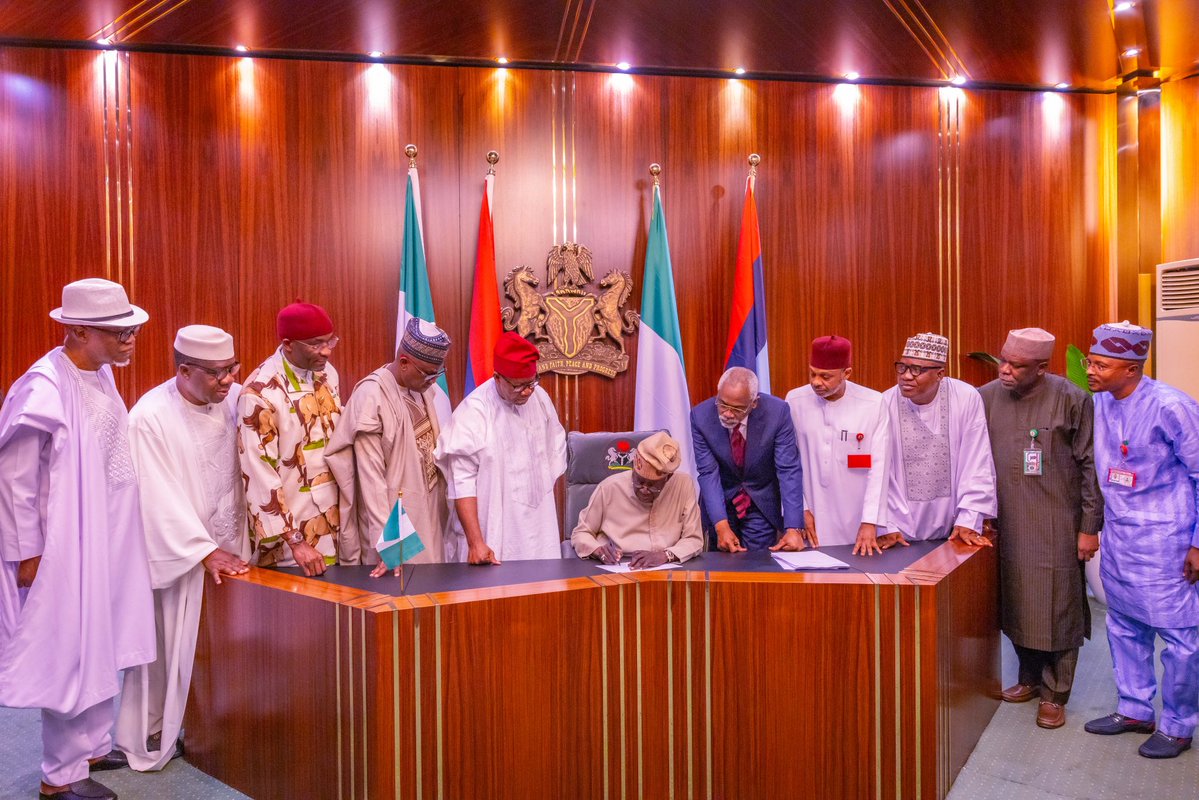
• Stresses human results over computers
• Nigerians will be happy with amendments – Senate President
• Ramadan timing concerns fixed, voter apathy eliminated – Speaker
________________________________________________
From Juliana Taiwo-Obalonye, Abuja
President Bola Tinubu on Wednesday signed the Electoral Act 2026 (Amendment) Bill into law, just days after the Independent National Electoral Commission (INEC) unveiled its 2027 election roadmap.
The assent took place at the State House, Abuja, around 5:00 p.m., witnessed by top National Assembly leaders. Lawmakers had fast-tracked the bill’s passage on Tuesday amid heated debates.
Tensions centred on real-time electronic transmission of polling unit results to INEC servers — a provision activists deem essential to curb vote rigging. Last week, civil society groups and opposition figures protested at the National Assembly, demanding mandatory live uploads to restore electoral trust. Protesters argued technology would minimise manipulation, but APC leaders countered that unreliable rural networks make it impractical, favouring a hybrid electronic–manual model.
In his remarks after signing, President Tinubu emphasised managed processes over rigid technology, quoting extensively on democracy’s human element. “I followed keenly what you were doing. The essence of democracy is to have very solid brainstorming discussions committed to national development and nation building, the stability of the nation.”
He downplayed historical precedents, stressing practical stability: “It’s not as important as the history aspect of this. What is crucial is the fact that you manage the process to the extent there will be no confusion, no disenfranchisement of Nigerians, and we are all going to see democracy flourish.”
Tinubu highlighted the need for public confidence: “It is time that we will have confidence in our system. No matter how good a system is, it’s managed by the people, promoted by the people, and result is finalised by the people. In fact, for final results, you are not going to be talking to the computer. You are going to be talking to human beings, who announce the results.”
Other News
He questioned Nigeria’s technical readiness amid debates on real-time transmission: “And when you look at the crux of various agreements, maybe, Nigeria should question our broadband capability. How technical are we today? How technical will we be tomorrow? To answer the call of either real time or no, and as long as you appear personally as a manual voter in any polling booth, a ballot paper is given to you, manually, you decide in a corner and fingerprint, thumbprint, the person of your choice. You cast your vote without hindrance and any interference.”
The President underscored manual counting with electronic safeguards: “Ballots are subsequently counted manually, sorted and counted manually. It’s just the arithmetic accuracy that is entered into from EC8A. It [is] still manually. Essentially, the transmission of that manual result is what we’re looking at, and we need to avoid glitches. I’m glad you did, interference, unnecessary kicking in this age of, you know, computer inquisitiveness.”
Tinubu concluded optimistically: “Nigeria will be there. We will flourish. We will continue to nurture this democracy for the fulfilment of our dream for the prosperity and stability of our country. I thank all of you very much.”
Speaking to State House correspondents, Senate President Godswill Akpabio hailed the amendments as a patriotic triumph tailored to Nigeria’s realities. “A lot of provisions in the amended Act will definitely make Nigerians very happy. We did a very thorough job, very painstaking. We took cognisance of the peculiarities of the country. We don’t allow too much outside interference, and we’re very patriotic in our submissions,” he said. “At the end, we believe strongly that what the President has just assented into an Act of Parliament will make for a better election in the future, lead to prosperity, and ensure transparency in the electoral process. At the end, Nigerians will benefit a lot from future elections — every vote will now count.”
Addressing protests over electronic transmission, Akpabio explained the hybrid solution: “All Nigerians wanted was that in the IReV portal — which is a kind of viewing centre for polling unit results — they would like to see those results transmitted electronically. We have included that in the amendment just signed into law. But we also took cognisance of areas where there may be no network or communication capacity. We said that since the polling unit result comes in from Form EC8A, signed by the presiding officer, party agents and independent security agents, with copies given to all, then we can use that as the primary source of collation at that unit. Then, of course, we transmit it — even if there’s no network at that time, once we step out toward the ward or local government centre, it will drop into the IReV, and people will still be able to view it.”
He detailed the anti-tampering safeguard: “The implication is that if what is eventually collated at the next centre differs from what’s in the IReV, Nigerians will be able to compare and see if the result was tampered with. That has always been the problem in our country: once an election result leaves a polling unit, it gets tampered with or mutilated. That has been eliminated today. So we are satisfied that we have met Nigerians’ aspirations. The issue of real-time transmission also comes in: once you transmit, even if there’s no network, then once you reach where there is network, it will drop. So eventually, everything will still be shown.”
Akpabio defended the process: “We are happy and satisfied that we have interpreted the intentions and yearnings of the majority of Nigerians — not those who are politically motivated. No matter what we did in the last two years — we went on retreats in Lagos, Obara, everywhere — those were mere consultations. The final outcome of what was amended happened in the plenaries of both chambers. In the last month, we have done a lot. Even the Senate sacrificed holidays; the Speaker had to recall members from break and budget sessions to undertake this all-important national assignment. That’s why we are very satisfied that, going forward, we will have more transparent elections.”
He touted historic innovations: “This has never happened since 1960 — we have never had electronic transmission of results in any of our laws. We never even recognised the IReV in the 2022 Act. All those things are now there. More powers are given to political parties to decide their candidates. Above all, participative democracy and more inclusiveness: members of different political parties can now do direct primaries. That means you can choose the person you want; delegate selection — one person can’t just write the list and submit. This time, party members will stand up and vote for their candidates of choice.”
Akpabio warned against misinterpretation: “There are other provisions you need to read, because if I stay here to tell you everything, it will lead to controversy on social media. Some people don’t understand that it’s not good in an election to have five contestants where one scores 300,000 votes, another 290,000, and for some reason, the top scorer is disqualified by court — then the person with 1,000 votes, not popularly elected, becomes the winner. All those things are eliminated. We have recommended that, where such a case happens, they should call for a fresh election. This applies even to governorship elections, where the second-highest scorer may not meet the two-thirds spread requirement across local governments to be declared the winner. No, we don’t want that. We want something that will help Nigerians truly elect their leaders. I thank you.”
On his part, Speaker of the House of Representatives, Tajudeen Abbas, endorsed the changes, adding a key detail: “Well, I think the Senate President has said most of the things we did yesterday during the amendment exercise. However, there is one area I’m sure he forgot to mention: the number of days’ notice, which was 360 days in the 2022 Act. Now we have seen the wisdom to reduce it to 300 days. This will inadvertently allow holding the presidential and National Assembly elections in January 2027, technically avoiding elections during Ramadan 2027. I think this is another ingenious piece introduced by the National Assembly to avoid voter apathy in the next general election.”