Follow Us on Google
By Chidi Nnadi and Obinna Odogwu
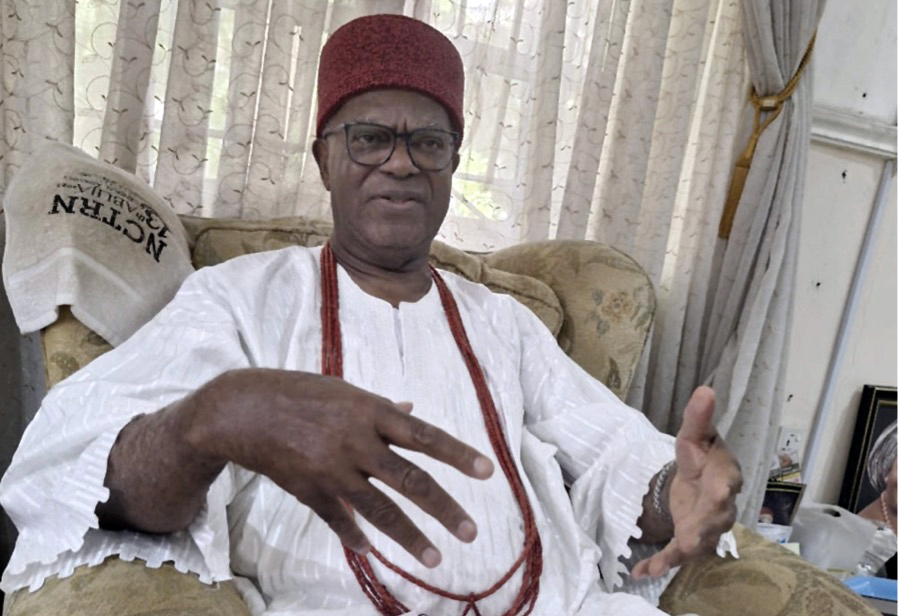
Yesterday , His Royal Majesty, Igwe Alfred Nnaemeka Achebe (Agbogidi), turned 85 years. yesterday too, he was 24 years on the ancient throne of Onitsha, Anambra State.
At 85, the Agbogidi has seen it all. He has seen Onitsha as a colonial river port, Biafran stronghold, post-civil war trading behemoth, and the 21st Century sprawling commercial city wrestling with its own growth.
In this special interview designed to councide with Igwe Achebe’s 85th birthday and 24th anniversary on the throne, he spoke frankly and candidly.
Igwe Achebe spoke of his early years and growing up, his parents, family, education abroad, the making of the Obi of Onitsha traditional stool, the rituals, IPOB sit-at-home order in Southeast, Ohanaeze Ndigbo’s ban of Ezigbo title in the Diaspora, the state of the economy, his joy and regrets, among others.
This is not merely an interview with a king. It is a conversation revealing Onitsha before the British Union Jack came down and the Onitsha that is charting its place in Nigeria’s next century.
It is explosive, insightful and revealing.
Your Royal Majesty, you were 19 years old at Nigeria’s independence. What are the outstanding memories you still remember about Onitsha before and immediately after independence?
I will start by saying that 1960 was memorable for me because that was the year I took my school certificate examination in Owerri. It was a year of independence. Onitsha was at that time a happy, commercial, and educational city. There was a bit of politics also. NCNC (National Council of Nigeria and the Cameroons) was, of course, very much in control then. The city was very clean and we had sanitary inspectors that would go from house to house. At that time, if you had a broken pot containing water and mosquitoes breed in it, you’re taken to the Local Government and fined.
So, everybody kept discipline of cleanliness. Onitsha was a very happy city. I was particularly impressed as a young boy growing up and as a grown man thereafter. New Market, Onitsha was lined by bookshops. Ordering books from abroad, particularly England, at Onitsha was easy. And what were those books for? They were to support people studying by correspondence, taking correspondence courses from British institutions for O’Levels and A’ Levels. A’ Levels were called Inter. So, you have Inter LL.B, Inter B.A, intermediate degree commercial subjects like RSA, HND and so on.
There was quest for education and there were study centres. Traders do their business in the market, and at the end of the day, they go to the study centres for lectures. I was fortunate to attend Government secondary school. The Government and Christian secondary schools were not enough to satisfy the people’s thirst for education. Private secondary schools came up in Onitsha – New Bethel College, African College that became Our Lady’s High School, Metropolitan College, Washington Memorial, Etukokwu Memorial College, Prince Institute, the famous Dennis Memorial and so forth. And I believe at that time, Onitsha probably had more private secondary schools than maybe any other city, including Lagos. Many who became Army Generals, Lai Mohammed, former Governor of Kogi State, Chris Garba came to Onitsha to do secondary school and then went on to do whatever they wanted. That was Onitsha then.
People worked hard, and the entertainment was cinema. There were night clubs for those who could afford them. Then on Sundays, there were usually football matches. We had Odoakpu vs Fegge etcetera, etcetera. Those were the entertainment then; and people were happy. On Monday they go back to work. So that was Onitsha for me. People like Cardinal Rex Lawson started his career here, playing at night clubs and a few other musicians. Onitsha was a bubbling city, a happy city and a city of opportunities, whether educational, entertainments that I just mentioned. C. T. Onyekwelu had the first recording studio in Onitsha, which was the first in West Africa and at least in Nigeria. That was Onitsha for me in those days.
In those days, it appeared that the Igbo did not focus on going to school given the number of young people that were involved in trading apprenticeship (Igba boi). What was it like in Onitsha then?
Well, some went to school and others learnt trading. However, the apprentice trading was a big thing. There was no question about that. We lived on the waterside and we had traders that were tenants. Our tenants were mainly from Umuoji. So, the first tenant brings his relative and trains that one, then start a business for him after the training. Often times, the boss moves out of our compound to a more luxurious accommodation and leave that place for his brother or cousin that he had trained. And that one would train another person. However, the quest for education was also on. As I said earlier, traders would close markets at 5 o’clock and go to the study centres to receive adult education. Talking about the apprentice system, Onitsha, Aba, Nnewi where popular; those trained there branched off to other places like Warri, Lagos and so on. You may get business card and the company’s head office was in Onitsha Main Market, with branches in Lagos, Warri or elsewhere.
What can you recall about your parents and Onitsha as a community. What values were instilled in you that are still relevant today?
I have to say that my parents were the bedrock of my foundation in life; for myself and my siblings. We were nine children – four boys and five girls. I’m the oldest; and then came the five girls before the three boys. That was basically the structure of my family. My parents were very loving and also very disciplined; they inculcated that in us. My parents were made for each. It is true because we were told that my mother was betrothed to my father before she was born because my two grandfathers – paternal and maternal, were friends, had business transactions. They were honest to each other.
My maternal grandfather was impressed with my paternal grandfather and he said to him, “I will give you a wife;” symbolically, that my family will give a wife to your family. The traditional ceremony was done maybe when my mother was 16 or 17 years; and then my father sent her off to finish school at St. Monica’s, Ogbunike where she learnt dressmaking, housekeeping, and all of that. When she finished at St. Monica’s, she went to Emekuku to further her studies. She got married at 20 and had me at 21. So, they were life partners. We never saw them quarrel. We knew that there were disagreements, but they managed it by themselves and they didn’t let it affect us.
Something happened. My father had a career in UAC. At 40, he decided to retire and start his own private business. He went into rubber and timber business in Benin, which was a big thing at that time; and my maternal uncle had just returned as a lawyer and was based in Benin. They put their resources together. My father was coming back from Benin to Onitsha to see us, he came once a month. He had a motor accident at Agbor and his back was broken. He was lucky because many people died in that accident.
We stayed in Agbor hospital for six to eight months. He couldn’t move and his business went down. Everything invested was gone. He returned to Onitsha and our mother became the breadwinner of the family. She was a dressmaker and was also trading.
So, we learnt from our mother how to work hard from the beginning. From primary school, I was earning a living. I would break firewood, place them on the wall and then people came and bought. I did that after school. On Saturdays, we went to Fegge. Fegge was then under construction. I carried blocks for the construction work. They paid us five shillings. It was a loving family; strongly Catholic.
My parents were brought up in Catholic tradition. Education was very important to them, and discipline also, but in a loving manner. We could make jokes with our parents. We could play, but if we did something wrong, we would not be spared. At that time, I could cook everything and I can still cook. At that time, we peeled cassava, soaked it in water for fermentation and then sieve it. It was very normal for us.
But you said you had female siblings, why were they not the ones doing that?
We did it together. That was the fun. It was me and then the five girls. I was brought up just like the girls. We were brought up together. We were doing it together. On Saturdays, I would wash clothes for all my siblings and my mother; and not my father. My sister did it for my father. There was a reason for that. So that was our family life.
Where are your other siblings?
The one next to me is in America with her children. The next two are late; but they left seven children each. And we brought up all the children. They are all graduates and are doing well in various professions. The next two women are in Lagos with their families. Then the next two boys are in Onitsha here. The youngest is in America.
You have talked about your family upbringing. What about the community? How did Onitsha shape your life?
The community was part of it, seriously, but in a very interesting way. We lived at Williams Street with a mixture of people from various towns and communities; even from outside. There wad Pa Nwokedi of Nwokedi Street, just a walking distance, from Nnewi; we had the Cole, Wenfo, and so on. The Coles were from Sierra Leone; Wenfo from Ghana. We had the Ogaluonyes from Omambala side, and so on and so forth. It was a blend of both Onitsha people and non-Onitsha people. We actually formed a community and had our own music group.
Every village had its own music group. We worked together. We had the Holmes. Holmes was Roman, but he left his family behind. So, we all grew up together, but standards were different. Some of them didn’t go to school enough; they dropped out early, but our parents kept us focused. That wisened me up because you could see the world around you. We had the Ameye family from Igala. Opposite us was Coker. Coker was Sierra Leone. The father of the wife was Sir Louis Mbanefo.
We had a community that was alive. Even when I came back as Obi of Onitsha in 2002, the Olieri community was still alive. Prof. Nwokedi was the son of Pa Nwokedi, older than me. He was then the head of the group. He has passed on now.
Could you share with us your school days at Stanford and Columbia? How did that shape your life for the corporate world? What lessons did you learn under this period that prepared you for the traditional leadership?
Stanford, Columbia; West Coast, East Coast. They are completely different environments. But that is the general environment; the cultures from people. California is relaxed and beautiful. You could go on excursions and the pace of life is easier, but they worked hard. Northern California is a base for the Silicon Valley. So, Google and all these technology were all developed there. University was also beautiful and easy to get along.
Columbia is in New York. New York City is big. And everybody is in a hurry; more impersonal than California, but the institutions are very much the same. You have to work hard. You are immersed in knowledge. All you have to do is to work hard to acquire that knowledge so that knowledge stays with you. The opportunity to learn is infinite in both places. You are given study works to do. You come back to class on Monday, the lecturer hasn’t even discussed the work he gave to you to read and he gives you a test on it to prove that you read it. Every test adds up to your final degree; whether it’s a daily test or weekly test. Two points, five points and all that. It’s a kind of continuous assessment.
Life in California was easy for me because I had a scholarship; full scholarship. I even took up a part-time job to earn money to send to my siblings at home. By the time we got to Columbia, the Nigeria-Biafra Civil war had started and I did have scholarship for my MBA. I saved up some money, but it didn’t go too far. There again, the university came to my help, to support me with tuition. I had to work to get my living money. But New York toughened me. California introduced me into the American system. It opened my eyes; but New York toughened me. You have to be tough to survive in New York. And today, New York is my favourite city in America.
Preparation for life was in two stages. From Nigeria, I was lucky to start at the easy pedestal to California; and then scale up to the tough one in New York. And I think all of them combined. The American system, like I said, pushes you to your limits. It is up to you to be what you want to be. And that is what has driven my life till today. In my jobs I set my goals and did my best to achieve them. As Obi of Onitsha, I set my goals and do my best to achieve them. I was fortunate to have gone to school then. It was a privilege.
The only thing I miss, having gone to school in America, is that all my friends and contacts that you normally make in school were those I had in secondary school. Not going to school in Nigeria, my scope was not broadened in terms of friendships and all that. But I had to build that up from my career and my other connections – social connections and all that.
You said that New York toughned you, in what way specifically ? Are you really tough?
New York makes you bold. To start with, the average travel to work in New York is one hour. You travel mostly by public transport. But if you drive, to park your car, you have to pay a lot of money. In the morning, everybody is rushing to get into the underground or the bus. If you say good morning to somebody in New York, they’ll say what are you talking about? What’s good about it? Get on the bus. Get on the train. Get to your office. People eat their breakfast walking on the street because there’s no time to sit down. There’s no time for that. You talk on the phone as you are walking, eating and cutting deals. That is New York for you.
Your Majesty, you studied in America. You came back after your studies. These day, we send our children abroad for studies and they don’t come back. What is the problem?
Other News
The problem is Nigeria. I went to America with clear intention of getting sound education. My academic objective kept changing. America also was helpful for that. I wanted to read Medicine. I changed my mind; I didn’t want to read Medicine. And then I took a degree in Chemistry. The option then was to go and do a PhD in Chemistry. I got admission for that, but I changed my mind again. I wanted something practical rather than being a teacher. If you are with PhD in Nigeria, you could go and teach. So, I wanted to do Pharmacy, but the cost of conversion in terms of academic years was much. I was exposed to an MBA opportunity. I went to Stanford Business School and spoke to advisers there. My eyes were opened and I said I’m going to go in for an MBA. I ended up with that, but all with the intention of coming back to Nigeria. And I came back to Nigeria. I had a job.
My bosom friend; my classmate, everything from primary school to secondary school, read Medicine, came back to Ibadan. Coming back with his high qualification, there was ethnicity; there was a conflict between American degree and British degree; they said that American degree was useless . They already had two children. I don’t know how many years he spent and he returned to America. Immediately, Columbia University grabbed him as a professor; made him head of plastic surgery and today, he is retired, but the American Association of Plastic Surgeons has an annual lecture in his honour.
Nigeria at a point was not receiving people sufficiently. The economy was changing; job opportunities were not on merit. So, as people came back, they returned abroad. With that, some didn’t venture into returning. Now, it is not us anymore because we are all retired. It’s our children. The downside of it is that when they retire in America, they are longing to be back home. Then, the re-entry point becomes even higher.
There is a series going on now on the Onitsha people in the American Diaspora. It’s a six-part series. One of our sons has been going around talking to people on how they came home, why they came home, how come they didn’t go home and all that. So, all the nuances came out. But for our people, many of them are now home on a regular basis. Somebody is taking Ozo title in Onitsha today and some people travelled all the way from America to come and participate. They will stay for a few days and they go back to America again.
You ascended as the 21st Obi of Onitsha on May 14, 2002. How did your choice come about and what did you tell yourself on the day you accepted the call to serve?
We have two dynasties in Onitsha. The throne basically rotates between the two dynasties – Okebunabo and Umuezearoli. Ofala Okagbue, my predecessor, was Okebunabo. Virtually it was my own dynasty. We are much bigger; and 21 candidates emerged for one throne. And the basic criterion is that you have to be able to trace your patrilineal lineage all the way to our ancestor father, Oke. But even though 21 people came out, I was sure hundreds of people can do the same. So, that is the basic one. Then, they looked at pedigree, your accomplishments; your contributions to the community and, of course, they are looking at the situation of Onitsha at that time, and who has the best combination of characteristics. So, it boiled down to somebody who had a global, urban perspective that can bring about change and who also is grounded in our culture and tradition. There were screening, interviews, discussions and all of that. And at the end of the day the kingmakers cast their ballot. I came out in first ballot. It’s the majority; overwhelming majority.
How many kingmakers were involved?
I have to work backwards. I am told that I had 19 votes. The second person who is also my cousin from the same route scored three votes. I was the first choice from my kindred unit. He was the next one. He scored three votes and that makes it 22. The third person scored one vote. That’s 23 and two electors abstained. That makes it 25.
Has the process been the same all along? Was there any time anything like ritual was involved in the selection process?
In the early days, it was war. In the early days, it was my force against your force. Native doctors were recruited. Incantations were performed. But as time went on, necessary adjustments were made. My people has got the crown for several kings; and at a time the other side was feeling left out. So, when Anazonwu passed away, my own side started fighting again; competing. Okosi was working for the Catholic Mission at Igbariam and he mentioned to the priest that this thing that my people were fighting over at Onitsha, that he was qualified to be Obi of Onitsha. They asked him to prove it. Of course, he traced his ancestry to our founding father. They took him to Asaba, the Royal Niger Company because that was the government then. And he convinced them. They just came here, fired guns in the air, everybody ran away and they installed him; with a lot of opposition though, but he prevailed.
Then, he passed away around 1935. My own side started fighting again. This time for five years, there were ttwo people – Egbunike and Nzegwu. For five years we didn’t have the Obi of Onitsha. Then, the age grade societies got together. We call them Ogbuisato, eight age grade societies. Not too old, not too young and they got together and managed the process. And invited the Okosi II as a neutral party to go on to the throne. But then, it was agreed at that point, Ogbuisato also came up with that protocol, that the crown will now rotate back and forth. When it was our turn, we always have the conclave. In my own case, we couldn’t agree at the conclave, so the entire Ezechima, including the other dynasty, brought kingmakers; they nominated kingmakers and then they met. It was peaceful. So, my emergence is the beginning, going forward, of the practice for various villages to nominate their electors and then they will elect.
You were asking what was on my mind. I was initially a reluctant participant. My kindred group was very keen to put me forward. They knew or they suspected that I may turn it down. I was living in the UK. I retired from Nigeria, I was sent to the UK by Shell International. I could work there till I die. So, they went to Igwe Alex Nwokedi of Achalla. Alex is my mentor, he’s my oga. If he tells me something, it would be difficult to say no. He called me on the phone from Lagos and told me ‘Nnanyelugo, prepare yourself. Your people said that you’ll be the next king.’ I asked him who the people that said that were? He responded, ‘I have told you’ and then dropped the phone. Having done that, my cousin came to Lagos and called me on the phone.
Anyway, I got into the competition. I wrote my profile. I also wrote a document which I called ‘The challenge before the next Obi of Onitsha’. I put it in a package and gave it to certain people I had respect for. And, of course, I think they wanted 21 or 25 copies for the kingmakers. I did that. Then, I am sure that one of the kingmakers or somebody else made it public. That document went viral. ‘Have you seen what Achebe wrote?’ There was no softcopy then. So, the printers were doing good business, printing and all that. In that document, I outlined the challenge before the Obi of Onitsha, whoever it may be. And I think that was the game changer because I was somebody who was thinking about peace, reconciliation. There were disputes in villages in Onitsha. So, there was need for peace building, reconciliation, change, and then transformation. Onitsha was living in the 19th Century and we are already in the 21 Century. So, how do you move a community up to the current times without getting into trouble? Truth and transparency and, of course, development; and most importantly, our youths that represent not just the future, but the present. So, these were the things on my mind. That was what moved me once I was pronounced. I selected like-minded people; people who have had good careers; they were professionals; who can think like me; who can work with me to gradually move the community forward to the 21st Century.
Basically, you were convinced by your mentor who called you on the phone.
No, he alerted me. My cousin was now sent to come and call me on the phone. And when he called me, he said that he was asked to come and request that I put myself forward or they put me forward. I said to him that our uncle was in the mortuary. He said yes. I told him that we cannot talk about such matter until we buried our uncle. I told him that I was coming back in December, and that after the burial we can talk. He said that was good enough. He went back and told them that I didn’t say no.
It was building up around me then. So, by the time I came back in December, which was about a month away, it had built up that Nnaemeka Achebe was coming out for Obiship and all that. I discussed with my family at that point. I said to my wife that my best option was to contest hard enough, come out a good second. She said no, if you must contest, you must contest to win. I think that was the key. That statement from my wife meant also that she and the children were in support. So, it built up. My wife did it. She said ‘If you must contest, you must contest to win.’
The Obi stool has a long history, 20 Obis had served before you, how were you able to strike a balance between modernity and the the traditional rites associated with the stool ?
I said earlier on that my people were afraid that I was too westernised; that I will just turn the whole thing down. That was not my issue at all because I grew up under the care of my father and my maternal grandfather who i met. I never met my paternal grandfather. But my grandmother was there. And I was very close to my grandfather, like my father. I absorbed the traditions and customs. I would go to all the ceremonies with my grandfather and my father – the New Yam festival, Ofala festival and others.
At the Ofala festival, we would sit down on the floor and cross our legs so as to see what was going on and all that. I started my career in Shell. I was coming back from the UK. I would sit on the balcony with my father in the evening for about two hours, quality time talking about my family, our nuclear family, the bigger family, Onitsha, what was going on, and I asked questions; he would explain to me. So, whether I became Obi of Onitsha or not, I was well grounded in the tradition even though I was an international corporate executive. So, it was not a big challenge actually.
My intents right from the beginning is that we have to deploy modern management in the transformation of the community without distorting our culture, customs and tradition. And the customs and traditions are not cast in stone which is where people get it wrong. Our ancestors didn’t do it this way; but our ancestors were walking around half naked and we are not half naked anymore. Even in my time, in my 24, going to 25 next year, we brought about certain changes in our customs and tradition but each one we brought about by dialogue and discussions with the community, various stakeholder groups to convince them that it is time to move forward. Others have been introduced because we are in a different era and all of that. So, it wasn’t a problem at all. It was all about using modern management and technology. As we are doing this interview, I could deploy our own system to get Onitsha people in America listen as we are speaking. We reach out to people; we have different platforms – WhatsApp and others. The fastest way to reach out to people is by WhatsApp. Everybody belongs to one organisation or the other, including the church groups. We have now a body of representatives from every organisation. The media people will put the message to them; they will broadcast it to all their members immediately through WhatsAppp, Facebook, Instagram and others. We have a website.
Imeobi Onitsha is enabled for wifi. If you get into the palace, it has a password you’ll log in and use the Internet free. These are happening without distorting our culture at all. In fact, you enhance people’s appreciation of the culture because of the technology. It was a win-win for us and for me as the Obi of Onitsha and for the community.
Twenty-four years down the line, how have you used the traditional institution to support economic growth and peace in Onitsha, a known flourishing commercial nerve centre?
We had a clear intent. As I got on to the throne, I started a series of workshops to identify our challenges as a community, and in 2002, I brought my colleague from Shell to help me run the workshop. And from then on, we set up what is then called our think-tank group in Lagos and Abuja working together; our professionals to analyse our challenges and to set priorities; what you called the low hanging fruits. And what they set up for a three-year agenda, within a year I had got most of them done. So, we set a new agenda. But in 2017 we came up with a wide range of studies on whatever we can consider affecting us in Onitsha here – youth developments, our land boundaries with other communities where there are conflicts and so on; economic empowerments, the role of women in the governance of Onitsha.
About 15 work groups. How do we establish and convince our people to use the cemeteries instead of burying in the village and all of that. We had about 15 work groups and we worked for a year. And then they made their presentations. All of these are going to come out in a book which I am working on. The book will be launched on the 25th anniversary. We had our conferences and set up our priorities. Money was an issue, but we took the easy ones first. Then came COVID. COVID changed everything. We put in abeyance the outcome of the 15 work groups and faced the COVID and created an organisation that became a model. We had our monthly meeting of the group. We called it Onitsha COVID Response Team. We met every week.
Thanks to technology, by this time Zoom was on and all that. Our people abroad could join both in the discussions and the work groups, particularly in the medical work groups, the communications and so on and so forth. And we managed COVID very well. We were producing our own facemasks and sanitizers here in Onitsha. We made sure that every Onitsha person had two or three facemasks without a cost to them. But this thing became very expensive and all that. So, that’s how far we went. But because in response to COVID we stopped all our social and community activities like burials, weddings, everything, the local economy just collapsed. People who cook for these festivities make money from there. There are those who supply chairs, there are photographers, those who sell drinks and even people who pick bottles. It’s all business. People who sell kolanuts and all of that. So, our local economy collapsed.
All these people, we had to put them on palliatives. Then the question came, what next after COVID? What is life after COVID? So we set up another study group led by Nebeora who was the first Managing Director of Fidelity Bank; one of the best bankers we have in this country. They produced a report that is as good as Mackenzie or any international consulting group. It had practical suggestions that led to setting up what we call Onitsha Advancement Foundation which we registered with the Corporate Affairs Commission; and the umbrella NGO for our various activities. There is Onitsha Leadership and Entrepreneurial Committee (OLEC). There is also ADIC, that is the Digital Information Development, teaching our children not just to be able to use the computer, but also to design commuter systems and all of that. There’s also women empowerment group. It’s for women’s advancement. The women are not just at home cooking food. An educated woman, even if her husband passes away, can hold onto herself. If she becomes a housewife, she becomes dependent and all of that. There was the educational programme for the youth.
On health and wellbeing, we have today medical insurance that costs N12,500 a year per person. And you get like 85 per cent of all medical needs. We work with the state government on that. The state government’s programme was tailored to our own need. We have a working clinic in our own palace. You wake up in the morning, you don’t feel well, go there. There’s a nurse there, she will talk to you and we call a doctor to come. We have volunteer doctors that can be called upon or we send you over to them. So, these were the programmes that we developed to move the community forward. We have economic empowerment of our youth; we have a cooperative society, where with N500,000 loan they can set up their own businesses. We also train them on just how to run any business. We also have the skill areas; if you want to be a dressmaker, hairdresser, jewellery maker, tailoring, commercial tailoring, making uniforms and all that, you are taken care of. So, economic empowerment is at the bottom of it.
We know you are involved in promoting education through the Onitsha Ado Foundation and youth empowerment. Is the Foundation still flourishing and what achievements have you made in this area?
Education has been at my heart even when I was in Shell. I started my career in Shell in the Personnel Department, Human Resource. So, human capacity development which is bothered on education has been at my heart. I have managed that. I got to the helm of it before I moved to be General Manager. So, when I came into Onitsha, my first focus was to create a fund to give scholarship to our graduates to go for postgraduate studies, and my premise was that with postgraduate degrees, their entry points, whether in the public service or in the private sector, will be enhanced and they can move faster. And we are looking for children that had at least Second Class Upper degrees, First Class Honours and all that. It had limited success. I think we produced about five PhDs and several Master’s degrees. We had surplus money…they asked what’s going on?
We found out that there’s a bigger challenge. There are a lot of kids who had admission to university, but their parents could not afford to pay and that became even a bigger challenge. I got a message this morning of a child from a very challenged family. He got admission twice to the university, but nobody is paying. We have to do something. He has to go to the university. We now took the fund down and broadened it. Also, the other challenge is that a lot of kids, all these private secondary schools I mentioned, they did well in those days. But things have changed. Even the mission secondary schools are doing well; CKC, DMGS because their old boys have taken over. Peter Obi is CKC, Peter Odili is CKC, Willie Obiano is CKC. If you go to CKC today, it looks better than any state or federal university. DMGS is pulling up also. But then, the private schools have been abandoned. So, the kids do their school certificate, they get two credits, three credits and all that. You go for JAMB and score very low.
We set up a remedial programme which became a game changer. They get intensive tutoring for six to eight months, they repeat the exams, get eight credits nonstop; get their JAMB results and they go to the university. And my job is to facilitate, call the Vice-Chancellor, please my children are coming, take care of them. As long as they meet the basic cut off mark, if you want to study Medicine and you don’t have enough mark to study medicine, okay go and study Biological Science or Lab Technology and all that. So, we are getting our kids into the universities.
Next question. When they graduate what’s next? That’s why the NGO is there. They now give them skills. We have a programme which is running just as I came in. For our university students running extra-mural programmes for secondary school students during the long vacation, it takes them out of the streets and keeps them busy. They learn a little bit of two plus two is four, but they learn discipline, moral education and if you go and see the class in progress, it’s mind-blowing. The Late Innocent Chukwuma of Ford Foundation came in; I took him around and he was very impressed and he gave us money. He gave us funds to support our programmes. That’s where we are now in education. There is no point favouring the few who have emerged at the top and yet the base is very weak. We are building a strong base; strong first degrees, skills and knowledge to help you to be self-employed and self-sufficient in life. That’s our target. And that’s where we’re heading and it’s working out very well for us.
For undergraduates, are you giving them any kind of stipend to encourage them to do what they do; to come and teach in this extra-mural classes?
Oh yes! I tell you what we do. At the beginning of the programme, before they start the programme, they send a note to all our constituent groups, Ndi Ozo, Ndi Odu, the various villages and all that, that the time has come again and they generously support them. The support doesn’t go directly to them. There is a committee led by one of my chiefs who is also an educator himself. The disbursements are made for teaching materials, transportation, and all of that. At the end of the programme, we look at what is left. We have to decide how much each of the university students gets. Then they have a grand party in the palace with music, groundnuts, biscuits, soft drinks and all of that.
The palace now supplements to make sure that every undergraduate takes a stipend because it is a vacation employment. For the university students, we have to have a workshop for them, maybe once a week on leadership, on life planning, on career planning and all of that, so they get something out of that also. And our own people who are professionals, who are lawyers, doctors and all of that, will take turns running workshops for them. That’s the package that we have.
Nigeria has faced security, economic, and ethnic challenges in the last two decades. Only recently the Monday sit-at-home declared by IPOB in the South East was stopped by the Anambra State governor, Prof Chukwuma Soludo in Anambra State. How did you feel during those periods, when your subjects were restricted from going out? What role do you believe traditional rulers should play in maintaining security and national unity?
How did I feel? Very painful. Painful that it is happening. Also painful that as a society and as a people, including the government, we are not sitting back to say, why is this happening? Why do our youths carry arms or threaten people? Why are they not working in the banks or working in the government or working as journalists and all of that? And many of them are even university graduates or people who dropped out of school and all of that. And we are calculating the loss to the economy of the state. We are not looking at the underlying causes of why one young man from somewhere can ask everybody to sit at home on Mondays and then people begin to do that. It’s the frustration. And those young ones don’t ask, what is the authority to do that? And if you sit at home, what are the consequences?
But if you are frustrated you try anything. So, it went from the fear that if you come out they are going to shoot you. I lead a small group of traditional rulers, religious leaders and civic leaders. We call it the Joint Body. We’ve put out one or two media statements, but we work behind the scene with whoever is the party. So, we work with the state governors, even the first election of the Anambra State Governor, Prof. Soludo, we made it happen because the IPOB had announced that there would be no election. We reached out to IPOB and said there must be an election because if you are asking for freedom from Nigeria, you cannot prevent the people from having their freedom. Nnamdi Kanu issued a statement from jail saying, there should be an election and all of that. We got to that stage where the fear of violence had gone, but people still wouldn’t come out. Anambra was the worst. Ebonyi State never really practiced it at all. And don’t forget that Simon Ekpa is from Ebonyi State. Abia State, I was in Abia State; from Umuahia I drove to Aba and all of that. Umuahia was doing business; even the banks were open. Aba was doing business on a Monday. In Enugu State, the governor called a town hall meeting and they agreed to open Ogbete Market and they all marched to Ogbete Market and opened it. Onitsha Market, Nnewi, Ihiala became an issue and all of that. So, it was very painful. We tried our best as traditional rulers.
On the sit-at-home days, even the police that are supposed to provide security, you don’t find them on the streets even though the government said ‘ah! you will be protected and all of that.’ So police are also afraid. I think that the last push by Governor Soludo has moved people to get back to the market. It’s the Main Market and the banks. I’m not quite sure whether it is completely back on the feet. But we still have to figure out why and what’s the solution. The solution is a stronger economy big enough to create opportunities; not salary jobs. Create opportunities that the person who is selling tomatoes will sell enough tomatoes to make a living. The person who is a taxi driver will make enough money to make a living. The Okada person will make enough money because all of us depend on each other. “Mama Put” will sell food to Okada people and all that. Just make the economy bigger and stronger and safer. That’s what it is. It is still work in progress I can say; but it’s very painful. Work very hard, but sometimes you get frustrated.