Follow Us on Google
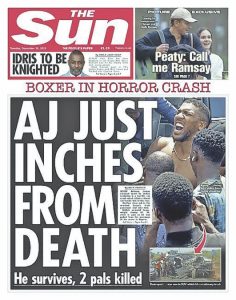
“Joshua himself lay in agony on Nigerian soil, heartbreaking pictures circulating of him seated by the roadside, face contorted in extreme agony, as if hit below the belt, surrounded not by medics or corner men but by bystanders—phones raised, cameras clicking, curiosity louder than compassion. In the age of content, even pain is not allowed privacy.”
I was already punching the keys of my laptop, aiming to write a column titled BOXING IS NO JAW-JAW when fate, that merciless editor, tore the manuscript from my hands and splashed red ink all over it.

Anthony Joshua had escaped death.
Not in the ring this time.
Not under bright lights.
Not before a roaring crowd chanting his name.
But on a Nigerian highway to death, somewhere called Makan, north of Lagos, in twisted metal, broken glass, screams, sirens—and the unbearable news that two fellow human beings did not survive the crash.
Suddenly, jaw-jaw was no longer just about boxing.
It was about life.
Barely two weeks earlier, Joshua had broken the jaw of Jake Paul with the cold authority of a man who knows that boxing is not talk-talk. One right hand. One brutal punctuation mark. The referee waved it off. Jake Paul went down not as a content creator, not as a viral sensation, but as a human being whose bones had met reality. Titanium plates. Hospital bed. Painkillers. Sobering humility.
Now the roles had shifted cruelly.
Joshua himself lay in agony on Nigerian soil, heartbreaking pictures circulating of him seated by the roadside, face contorted in extreme agony, as if hit below the belt, surrounded not by medics or corner men but by bystanders—phones raised, cameras clicking, curiosity louder than compassion. In the age of content, even pain is not allowed privacy.
It is a fearful symmetry, to echo William Blake’s “The Tyger” and the theme of symmetry which I came across in my A-level English Literature class at Ijebu Jesha Grammar School.
In the ring, Joshua delivers pain professionally. Outside it, pain visits him uninvited.
And that is when the lesson hit me harder than any punch: boxing teaches you about violence, but life teaches you about vulnerability.
When Joshua fought Jake Paul, the outcome was inevitable to anyone who truly understands boxing. This was not arrogance; it was arithmetic. Decades of elite training versus bravado. Muscle memory versus muscle for Instagram. You can talk yourself into a fight, but you cannot talk yourself out of a punch already in motion.
Jake Paul danced.
He circled.
He clinched.
He performed.
Joshua waited.
And when the punch landed, the jaw cracked like a lie finally exposed. No jaw-jaw could save him. Words have no defence against physics.
Paul survived. That is important. Survival is victory in boxing, too. He would later joke online, X-rays in hand, bravado stitched together with pain. But underneath the humour lay a truth even he could not meme away: boxing is not a game of personalities; it is a craft of consequences.
Two weeks later, consequences returned—this time without gloves.
On a Nigerian highway, there was no bell to save Joshua. No referee to step in. No ropes to lean on. Just steel, speed, and chance. And this time, others paid the ultimate price.
That is the part that silences the room.
In boxing, both men enter the ring by consent.
On the road, fate drafts its own opponents.
PHOTO OPPORTUNITY
The photographs from the accident are disturbing, not because they are gory, but because they are ordinary. A global boxing icon stripped and reduced to a man in pants and pain. No belts. No entourage. No anthem. Just suffering, surrounded by spectators who mistook a human emergency for a photo opportunity.
In those images, Anthony Joshua is no longer the puncher. He is the punched.
It forces reflection.
We celebrate boxing for its violence, yet recoil when life delivers a heavier blow without warning. We applaud broken jaws in arenas, but struggle to process broken lives on the roadside. The ring prepares you for controlled danger; it does not prepare you for chaos.
This is where the old masters understood something we are forgetting.
Hogan “Kid” Bassey knew that every punch carried destiny. Dick Tiger fought not for memes but for survival, dignity, and discipline. They did
not confuse noise for substance. They respected danger—inside and outside the ring.
Joshua, too, has always respected the craft. That is why Jake Paul’s jaw broke—not out of cruelty, but out of hierarchy. Boxing punishes shortcuts.
But life does not even pretend to be fair.
One week you are teaching a YouTube millionaire that boxing is war-war.
The next, you are thanking God for breath while mourning two others dead, friends who will never go home again.
There is something sobering, almost biblical, in that turnaround.
Jake Paul’s broken jaw will heal. Titanium is strong. His lesson will linger longer.
But death does not heal. And survival carries its own burden—the weight of why me?
This is why the original title still stands, but with deeper meaning.
Boxing is no jaw-jaw.
Neither is life.
You can hype a fight.
You cannot hype survival.
You can sell bravado.
You cannot negotiate with fate.
Joshua learned it in reverse order—first as executioner, then as escapee.
And for those of us watching from the safety of our pens and screens, the message is unavoidable: respect danger. Respect preparation. Respect life. Because whether in the ring or on the road, arrogance has no helmet.
Jake Paul talked his way into a broken jaw.
Anthony Joshua drove into a reminder of mortality.
One survived humiliation.
The other survived death.
May the souls of the two departed rest in peace.
Both stories meet at the same altar of truth: impact is real, pain is real, and consequences do not care who you are.
So yes, boxing is not jaw-jaw. Ask Jake Paul.
And life is not jaw-jaw either. Ask anyone who has seen death from the corner of their eye and lived to tell the story.
Anthony Joshua did.
Others, sadly, did not.
And that is the heaviest punch of all.