Follow Us on Google

By Zika Bobby
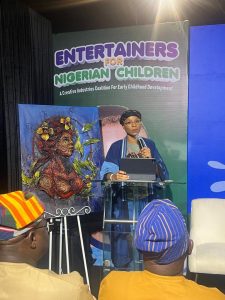
In the neon-lit halls of Ogidi Studios, Lagos, where the air usually vibrates with the bass of chart-topping afrobeats hits, a new kind of production recently took center stage. Nigeria’s “modern griots”—an influential assembly of film producers, musicians, and digital disruptors—convened not for a film wrap, but for a mission of national survival: Early Childhood Development (ECD).

The initiative is spearheaded by the Centre for Black and African Arts and Civilisation (CBAAC) and Ogidi Studios, with technical support from World Bank.
Opening the session, CBAAC Director General Aisha Adamu Augie provided a poignant reality check. She noted that while modern science is obsessed with “brain architecture,” African tradition has always held the blueprint.
”The first classroom was never a building,” Augie stated, “but our mother’s lap, our father’s drum, and our grandmother’s folktale.”
”However, this ancient wisdom is under siege. Nigeria currently faces a quiet emergency: 40 percent of children face stunting, and less than half are hitting key developmental milestones. With the population projected to hit 375 million by 2050, the window to turn a potential demographic liability into a dividend is closing. The solution lies in the first five years of life.”
The keynote address, delivered by Fadekemi Olumide, a legal and policy expert with deep roots in early years education, drove home the stakes. She challenged the room to reconsider how the nation views its youngest citizens.
”When Nigeria dreams of itself, does it see its children?” Olumide asked. She recounted a powerful experiment where four-year-olds used a story about the Mediterranean migrant crisis to debate international cooperation and resource allocation.
”Before literacy, before arithmetic, the architecture of citizenship is already forming. In Nigeria, we build roads, bridges, and rail. But the most important infrastructure is neurological. That neurological infrastructure is built in living rooms—and on screens,” she noted.
Other News
The convening marked a landmark shift in how Nigeria views its “soft power.” The dialogue emphasised that the creative industries—Nollywood, Afrobeats, and digital media—are not merely entertainment engines; they are the architects of the environment in which the next generation grows.
Olumide highlighted a worrying trend in modern “bankable” content. She recalled a five-year-old’s birthday party where the DJ played songs glorifying adult themes, claiming “na wetin dey reign” (that’s what’s trending).
”What is bankable shapes us,” Olumide warned. “If our creative economy can redefine global fashion and language, it can also shape national priorities.”
To bridge the gap between “what reigns” and what builds a nation, CBAAC conceptualized the creative industries coalition for Nigerian children. The strategy relies on three pillars:
Incentivize, Don’t Moralize: Instead of censorship, the goal is viability. This involves structured funds and grants for high-quality children’s content across film, music, and gaming.
Unstoppable Distribution: Moving stories beyond premium streaming into free-to-air broadcasts, radio, and community spaces to ensure reach.
Early Integration of Expertise: Pairing child development specialists with creatives at the scriptwriting stage to ensure content is both imaginative and scientifically sound.
The consensus at Ogidi Studios was absolute: the creative sector is no longer on the sidelines of development. Whether it is through the success of programs like Tanzania’s Akili and Me or the legacy of Nigeria’s Tales by Moonlight, the power of storytelling is being repurposed as a primary partner in building Nigeria’s human capital.
As Olumide concluded, “Nations are built twice—first in imagination, and then in policy. If we do not intentionally shape what our children see, hear, and rehearse, we will inherit an imagination we did not design.”
The modern griots have been called to action. The script for Nigeria’s future is being rewritten, and for the first time, the protagonists are only five years old.