Follow Us on Google
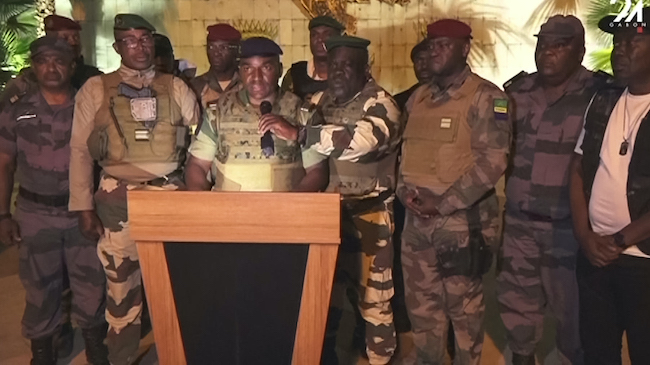
Once again, the recent overthrow of the civilian government of the Central African nation of Gabon has brought to the fore the coup epidemic ravaging Africa. The latest coup, coming barely one month after a similar putsch in Niger Republic, deepens concerns and raises another red flag about a possible domino effect of undemocratic takeover of governments in Africa. Army officers, who ousted the government of Ali Bongo Ondimba, 64, cited flawed elections as major reason for their intervention. Bongo sought a third term in office in the last presidential poll held on August 26, 2023. Irregularities marred the exercise.
The military struck shortly after he was announced as the winner of the election on Wednesday, August 30, 2023. This elicited celebrations in Libreville, the capital, and some other parts of Gabon. There had been a failed coup attempt against Bongo in 2019. Like the dynasties in Togo, North Korea, Syria, Equatorial Guinea and some others, the Bongo family had more or less instituted a dynasty that has lasted for 56 years. Bongo had succeeded his father, Omar Bongo, who died of cardiac arrest in 2009. He has been the President since then. He was foreign minister, defence minister and Congressman before becoming President. His father ruled from 1967, seven years after Gabon gained independence from France, until his demise in 2009.
The soldiers who overthrew him placed him under house arrest, arrested his son, Noureddin Bongo Valentin, and closed all borders. They also voided the election results and dissolved many government bodies, including the parliament. They named Gen. Brice Oligui Nguema, the late Omar Bongo’s onetime bodyguard, as the transitional leader.
The coup came on the heels of a July 26, 2023 coup in Niger which overthrew the government of President Mohamed Bazoum. The coup, led by Abdourahamane Tchiani, had the support of many Niger citizens, fellow military juntas in Burkina Faso, Guinea and Mali but drew condemnations from the Economic Community of West African States (ECOWAS), African Union (AU) among other world bodies. Six sub-Saharan African nations have suffered up to eight coups or attempted coups since August 2020.
This is a serious setback for Africa. Soldiers are trained to defend the territorial integrity of their countries. But because of poor leadership, corruption, manipulated elections, high insecurity and high cost of living, the military is tempted to intervene. It is quite unfortunate that while other continents are moving forward, Africa is bedevilled by coups. This is an uncomfortable wind of change. Nigeria’s President, Bola Tinubu, described it as a contagion of autocracy in Africa.
The Economic Community of Central African States (ECCAS) and African Union (AU) should take it as a big challenge to ensure that constitutional order is restored in Gabon. Soldiers should keep to their professional training. But African leaders must sit up and deliver good governance.
We are worried that more coups may occur if care is not taken. All across Africa are sit-tight leaders some of who change the constitution of their countries to remain in office. In 2003, Gabon removed its constitutional provision on term limits to ensure that Bongo serves as President for life. In Cameroon, Paul Biya is still the President after coming to power since 1982. Yoweri Museveni of Uganda, Teodoro Obiang Nguema Mbasogo of Equatorial Guinea, who has been in power since 1979, and Denis Sassou Nguesso of the Republic of Congo have all tinkered with the constitution of their countries on term limits to remain in office. They have each stayed over 30 years in power against their term limits.
Democracy makes sense when the welfare of the people takes centre stage. But in most African countries, the masses die in penury while the leaders live in opulence. A day after the Gabon coup, soldiers reportedly uncovered bags and suitcases of currencies in the house of the son of Ali Bongo. The family is stupendously rich. In 2007, a French financial police investigation discovered that the Bongo family owned 39 properties in France, 70 bank accounts and nine luxury cars worth 1.5 million euros.
What has happened in Gabon raises the red flag in some other African countries where the will of the people is subverted in the name of elections. African leaders should watch it. Obsession for power has led many of them to manipulate elections in their countries. This has consequently led to unrest and putsch in some of these countries. In 1983, the Nigerian military overthrew the government of Alhaji Shehu Shagari due largely to discontentment among the citizens over the conduct of the election of that year.
The antidote to coups in Africa is good governance, respect for human rights, good management of diversity, conduct of free, fair and transparent elections and respect for term limit. When any of these ingredients is missing, coups may become inevitable.
We condemn the coup in Gabon and call on the Gabonese junta to draw a timetable for return to democratic order in the country. We urge African leaders to examine their style of leadership and make amends where necessary.