Follow Us on Google
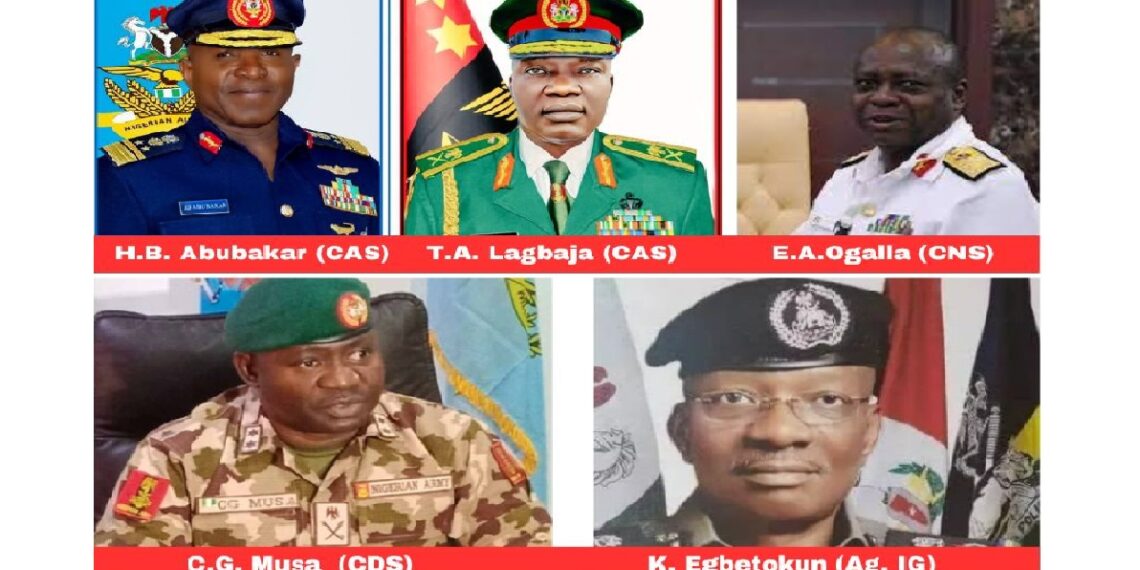
In order to rejig the nation’s security architecture for optimum performance, President Bola Ahmed Tinubu recently appointed new service chiefs. They replaced the ones he inherited from his predecessor. This came in the wake of renewed killings across the country since the inauguration of the new government.
The new service chiefs are: the Chief of Defence Staff, Major General Christopher Musa; the Chief of Army Staff, Major General Abiodun Lagbaja; the Chief of Air Staff, Air Vice-Marshal Baba Abubakar; and the Chief of Naval Staff, Rear Admiral Emmanuel Ogalla. The Chief of Defence Intelligence is Major General Paul Undiandeye, while the former Chairman of the Economic and Financial Crimes Commission (EFCC), Mallam Nuhu Ribadu, is the new National Security Adviser (NSA). The new Acting Inspector-General of Police is Mr. Kayode Egbetokun.
The tasks before these men are enormous. Insecurity is a major challenge in Nigeria. The immediate past administration of Muhammadu Buhari witnessed unprecedented killings and kidnapping of innocent citizens, including schoolchildren in different parts of the country. Efforts to tackle the problem yielded little dividends. Unfortunately, the terrorists and bandits have not relented. In the few days of the current Tinubu’s administration, they have killed hundreds of Nigerians in some areas of Niger, Plateau, Benue, Zamfara, Sokoto, Kaduna and some other states. Some other individuals have been kidnapped.
Nevertheless, we believe the security challenge is surmountable. The new security chiefs have the experience to tackle it head on. For instance, Major General Musa, who comes from Southern Kaduna, was a member of the 38th Infantry Course of the Nigerian Defence Academy (NDA) and was commissioned in September 1991. He was a Theatre Commander of JTF (North East), Operation Hadin Kai. Major General Lagbaja, who hails from Ilobu in Irepodun Local Government Area of Osun State, entered the Nigerian Defence Academy in 1987 as a member of the 39th Regular Course. He became a Major General in 2019 and has held different positions in the Nigerian Army. Until his new appointment, he was the General Officer Commanding the 1 Division, Kaduna. Rear Admiral Ogalla, who hails from Enugu State, was commissioned Lt in 1992 and became Rear Admiral in 2021. He has served on the board of many ships, including NNS Ambe, Aradu, Agu, Beecroft, Ekun, Lana, Pathfinder, Quorra and Delta. Air Vice-Marshal Abubakar, who is from Kano State, also graduated from the NDA in Kaduna and has held many positions in the Air Force, including Aviation Planning Officer, United Nations Organisation Mission (MONUC) Air Operations Kinshasa, Democratic Republic of Congo.
On his part, Ribadu, who hails from Adamawa State, studied Law at the Ahmadu Bello University, Zaria. He joined the Nigeria Police Force a few years after leaving Law School. He was the pioneer Chairman of the EFCC from 2003 to 2007. Similarly, Egbetokun, who hails from Ogun State, enlisted into the Nigerian Police Force as Cadet ASP (Course 16) in 1990. He has held different positions in the police and was the Chief Security Officer to Tinubu when he was the governor of Lagos State. He was recently promoted Deputy Inspector-General of Police, Force Criminal Investigations Department, Abuja.
The new service chiefs should come up with innovative ideas and strategies to confront insecurity frontally. They should have timelines on achieving specific targets. Their security strategies must be technology-driven. Part of what they need to do is to ensure that security agents embark on training and retraining to keep them abreast of modern ways of fighting terrorists and other criminals.
Soldiers should also be adequately equipped with modern, sophisticated weapons that will outclass what terrorists and bandits operate with. They should also be well remunerated and motivated. The service chiefs, in conjunction with relevant government defence officials, should ensure there is no room for diversion of funds meant either for the welfare of soldiers or purchase of weapons.
There is also the need for intelligence gathering and sharing among the security agencies. This is very crucial to winning the war against insurgency and terrorism. The service chiefs must work as a team in the greater interest of the country. They should avoid the type of altercation that occurred between Babagana Monguno and Tukur Buratai during their time as the NSA and the Chief of Army Staff, respectively.
We commend the President for the appointment and urge him to keep tabs on the performance of the service chiefs. He should go beyond his predecessor who promised much but delivered very little as far as Nigeria’s internal security is concerned. We also congratulate the new service chiefs on their appointments and urge them to do everything possible to dismantle the criminal gangs making life unbearable for Nigerians.