Follow Us on Google
By Henry Akubuiro
A literary critic plays an indispensable role in the literary enterprise. After a writer has burnt the candle at both ends to produce a work of literature, the onus rests on a critic to interpret, evaluate, and judge the work. He, thus, analyses themes, stylistic techniques, and cultural significance to uncover deeper meanings, educating the public and helping situate the historical basis in the textual evidence. Ultimately, he enriches a reader’s engagement with the work before or after coming in touch with the text.
Some new age wanna-be critics have made a sport of outlandishly dismissing literary works for the sake of clicks and emojis. They come as undertakers with an obligation to hasten the obituary announcement of chosen books or writers. But we should revisit the storied career of a butcher in an abattoir, given to separating the meat from the bones before leaving the carcass for whom it may concern. Needless to say, critics who expertly deconstruct a text for the layman deserve their flowers. They not only enhance the appreciation of the text but also offer binoculars for the writer to see the text from a different light.
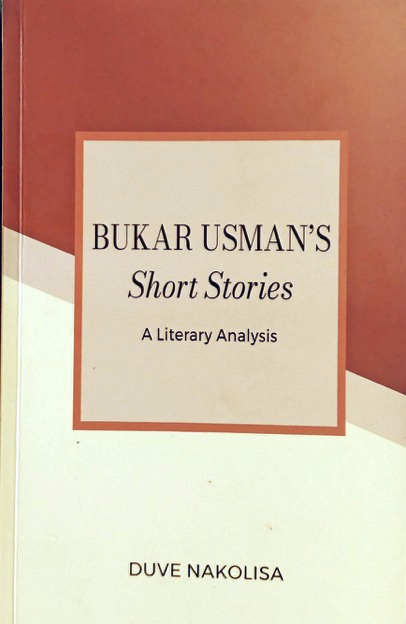
Enter Duve Nakolisa, the General Editor of Klamidas Books, Abuja, and the author of Bukar Usman’s Short Stories: A Literary Analysis, published by Klamidas Books (2026). In this book, he enumerates the merits of Bukar Usman’s short stories, which are not so much discussed in the literary domain. Writing in the prefatory note of the book, Nakolisa says Bukar Usman’s Short Stories: A Literary Text, was conceived to correct this negligence and to stimulate interest in the academic study of his short stories. The book comes in two parts. While the first part studies the book, the second part unveils the original 26 short stories of the author. This is another way of making Usman’s short stories available to both old and new audiences at the same time.
Usman’s 26 stories featured in this book are drawn from the revised three books of short stories written by him: including The Bride without Scars and Other Stories, The Stick of Fortune, and Girls in Search of Husbands and Other Stories. From the first book, you have the short stories: “The Bride without Scars”, “The King and His Marabout”, “The Old Woman and the Girl”, “Engaged to be Married before Her Birth”, “Destined to be Queen”, “The Cat and the Unfaithful Rat”, “The Tale of Long and Short Beaks”, “Stealing Monkeys”, “The Spider and the Chief”, and “The Hyena and the Hare”.
From The Stick of Fortunes, you find the title short stories, “The Stick of Fortune”, and “The Forbidden Fruit”, “Talking Rivers”, “War of Witch-doctors”, “A Shadow in the Cloud”, “The Inheritors”, “The Tree of Fortune”, as well as “The Bride’s Order”. From the third book, Girls in Search of Husbands and Other Stories, we have the following stories: “Girls in Search of Husbands and Other Stories”, “The Hyena and the Squirrel”, “A Tale of Two Betrayals”, “The Monkey and the Fish”, “The Spirit Child”, “The Squirrel and the Bison”, “The Three Snake Hunters”, and “Dan Agwai, the Hyena and the Monster.”
What are the qualities of Usman’s short stories? Nokolisa writes: “A Notable trait of Usman’s short stories is their folkloric flavour. This is not surprising since Usman is a folklorist engaged in creative writing. However, the folkloric resources upon which he draws to build his stories are raw materials that should not detract from the creativity and peculiarity of his art” (p.18).
Other News
Explaining the first story in the new book, “The Bride without Scars”, Nakolisa enlightens us that, among the themes are vanity, shallowness of judging love by mere looks, and folly of pride and eccentricity in social conduct and pursuits. In his view, even the sub-themes, such as those of unrequited love, retributive justice, hubristic foolhardiness, and the stillness of choosing shadow over substance, are driven by the matter of scars.
On “The King and his Marabout”, the Nakolisa says various themes have emerged from the story’s moral flux: themes of unbridled perfidy, treachery, and disloyalty; themes of the manipulative leanings in monarchical succession and the slippery nature of high-stake intrigues; and theme of divine redemption in the midst of callous eleventh-hour disappointment. He also says the story illustrates how barrenness can push a woman, even a noble woman, to take desperate and crooked measures in order to bear or own a baby. The power of this story, he affirms, rests more on the plot than on the moral fibre of the characters.
“The Old Woman and the Girl” tells the story of an orphan girl who overcomes various challenges to become the mother of the King’s only son and successor to the throne. Nakolisa explains that the recurring element with symbolic relevance in this story is the old woman who serves as the orphan girl’s saving grace and guiding angel and the continual agent of providential intervention in her life. He identifies the author’s characteristic style of using simple words and conversational sentence structure to describe situations and events, adding, “Imagery is barely used but its lack does not necessarily obstruct the narrator’s capacity to convey tone or reveal the emotional state of the major characters” (p.31).
Writing on “The Cat and the Unfaithful Rat”, the critic traces the conflict in the story to that between the cat and the rat, which reflects the classic problem of selfishness and mutual suspicion that is the bane of many partnerships, businesses and marriages. He identified brevity as the hallmark of the story. He writes: “In all aspects of the story – in narration, description, and even dialogue – the author endeavours to use very few words to say much” (p.37). He cleverly detects, too, the author’s use of equivocation in the story.
Explaining the short story, “The Stick of Fortune”, Nakolisa says the pursuit of fortune is its overriding theme. The story itself is about the adventures of a young man who inherited only a stock from his parents, but, through pragmatic bargaining and sheer luck, used it to generate money, get married, and become rich. Of Usman’s short stories, elements of magical realism are most fully and creatively utilised in “The Tree of Fortune”, and that is the matter-of-fact inclusion of fantastic or mythical elements into seemingly realistic fiction. In this story, an oracle ancestor inhabits a certain tree, the bwala , and, through it, becomes the god-tree of the protagonist, a grown-up boy separated from his beloved mother and sister by the warriors of Kucaku, a warmongering kingdom.
If you are desirous of short stories with a ring of the folkloric, you have to read this book to get acquainted with this unique bent and Usman’s short narratives.