Follow Us on Google
Governors’ wives, others join forces at 6th annual summit
By Juliana Taiwo-Obalonye, Abuja
Amid the 16 Days of Activism Against Gender-Based Violence 2025, the Nigeria Governors Spouses Forum (NGSF) recently issued a powerful and unified call to end the rising threat of digital violence targeting women and girls across Nigeria.

Women in Nigeria, endure technology-facilitated GBV, including sexist slurs, rape threats in messaging groups, and doxxing (malicious act of publicly revealing someone’s private personal information online without their consent) to enforce patriarchal norms and deter participation, where women hold just 4.5% of parliamentary seats.
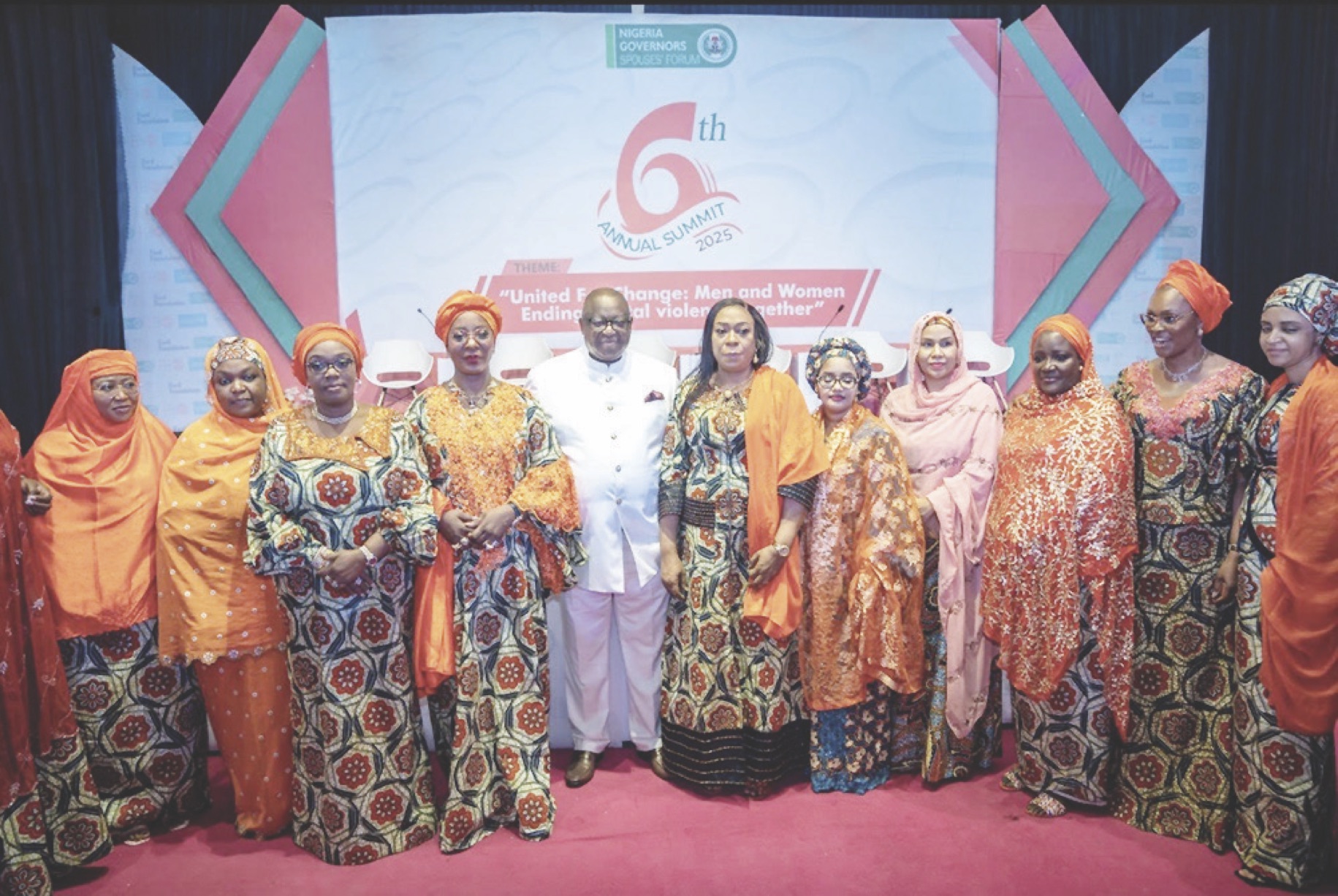
The 6th Annual NGSF Summit, held in Abuja under the theme: “Unite for Change; Men and Women to Ending Digital Violence Together,” brought together governors’ wives, government officials, and civil society to confront the pervasive abuse emerging in the country’s digital spaces.
First Lady of Kwara State and Chairperson of the NGSF, Olufolake Abdulrazaq, opened the summit by emphasising the urgency of addressing digital violence. “The challenge of digital violence is both timely and compelling,” she declared. “The digital world has become an essential part of our daily lives, expanding opportunities for learning, expression, and economic participation, yet it has simultaneously created avenues to harm the vulnerable in society.”
She highlighted the forms digital violence takes, stating: “Technology facilitates violence, cyber-stalking, online harassment, digital blackmail, gender misinformation, and various forms of exploitation — trends escalating at an alarming pace with profound psychological, social, and economic consequences.”
Elaborating on the damage caused, she warned: “We must recognise that digital violence is not a virtual problem. It is a real-world threat. It suppresses voices, distorts choices, erodes confidence, and limits participation in public life. When women and girls withdraw from digital spaces for fear of abuse, our society loses ideas.”
Mrs. Abdulrazaq also stressed the Forum’s commitment moving forward: “We will continue to work with state governments to harmonize cybercrime legislation and digital safety laws across all states to ensure a more secure and predictable digital environment for citizens. We will also work with state governments and community partners to expand digital literacy and online safety programmes in schools and communities, especially empowering young girls to confidently navigate digital spaces.”
She cited the 2024 National Demographic and Health Survey (NDHS) report, which indicated that “approximately 2% of women aged 15 to 49 have experienced technology-facilitated gender-based violence – a figure that translates to about 1.2 million women nationwide.”
The gravity of this data, she noted, “reflects the pressing need for stronger protective frameworks, multi-sector collaboration, and community education.”
Representing NGF Chairman and Kwara State Governor Abdulrahman Abdulrazaq, Plateau State Governor Caleb Mutfwang, echoed these concerns. “Digital violence is not a virtual problem,” he stressed. “It is a real-world threat impacting women’s psychological wellbeing and their participation in democracy and development.”
Mutfwang reiterated the NGF’s commitment, saying: “We pledge to continue working with the Governors’ Spouses Forum to address digital violence and make Nigeria’s digital space safer, especially for women and girls who are disproportionately targeted. In the coming years, the NGF will intensify efforts to harmonize cybercrime legislation and to promote digital safety frameworks and online protection laws across all states.”
He stressed the vital importance of collaboration: “Bringing together justice, ICT, education, women’s affairs, and security sectors is imperative to ensure an integrated and effective response. We will expand digital literacy and online safety programmes in schools and communities, focusing on empowering young girls to navigate digital spaces confidently.”
Attorney General and Minister of Justice, Lateef Fagbemi, presented a sober legal analysis of the digital violence crisis. “Across our nation, countless women and adolescents experience various forms of digital violence with devastating consequences,” he stated. “The anonymity of digital platforms emboldens perpetrators, while victims face barriers, including legislative gaps, difficulties with evidence, limited digital literacy, and societal stigma, all of which hinder justice.”
As the chief law officer, Fagbemi vowed: “The federal government and the management of justice are committed to strengthening legal and policy frameworks that protect citizens online.”
He mentioned key legislations, including the Cybercrime (Prohibition, Prevention) Act and the Violence Against Persons Act, adding: “We have recently concluded a bill to amend the Violence Against Persons Act to propose stiffer penalties and to ensure all forms of violence are covered within the law.”
Furthermore, Fagbemi detailed the formation of a specialized Sexual and Gender-Based Violence unit within the Ministry of Justice, aimed at “strengthening prosecution, reducing delays, and supporting survivors through coordinated legal, psychosocial, and referral pathways.”
He explained ongoing collaboration with states: “We are working together to harmonize case management and responses nationwide, train prosecutors, investigators, and first responders to handle cases sensitively, and advocate for legal reforms that protect women, children, and vulnerable groups.”
Fagbemi concluded by emphasizing multi-sector engagement: “Ending digital violence demands collective responsibility involving government institutions, law enforcement, civil society, technology stakeholders, religious and traditional leaders, parents, and citizens. We stand firmly committed to building a safer digital Nigeria.”
The summit’s panel included compelling contributions from governors’ wives across the country. Hajiya Fatima Ahmad Aliyu, First Lady of Sokoto State, called for practical tools to protect victims, stating: “Women are facing online bullying and harassment every day. States must organize digital feminist groups and provide dedicated hotlines to document harassment and offer support. A one-stop hotline with a team that can immediately respond would empower women to report safely and access justice.”
Similarly, First Lady of Yobe State, Hafsat Kollere Buni, stressed the importance of community education to fight stigmatization. “Many parents do not even know their children are victims of digital violence because the children remain silent,” she lamented. “We must hold town hall meetings and engage Parent-Teacher Associations, churches, mosques, and local leaders. Advocacy and sensitization in local languages are essential. We need people to reflect on their behaviour; digital violence is a disease of the heart.”
First Lady designate of Akwa Ibom State, Helen Eno Obareki, emphasised cross-sector collaboration: “Government, civil society, and technology companies must work hand-in-hand. Legal frameworks must be robust and enforced. Civil society leads prevention education and survivor support, and tech companies must invest in transparent, localized safety measures.”
She further noted the complexity introduced by emerging technologies, including artificial intelligence. “Cyberbullying has become more difficult to manage. Technology firms need to be accountable and collaborate with government agencies to ensure transparency and effective enforcement.”
UNICEF’s Country Representative, Wafaa Saeed, warned of the blurred line between online and offline violence. “A threat made on a phone or social media can quickly translate into physical danger,” she explained. Saeed highlighted Nigeria’s commitment to the Bogotá Partnership to End Violence Against Children and advocated for male allyship: “Your Excellencies, when fathers, teachers, and young men model respect and positive masculinity, entire communities transform.”
UNFPA Resident Representative Muriel Mafico echoed the urgency, referencing NDHS statistics: “Technology-facilitated gender-based violence poses a significant threat to women and girls’ safety and freedom. Ending this violence requires collective responsibility, including active engagement by men and boys as allies in creating safer communities.”
Acting Deputy High Commissioner, Gill Lever, spoke candidly about the political dimension: “Women who participate publicly online face vicious harassment, especially during elections. It is crucial to criminalize digital abuses like deepfake pornography and misogynistic harassment clearly.” She called for training law enforcement in digital forensics and urged: “Please, do not amplify hateful content by sharing it. Those who attack anonymously online are cowards. Let us stop enabling them.”
In a final call to political empowerment, Mrs. Abdulrazaq reaffirmed support for the campaign advocating special parliamentary seats for women. “The governors will mobilize their members in the National Assembly to ensure women’s representation increases, creating a fairer, safer political environment.”
The summit concluded with a collective call for Nigeria to embody the spirit of the 16 Days of Activism: “Together, we must build a Nigeria where every citizen can participate online without fear. Digital rights are human rights, and technology’s promise must be matched by safety and dignity for all – especially women and girls.”