Follow Us on Google
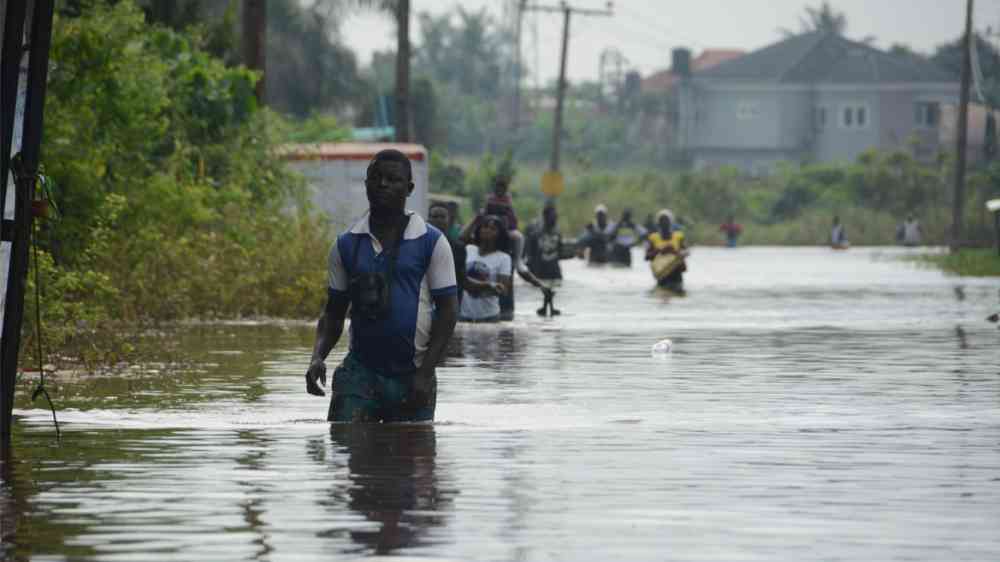
The recent warning of possible heavy rainfall and flooding in 32 locations across 11 states in the country has further underlined the enormity of the perennial flooding challenge. Nigeria’s flooding, which used to be seasonal has been exacerbated by the global climate change, which has changed the pattern and intensity of flooding in the country. Although the flood was anticipated for some days in September in Adamawa, Benue, Nasarawa, Taraba, Delta, Niger, Kebbi, Kano, Katsina, Sokoto and Zamfara states, it can still serve as a warning to other flood-prone states.
Despite early warning signals on flooding, experience has shown that we have not learnt enough lessons and how to apply the best strategies to mitigate the effects of flooding. Every flooding in the country has led to avoidable colossal economic and losses. However, we commend the National Flood Early Warning Centre of the Federal Ministry of Environment for its timely flood alerts. But, at times floods can occur without any warning. It is imperative the states along Rivers Niger and Benue and states in the coastal region should take any flood alert seriously. We say this bearing in mind that flooding occurs most in these zones. That is why these states must take preemptive measures to mitigate flooding and attend to the needs of displaced people.
Let all flood-prone states learn from the experience of others and build barriers to check the perennial flooding with its attendant consequences. Recently in Lagos State, residents and commuters were recently stranded along major roads in the metropolis following a heavy rainfall and consequent flooding. In Kaduna State too, houses and farmlands were submerged after a devastating flood swept through Manchok community in Kaura Local Government Area of the state. The flood which was triggered by three days of heavy rainfall, destroyed properties, food crops, and plantations, leaving residents stranded and counting their losses.
The latest alert came few days after the government warned of flooding in Adamawa and 10 other states, advising residents around River Gongola, River Benue, and River Niger; and the communities on the flood plains of River Gongola up to Numan, as well as those on the flood plains of River Benue and River Niger up to Lokoja to evacuate immediately. Earlier in March this year, government had predicted heavy rains and flooding in 30 states and the Federal Capital Territory (FCT), Abuja, between April and November. Some of the states included Abia, Adamawa, Akwa Ibom, Anambra, Bauchi, Bayelsa, Benue, Borno, and others.
The alert which was contained in the 2025 Annual Flood Outlook by the Nigeria Hydrological Services Agency, added that coastal and riverine areas such as Bayelsa, Cross River, Delta, Lagos, Ogun, Rivers and Ondo would face additional challenges from rising sea levels and tidal surges, impacting fishing, wildlife habitation and river navigation. About 1,249 communities in 176 Local Government Areas in 30 States and FCT fell within the high flood risk areas according to the prediction, while 2,187 communities in 293 LGAs in 36 states of the federation and the FCT fell within the moderate flood risk areas.
Flooding remains one of the most devastating natural disasters in Nigeria with climate change accelerating its frequency and severity. The menace has become a yearly occurrence in many communities and states with disastrous consequences. Only few states in the country are spared the stress. The worst hit are communities and states in the littoral regions, though upland settlements are not entirely free. The occurrence has been attributed to heavy rains and the release of dam water from neighboring countries. Failure to adequately prepare for climate change is also a factor. This is due to the non-implementation of environmental guidelines, lack of preventive infrastructure and the unhealthy attitude in tackling the flood menace.
Every year, many states and communities affected, count their losses in human and material waste. Flood that swept through Mokwa in Niger State last May, submerged many communities and washed away homes. Not less than 200 residents were confirmed killed in the disaster and 1,000 were missing. Also, 2,000 homes were destroyed. Between August and September 2024, no fewer than 4,167 houses and farmlands were destroyed by flood in Gombe and Yobe states. Some other states were also affected.
The fresh alert by the National Flood Early Warning Centre must therefore not be waved aside. There is need for the federal government and flood-prone states to engage in mitigating measures to minimise the impacts of the challenge. Dams should be constructed to conserve the flood water and harness same for farming and irrigation purposes. Also, water/flood barriers should be erected to minimise the movement of flood. Every state has its peculiar challenge and factors responsible for flooding. Preventive steps should be taken to tackle the menace.
Nigerians should equally begin to change their poor attitude to the environment. Government should take steps to ensure that water channels are left open always to allow free flow of water. Residents of flood-prone regions should be encouraged to relocate to safer areas. Property owners and developers should desist from embarking on any form of physical development without adherence to building codes. Let the National Emergency Management Agency (NEMA) and other relevant bodies act early enough to put mitigating measures in place. Early warning alarm and enlightenment campaigns equally need to be intensified.