Follow Us on Google
From Juliana Taiwo-Obalonye, Abuja
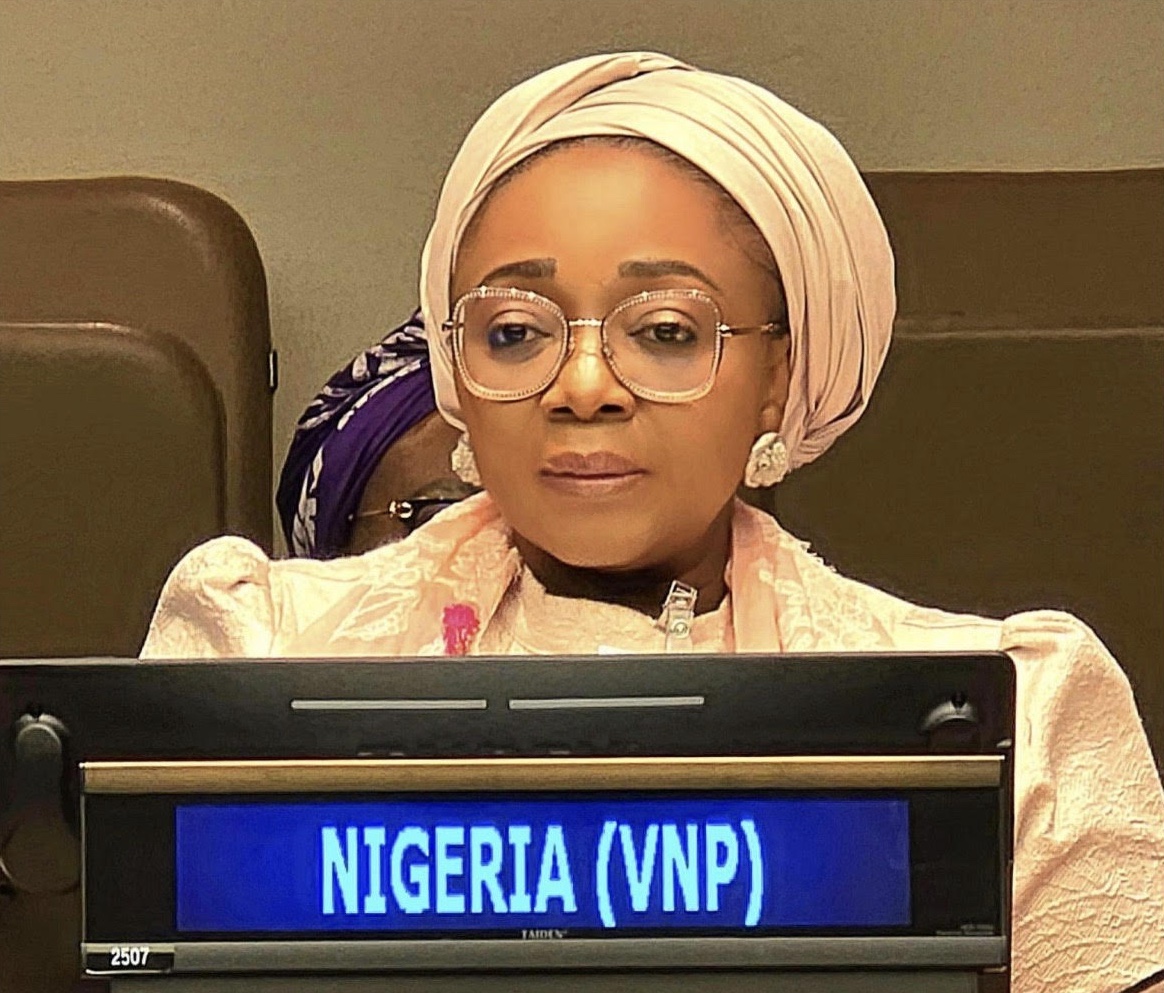
Nigeria’s Minister of Women Affairs and Social Development, Imaan Sulaiman-Ibrahim, on Friday in New York, unveiled a comprehensive policy roadmap outlining how the country is expanding access to justice, economic empowerment and political participation for women and girls.
She made the unveiling while delivering Nigeria’s Voluntary Country Statement on behalf of the Federal Republic of Nigeria and the African Group at the 70th Session of the Commission on the Status of Women (CSW70) at the United Nations Headquarters in New York, describing justice for women as a cornerstone of equitable national development.
She aligned Nigeria firmly with the CSW70 priority theme, stressing that ensuring and strengthening access to justice for all women and girls is central to sustainable progress. “The priority theme of CSW 70, ensuring strengthening access to justice for all women and girls, is a right, it’s not a privilege, and a foundation for equitable national development,” Sulaiman-Ibrahim said.
The minister noted that the session’s review theme – women’s participation in public life and the elimination of violence against women and girls – captures two “deeply interconnected and mutually reinforcing” priorities that demand coordinated policy responses at national and global levels.
Reflecting on CSW65, which coincided with the COVID-19 lockdowns, Sulaiman-Ibrahim recalled how the crisis exposed structural inequalities, heightened violence against women and girls and disrupted justice and protection systems worldwide. “For Nigeria, it reinforced the urgency for us to build a more resilient, a more inclusive, and a gender responsive social system, and to strengthen our social workforce,” she said.
She explained that with Nigeria’s population exceeding 240 million people, and women and girls representing more than half, access to justice is realised through economic empowerment, political representation, civic identity, social protection and institutional inclusion. “Inclusive justice systems are not just optional; they are foundational for any national stability and security,” she stated.
Sulaiman-Ibrahim stressed that Nigeria fully aligns with the CSW70 framing that justice for women is simultaneously economic, political, civic, social and institutional, and must therefore be pursued through integrated national frameworks rather than fragmented interventions.
Highlighting national leadership and governance trends since 2021, the minister pointed to measurable gains in women’s leadership across the executive, legislature, judiciary, civil service, financial sector and security architecture. Women now hold multiple ministerial portfolios in the Federal Executive Council, have consecutively headed the Civil Service of the Federation since 2015, and occupy about 40 per cent of Superior Court judgeships, including the offices of Chief Justice of Nigeria and President of the Court of Appeal, both currently held by women.
However, she acknowledged that women remain significantly under-represented in elective offices, describing the current figures as far below global averages and in need of deliberate corrective measures. “In Nigeria, we have less than five per cent representation. In the National Assembly, we have four senators out of 109. In the House of Representatives, we have 17 women out of 360 seats,” Sulaiman-Ibrahim said.
She added that 13 state assemblies currently have no female lawmakers, even though women hold 54 out of 991 seats nationwide, and there are no female governors out of 36 states, but 11 female deputy governors. To close these gaps, she said Nigeria is advancing reforms, including the Special Reserve Seat Bill, structured mentoring, voter mobilisation and candidate-support initiatives designed to significantly expand women’s participation in elective politics.
Economic empowerment as a justice tool
Positioning economic empowerment as a key justice mechanism, Sulaiman-Ibrahim noted that women constitute around 41 per cent of micro, small and medium enterprise (MSME) owners, yet face disproportionate barriers in access to finance, markets, land and digital inclusion. National surveys show that only about 47 per cent of women have access to formal financial services compared with 58 per cent of men, underscoring persistent structural inequalities.
She highlighted the Nigeria for Women Programme as a flagship intervention, explaining that during the pilot phase, more than 560,000 women organised into Women Affinity Groups collectively saved about ₦4.9 billion. Nigeria is now scaling the initiative through a $540 million programme that will reach 10 million women across all 36 states, the Federal Capital Territory and the 774 local government areas, enabling women to expand businesses, meet health needs and finance children’s education.
To reinforce these gains, Nigeria is implementing gender-responsive budgeting, affirmative procurement and linking empowerment platforms to formal identity and voter registration systems to strengthen women’s civic visibility. The Happy Woman App Platform is also being deployed to reach 10 million women with digital financial tools, health information, civic education and identity services in one integrated interface.
The minister outlined additional flagship initiatives under the Renewed Hope agenda that treat economic justice, social protection and climate resilience as mutually reinforcing. These include the Renewed Hope Social Impact Interventions 774 (RHSII-774), Nigeria’s flagship grassroots programme designed to reach all local government areas with integrated support around energy access, family cohesion, child protection, gender-based violence (GBV) prevention and financial inclusion.
She also referenced the Women Agro-Value Expansion (WAVE) Programme, which strengthens women’s integration into agricultural value chains in recognition of their high participation in rural agricultural labour but limited control over productive assets. Other initiatives include a Clean Cooking Initiative to reduce the 67.8 per cent reliance on firewood that exposes women and girls to health and environmental risks, and the Green Economy Empowerment (GEE774) programme that will empower 10,000 women with electric tricycles for commercial use, advancing green jobs, sustainable transport and women’s entrepreneurship.
Other News
On access to justice and GBV response, Sulaiman-Ibrahim said Nigeria is pursuing a comprehensive multi-sectoral approach that treats GBV as both a human rights violation and a development impediment. The country has deployed a National GBV Dashboard to provide real-time tracking of GBV cases, aggregate data, and coordinate responses, enabling evidence-based resource allocation and monitoring of survivor outcomes and case resolution timelines.
She said Nigeria is scaling up Sexual Assault Referral Centres (SARCs) across the country to offer integrated medical, psychological and legal services as a primary institutional entry point for survivors seeking justice and recovery. This is complemented by an expanded network of safe spaces and shelters providing secure accommodation, rehabilitation and psycho-social support for vulnerable women and girls, as well as robust community partnerships with traditional and religious leaders, civil society and NGOs to shift harmful norms and strengthen community-based prevention.
According to her, ongoing reviews of the Violence Against Persons (Prohibition) Act 2015 and the Child Rights Act 2003 are addressing protection gaps, emerging forms of technology-facilitated GBV and the need for stronger preventive and accountability mechanisms.
The minister distilled key lessons from Nigeria’s recent experience, noting that structured grassroots delivery through organised community groups such as Women Affinity Groups produces durable, measurable economic and social outcomes for women and their families. She said evidence shows that women with financial independence are better able to access legal systems, assert their rights and participate in civic processes, confirming that economic empowerment unlocks justice.
She also underlined the importance of digital and civic identity, explaining that linking empowerment platforms to national identity systems and voter registration has strengthened women’s political agency and collective representation ahead of elections. Integrated national systems that connect social protection, economic inclusion and GBV response, she added, are delivering far stronger outcomes than isolated, project-based interventions.
At the same time, Sulaiman-Ibrahim flagged persistent challenges, including very low levels of elective representation – fewer than five per cent of seats in the National Assembly are held by women, compared with a global average of about 26 per cent. Other concerns include uneven access to identification documents, subnational capacity gaps in implementing gender-responsive policy and emerging technology-facilitated GBV that requires updated legal frameworks and digital literacy programmes.
Good practices cited by the minister include the Happy Woman App Platform, the scale-up of SARCs, the National GBV Dashboard and sustained engagement with faith and community leaders to embed gender equality norms within cultural and religious frameworks.
Year of Family and Social Development
Sulaiman-Ibrahim informed delegates that the President of Nigeria has declared 2026 as the Year of Family and Social Development, placing households at the heart of the country’s development agenda. The declaration, she said, underscores the centrality of families to national stability, cohesion and inclusive development and will guide social and economic programme priorities throughout the year.
With about 63 per cent of Nigerians experiencing multidimensional poverty, universal child benefits and family-centred social protection instruments are being prioritised as critical tools to reduce poverty and inequality and secure intergenerational wellbeing. She stressed that economic empowerment has also strengthened civic identity, as linking empowerment platforms to voter registration has increased women’s visibility and participation ahead of elections.
Nigeria, she added, remains committed to strong partnerships with traditional and religious leaders, NGOs, civil society and international partners, viewing these alliances as essential for norm change, survivor support, community prevention and scaling successful interventions.
International dialogue and local ownership
Following Nigeria’s presentation, delegates from Serbia and The Gambia commended the country’s detailed roadmap and sought further clarification on the sustainability of empowerment initiatives and the link between economic inclusion and justice outcomes.
Responding, Sulaiman-Ibrahim emphasised that local ownership is central to sustaining reforms and ensuring that programmes remain responsive to community needs.
“My one-minute response to this question is that most of these interventions are localised, and when you give local ownership, then there could be sustainability and scalability,” she said.
She reiterated that Nigeria’s experience shows that access to justice for women and girls is achieved when empowerment is structured through organised, data-driven programmes; representation is deliberate through affirmative action and reserved seats; data is visible through gender-disaggregated dashboards and registers; cultural norms are engaged through faith and community networks; and systems are coordinated rather than fragmented.
Through its Voluntary Country Statement at CSW70, Nigeria reaffirmed its commitment to accelerating progress on gender equality and inclusive development through affirmative action, robust economic interventions and strategic partnerships, ensuring that justice for women and girls is systemic, measurable and enduring.